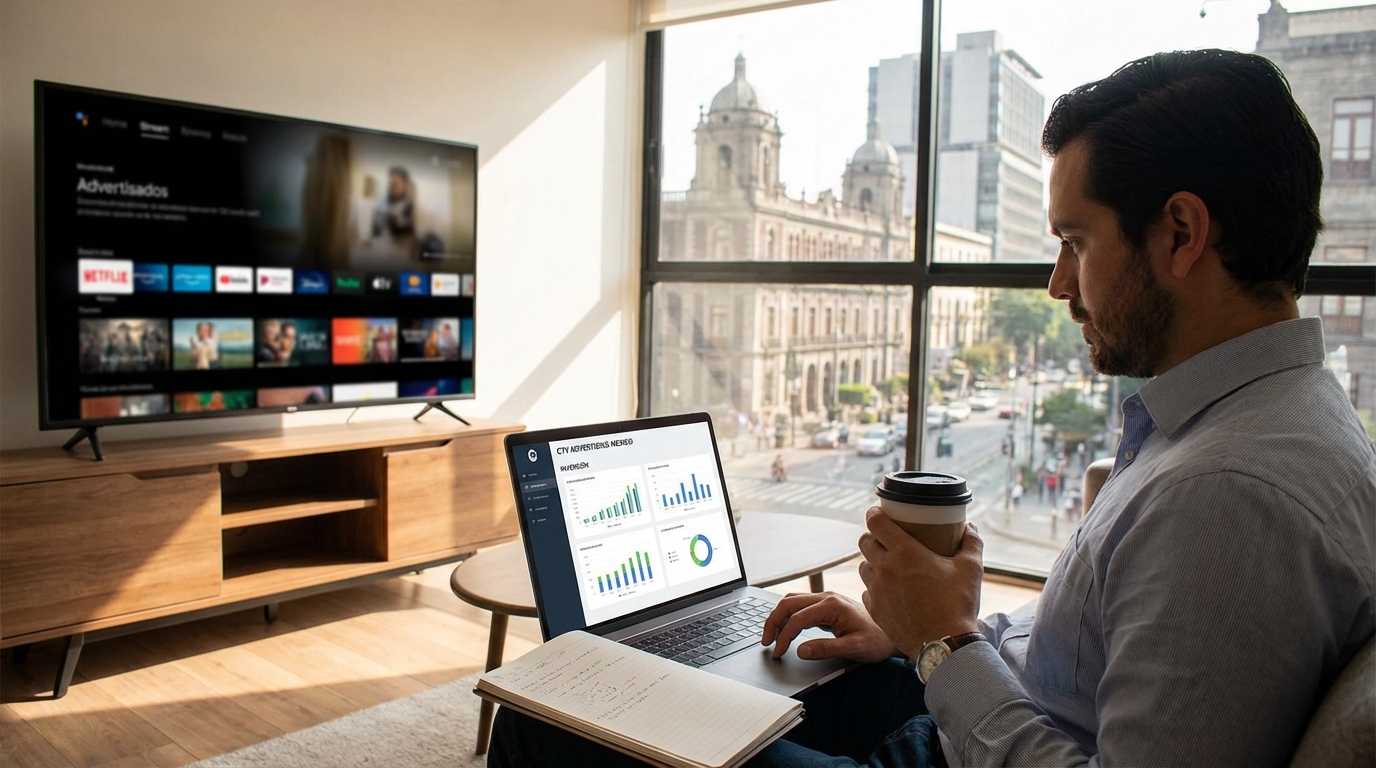
Imagine your local brand appearing on the big screen in the living room, right when your ideal customer is relaxing and watching their favorite show. They aren't distracted by notifications or endlessly scrolling. They are paying attention. That is what TV—and especially Connected TV—can do for a Mexican small business that dares to go beyond the typical combo of social media and search engines.
It is no coincidence that 70% of SMEs in Mexico invest in advertising to attract new customers. And they aren't left wondering: 84% of those SMEs believe their investment is working and actually bringing them new customers. The question is no longer "should I advertise?", but "how can I use channels like TV to grow without wasting money?"
Why TV remains a winning bet for your SME
Many small businesses think TV is only for banks, car manufacturers, or consumer giants. However, the reality of the Mexican market says otherwise. Advertising on broadcast and cable TV remains so relevant that it accounted for 22% of the advertising budget in 2022-2023. That means brands, both large and small, still see TV as a powerful channel for building trust.
For an SME, TV acts as a shortcut to credibility. If a local business, an online store, or a medical practice appears on the same screen as major brands, the perception changes. You stop being "just another brand on social media" and become "the company that's on TV." And if you combine that authority with digital targeting and measurement, the result stops being just "branding" and starts turning into real sales.
Connected TV vs. traditional TV: what is best for your SME
Connected TV (CTV) is any TV content viewed over the internet: smart TVs, devices like Roku, and streaming apps on phones, tablets, or computers. It is TV, but with a digital brain. In Mexico, CTV already reached 38 million people in 2023, a massive audience that was previously only accessible to brands with million-dollar budgets.

The big difference for an SME is control. With CTV and Streaming TV, you can decide which cities to appear in, what type of content to target, what times to air, and which interests to focus on. Self-service platforms like Masha allow you to launch campaigns on streaming channels like Pluto TV, Roku, and other OTT apps with just a few clicks—no need to talk to a salesperson, no need to negotiate complex packages, and with clear, real-time metrics. It is the perfect blend of massive reach and digital precision.
- Massive reach, but without the waste: you don't pay to appear nationwide if you only serve specific areas.
- Advanced targeting: by state, city, interests, and content consumption habits.
- Total flexibility: campaigns can be paused, adjusted, or scaled based on results.
- No "Hollywood" production needed: high-quality digital videos can work perfectly on CTV.
How to design an effective TV campaign step by step
Before turning on the camera or uploading your spot, your strategy must be clear. SMEs that have made the leap to digital are seeing concrete benefits: 69% of SMEs that have digitized their processes report an increase in sales and a better customer experience. A well-thought-out TV campaign is part of that shift in mindset: using data to test, measure, and optimize.
Campaign design can be summarized in four pillars: objectives, audience, message, and measurement. If these elements are worked on carefully, TV stops being a "branding expense" and becomes a measurable channel—as tactical as any social media campaign, but with much greater brand impact.
Define clear and measurable objectives
The most common mistake is saying "I want to sell more" and nothing else. That doesn't help with the script or the targeting. It is better to ground the campaign in concrete objectives: announcing a new branch, increasing site visits, getting more quotes, reinforcing a limited-time promotion, or positioning a new service. Each objective translates into a different type of message, creative, and call to action. The more specific the objectives, the easier it will be to compare results across cities, segments, or creatives later on.
Know your audience and target effectively
The magic of CTV is that you aren't speaking to "the whole country," but to the people who are actually likely to buy from you. Platforms like Masha allow you to choose states and cities, interests, the types of content consumed, and even viewing habits. A taco shop can focus on nearby neighborhoods, an e-commerce business on cities where it offers fast delivery, and a professional services firm on areas with the right socioeconomic profile. The better your ideal customer is defined, the more relevant your impressions will be and the less you will spend on people who will never buy from you.
- Location: states, cities, or regions where you can provide good service.
- Interests: sports, entertainment, news, children's content, lifestyle, etc.
- Context: types of programs or channels where your ad makes the most sense.
- Timing: times when your customers are usually at home watching content.
Message and format: what your ad needs to achieve
A good TV ad for an SMB doesn't need big special effects, but it does need to be clear, direct, and memorable. The basic structure works very well: present the customer's problem, show your solution, highlight a reason for credibility (years of experience, reviews, results), and close with a simple call to action: visit your website, scan a QR code, send a WhatsApp, or visit a store. The logo must be clearly visible, the offer must be easy to read, and the audio must be understandable even if the TV is at a moderate volume. Less is more: a single strong message usually works better than trying to say everything.
Strategies to make the most of CTV with small budgets
The most exciting part for SMBs is that TV is no longer synonymous with investing a fortune. With self-service platforms like Masha, you can launch Streaming TV campaigns paying from $0.01 MXN per view, without long-term contracts and with total control over your daily budget. You don't need to book months of ad space, buy closed packages, or accept “bonuses” that no one understands. You can literally test with a small amount, measure results, and then decide whether to scale.
To make every peso count, it is best to start with a focused strategy that is more tactical than "brand-focused." Start with a few key cities, test two versions of an ad with the same budget, limit frequency to avoid saturation, and review which segments respond best. From there, the ad spend becomes a system: you cut where it doesn't perform and inject more budget into the groups that do convert, just like in traditional digital campaigns.
- Start with narrow targeting instead of trying to cover too many areas from the beginning.
- Test different messages (promotion vs. main benefit) to see which one generates more action.
- Use QR codes or short URLs to better track visits coming from your TV ad.
- Adjust your ad spend week by week based on platform metrics, not blindly.
How to measure results and optimize your TV campaigns
The big difference between traditional TV and CTV is that here you do have real-time data. Platforms like Masha show live metrics: views, impressions, frequency, devices, areas where your ad was seen the most, and top-performing times. That data allows you to make quick decisions: move budget from one city to another, pause a segment, change the schedule, or upload new creative if the current one has "worn out."
Measuring isn't about getting lost in numbers; it's about connecting those metrics to what’s actually happening in your business. If you notice spikes in website traffic when your TV campaign is running, or an increase in WhatsApp messages, calls, or branch visits, that’s a clear sign of impact. The best approach is to track these changes: before and after the campaign, by city, by date, and by promotion. With that history, every new campaign starts from a higher baseline of knowledge.
- Monitor website visits and contact forms during the campaign.
- Track calls, messages, and new appointments during the period the ad is running.
- Ask directly, "Where did you hear about us?" at the point of sale or during the sales process.
- Compare sales by region with the cities where you ran your CTV campaign.
From theory to action: launch your first CTV campaign
Well-executed advertising isn't just for selling in your neighborhood or city. According to recent data, 64% of Mexican SMEs report that their advertising strategies have had a positive impact on the international growth of their businesses. This shows that investing in channels with massive, well-segmented reach can open doors to markets you might not even be considering today.
The logical next step for many Mexican SMEs is to add Connected TV to their digital marketing mix. The process can be much simpler than it seems: on platforms like Masha you can create an account in a few minutes, choose your objective, define your audience (cities, interests, content type), upload your video, and with just a few clicks, your campaign is ready to go live on Streaming TV. No middlemen, no contracts, and the peace of mind that comes with seeing metrics in real time. Ready to launch your first TV campaign and see how your brand looks on the big screen?
- Review your business goals for the coming months and define the role Connected TV will play.
- Prepare a clear, concise video with a single strong message and a simple call to action.
- Choose a self-service CTV platform, create your account, and set up your targeting.
- Start with a manageable budget, measure results from day one, and adjust with confidence.
- Once you see what works, scale gradually: more cities, more creative assets, and a greater presence on Streaming TV.
Take the next step and transform your business's visibility with Masha. In just a few minutes, you can set up your streaming TV campaign and start connecting with your audience effectively and affordably. With investments starting at $2,000 MXN and costs as low as $0.01 per view, Masha makes television advertising accessible and hassle-free. Don't wait any longer to compete in the big leagues of advertising. Ready to launch your first TV campaign?