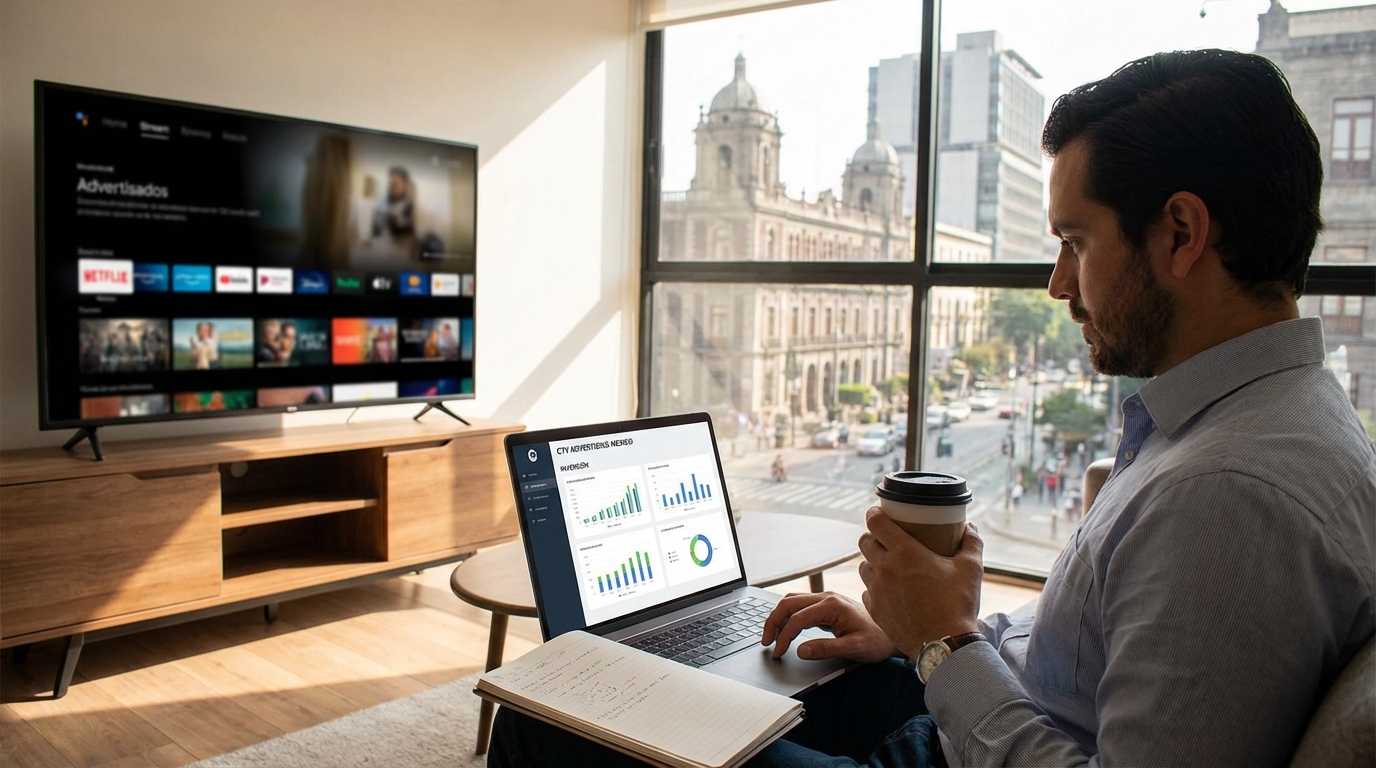
The 2026 World Cup: A historic milestone for connected TV
The upcoming 2026 FIFA World Cup will be unlike any other in history. With 48 participating teams, 104 scheduled matches, and an estimated audience of 6 billion viewers, this tournament represents a 62.5% increase in matches compared to Qatar 2022. But here is what really matters for brands and agencies: the way we consume this event will be radically different. Connected TV will dominate screens, programmatic advertising will reach unprecedented levels of sophistication, and fragmented audiences will force a rethink of every media strategy.
Mexico, the United States, and Canada will host an event that coincides with the maturity of the streaming ecosystem in the region. Projections indicate that CTV ad spending in the United States will reach approximately $38 billion in 2026, while Latin America is experiencing accelerated growth in streaming platform adoption. For mid-sized digital agencies, this represents a unique window of opportunity: accessing premium television inventory during the biggest sporting event on the planet, with targeting tools that were previously only available to large advertisers.
Growth of CTV penetration in North America and Latin America
Connected TV stopped being an emerging trend several years ago. In North America, CTV device penetration exceeds 80% of households with internet access. Platforms like Roku, Amazon Fire TV, Apple TV, and integrated smart TVs have transformed the way families consume audiovisual content. The shift is not just technological: it is a behavioral change that directly affects how brands can reach their audiences.
In Mexico, the landscape is particularly interesting. The penetration of smart TVs has grown steadily over the last five years, driven by price reductions and the expansion of streaming services local and international. Platforms such as Pluto TV, which offers free, ad-supported content, has democratized access to streaming for segments of the population that cannot or do not want to pay for multiple monthly subscriptions.
The context of the 2026 World Cup amplifies this trend. Broadcast rights will be fragmented across multiple platforms: some traditional networks will retain certain matches, while streaming services will have exclusivity over others. This fragmentation means that advertisers cannot rely on a single channel to reach their entire audience. They need a presence on multiple screens simultaneously.
For digital agencies, this represents both a challenge and an opportunity. The challenge lies in the complexity of planning campaigns that span multiple platforms with different technical specifications and purchasing models. The opportunity lies in the fact that programmatic buying tools allow for managing this complexity efficiently, reaching specific audiences regardless of where they are watching the match.
Consumption data from previous sporting events shows clear patterns: younger viewers prefer streaming over traditional television, while older segments maintain a preference for cable, although this gap is narrowing year by year. During the 2026 World Cup, we will see the most significant convergence between both worlds to date.
Paradigm Shift: From Traditional Cable to Sports Streaming
For decades, sporting events were the last bastion of traditional television. The logic was simple: live sports require immediate broadcast, and cable offered that immediacy reliably. But that logic has eroded. Improvements in internet infrastructure, reduced streaming latency, and massive investment by digital platforms in sports rights have changed the rules of the game.
Amazon broadcasts NFL games. Apple holds MLS rights. Paramount+ and Peacock compete for UEFA events. This pattern will intensify for the 2026 World Cup, where multiple streaming platforms will have access to live matches. For viewers, this means more options. For advertisers, it means completely rethinking their media strategy.
Traditional cable operated under a simple model: you bought ad space on a specific channel during a set time, and your ad reached everyone watching. There was no segmentation beyond the general demographics of the program. Sports streaming works in a completely different way. Each viewer can receive personalized ads based on their profile, location, browsing history, and purchasing behavior.
This personalization has profound implications for agencies. A craft beer brand can show its ad only to men aged 25 to 40 in Mexico City during the Mexico match, while a gym chain shows a different ad to the same viewer during halftime. Advertising efficiency increases dramatically when each impression is targeted at someone with a higher probability of converting.
The 2026 World Cup will be the first global sporting event where the majority of ad impressions will be programmatic. This does not mean that traditional television will disappear; it will remain relevant, especially in markets with lower high-speed internet penetration. But the balance will definitely tip toward digital.
Programmatic Advertising Strategies During the Tournament
Programmatic advertising during an event like the World Cup requires planning months in advance. It is not just about having a budget available; it is about understanding how real-time auctions work, what inventory will be available, and how to optimize bids to maximize reach without wasting resources on low-value impressions.
The first step is to clearly define campaign objectives. Some brands seek massive awareness during the most-watched matches. Others prefer efficiency, concentrating their investment in specific moments where competition for inventory is lower. Both strategies are valid, but they require completely different technical configurations.
Programmatic CTV buying operates primarily under two models: open auctions and private deals. Open auctions allow for competing for available inventory in real time, with prices that fluctuate based on demand. During a quarterfinal match, CPMs can multiply by five or more compared to a regular program. Private deals, on the other hand, allow for securing premium inventory at pre-negotiated prices, with guaranteed delivery.
For agencies with mid-sized budgets, combining both models is usually the most effective strategy. Secure private deals for the most important matches in your target market, and supplement with open auction buying for the rest of the tournament. Platforms like Masha allow you to manage both types of buying from a single interface, simplifying operations and reducing implementation time.
The key is not to wait until the last moment. Premium inventory for the 2026 World Cup will begin to be negotiated more than a year in advance. Brands that wait until May 2026 to activate their campaigns will find inflated prices and limited availability.
Behavioral and Real-Time Geolocation Segmentation
Segmentation is where CTV advertising shows its true differentiating potential. Unlike traditional television, where the only segmentation criterion was the program you were watching, CTV allows for combining multiple variables to create precise audiences.
Geolocation is particularly relevant for the 2026 World Cup. With matches being played in 16 cities across three countries, brands can adapt their messages based on the viewer's location. A restaurant in Guadalajara can show ads only to viewers within a 20-kilometer radius, inviting them to watch the next match at their establishment. A national chain can vary its message by city, highlighting specific promotions for each branch.
Browsing behavior adds another layer of precision. Users who have searched for flights to the United States or Canada over the last few months are likely considering traveling to the World Cup. Tourism brands, airlines, and financial services can target specific messages to this segment. Those who have recently purchased Mexican national team jerseys show a level of engagement with the event that makes them receptive to soccer-related messaging.
Real-time segmentation allows for dynamic adjustments during the tournament. If Mexico advances to the round of 16, public interest intensifies: CPMs rise, but so do attention and engagement. Smart brands prepare specific creative for different scenarios: victory, defeat, or a draw. The ability to activate the right creative in the minutes following a match can generate emotional connections that a generic ad never could.
Combining geolocation and behavior allows for the creation of audiences such as "men aged 25 to 45 in Monterrey who have shown interest in sports betting in the last 30 days," or "women aged 30 to 50 in Mexico City who have recently purchased sports products online." The granularity is impressive, and conversion rates reflect that precision.
Interactive advertising formats and shoppable ads
Advertising formats on CTV have evolved beyond simple 15 or 30-second videos. Shoppable ads allow viewers to interact directly with the ad using their remote control, adding products to a cart or scanning a QR code with their phone to complete a purchase. During an event like the World Cup, where emotions run high, the ability to convert that impulse into an immediate sale is incredibly valuable.
Interactive ads go beyond direct purchasing. Real-time polls on who will win the match, trivia about World Cup history, or promotions that activate if the viewer answers a question correctly: all these mechanics increase engagement and brand recall. A recent study showed that interactive ads generate recall rates up to three times higher than traditional static ads.
The pause ad format is particularly relevant for sporting events. When the viewer pauses the broadcast, instead of seeing a static screen, a full-format ad appears and remains visible until playback resumes. It is a moment of guaranteed attention: the viewer is looking at the screen, likely having returned from the kitchen. The brand has their full attention.
Overlays during the broadcast represent another opportunity. Small banners at the bottom of the screen do not interrupt the match but maintain brand presence. These formats are less intrusive and generate less viewer resistance, although they also have less individual impact. The optimal strategy combines different formats throughout the tournament.
To implement these advanced formats, agencies need platforms that support the required technical specifications. Not all programmatic buying platforms offer access to interactive inventory. Verifying technical capabilities before committing budget avoids unpleasant surprises during execution.
The importance of measurement and attribution in CTV
Measurement has always been the Achilles' heel of television advertising. For decades, brands invested millions based on audience estimates that, at best, offered a general approximation of how many people saw their ad. CTV fundamentally changes this equation by offering precise metrics at the individual impression level.
Global advertising spend projected for 2026 will reach $1.30 trillion, with 9.1% growth. Of that total, digital advertising will account for 68.7%, growing approximately 6.7% compared to the previous year. This growth is directly related to the improved measurement capabilities offered by digital channels, including CTV.
Attribution in CTV allows you to connect an ad impression with a subsequent user action. If someone saw your ad during the Mexico match and visited your website three hours later, that connection can be tracked. If that same person made a purchase within the next seven days, you can attribute that conversion to the ad exposure. This level of traceability was impossible in traditional television.
However, attribution in CTV has its complexities. Streaming devices do not have cookies like web browsers, which requires alternative tracking methodologies. The most common solutions include IP address matching, the use of device identifiers, and integration with third-party data platforms that allow for connecting CTV exposure with behavior on other channels.
Key metrics: From reach to direct conversion
Reach remains a relevant metric, especially for awareness campaigns during massive events like the World Cup. Knowing that your ad was seen by 2 million people has value. But stopping at reach alone is wasting the potential of CTV. The metrics that truly matter go further.
The video completion rate indicates the percentage of viewers who watched your entire ad. In CTV, this metric is usually significantly higher than in other digital channels because the format doesn't allow for skipping ads as easily as on YouTube. Completion rates above 90% are common, meaning your message reaches the audience in its entirety.
The frequency cap controls how many times a single user sees your ad. Without proper control, you could show the same ad 20 times to the same person during the tournament, causing fatigue and negative brand associations. The optimal setting depends on the campaign objective: for awareness, frequencies of 3 to 5 exposures per week are usually effective. For conversion, higher frequencies may be justified if the message varies.
Cost per site visit and cost per conversion are the metrics that connect advertising spend to tangible business results. Platforms like Masha offer real-time dashboards where you can see exactly how many people visited your site after seeing your ad, and how many of those visits turned into sales or leads. This visibility allows you to optimize the campaign on the fly, redirecting budget toward the segments and creatives that perform best.
Cross-device measurement adds another dimension. A viewer might see your ad on their living room smart TV and complete the purchase on their mobile phone an hour later. Modern attribution solutions can connect these dots, giving you a complete view of the consumer journey.
User experience and the second-screen phenomenon
Sports content consumption rarely happens in isolation. While the match unfolds on the main screen, viewers have their phones in hand: checking stats, commenting on social media, participating in WhatsApp groups, or searching for information about players. This second-screen behavior creates additional advertising opportunities that smart brands leverage.
During the 2022 World Cup, spikes in social media activity coincided exactly with the most exciting moments of the matches. A goal generated millions of tweets in seconds. Brands that had content ready for those moments captured massive attention. By 2026, this dynamic will be even more pronounced, with platforms like TikTok playing a central role in real-time conversation.
The user experience in CTV must consider this multi-device context. Ads that include specific calls to action for the phone, such as "scan this code" or "find our offer in the app," work better than generic messages. The viewer already has the device in hand; giving them a reason to use it for your brand's benefit is an effective strategy.
Ad saturation is a real risk during massive events. If every commercial break bombards the viewer with aggressive messages, the natural response is to disconnect emotionally. Less intrusive formats and messages that provide value—useful information, entertainment, or genuinely attractive offers—are better received than traditional advertising that only seeks to sell.
Synchronization between mobile devices and the main screen
Synchronization between devices opens up fascinating creative possibilities. Imagine an ad on a smart TV that invites the viewer to open an app on their phone to participate in an exclusive promotion. Or a QR code that appears during halftime and offers a discount valid only for the next 15 minutes. These mechanics generate urgency and immediate action.
Audio fingerprinting technologies allow a phone app to "listen" to what is playing on the television and automatically trigger complementary content. When your ad starts on TV, the app can display additional information, a downloadable coupon, or a direct link to the product page. The experience becomes immersive and multichannel.
For agencies, implementing these synchronized experiences requires coordination between CTV, mobile, and development teams. It is not trivial, but the results can be spectacular. Brands that have executed this well report engagement rates up to ten times higher than traditional campaigns.
The data generated by these interactions is valuable beyond the immediate campaign. Knowing which users interacted with your content during the World Cup allows you to create audiences for subsequent retargeting. Those people demonstrated active interest in your brand: they are hot leads that deserve personalized follow-up.
The main technical challenge is latency. If the content on the phone does not appear in sync with what is happening on the television, the experience breaks. The most sophisticated platforms have solved this problem, but it is important to verify technical capabilities before committing to a synchronization strategy.
Challenges and opportunities for brands in 2026
The 2026 World Cup presents an advertising landscape with enormous opportunities, but also significant challenges that brands must anticipate. The competition for attention will be fierce: thousands of advertisers will want to capitalize on the most-watched event on the planet. Standing out in that noise requires strategy, creativity, and flawless execution.
The first challenge is cost. CPMs during important matches will be substantially higher than during regular programming. A brand with a limited budget cannot compete directly with major advertisers for premium inventory during the final. The strategy must be smarter: identify moments of lower competition with equally valuable audiences, or focus on specific segments where competition is lower.
The second challenge is creative relevance. A generic ad that might work at any time of the year will get lost in the context of the World Cup. Viewers are emotionally invested in the event; ads that connect with that emotion resonate more strongly. This requires producing creatives specifically for the tournament, which implies additional investment in production.
The third challenge is reaction speed. The World Cup generates unpredictable moments: a historic goal, a surprising elimination, a refereeing controversy. Brands that can create and activate relevant content in hours, not weeks, capture conversations that others miss. This requires agile processes and quick approvals that many organizations do not have.
Managing ad saturation in mass events
Ad saturation during mass events creates a phenomenon known as ad fatigue. When viewers see too many ads in a short period, their attention wanes and their perception of the brands being advertised can turn negative. Managing this risk requires specific strategies.
Diversifying formats helps reduce fatigue. Instead of showing the same 30-second spot repeatedly, a brand can combine short videos, overlays, pause ads, and interactive content. Each format captures attention differently, reducing the feeling of repetition.
Message sequencing is another effective tactic. Instead of showing the same message over and over, the brand tells a story throughout the tournament. The first ad introduces the concept. The second goes deeper. The third presents an offer. The fourth reinforces it with testimonials. Each exposure adds value rather than simply repeating.
User-level frequency capping is essential. Programmatic buying platforms allow you to set limits on how many times a single user will see your ad within a given period. Configuring these limits intelligently—more exposures for users who have shown interest, fewer for those who haven't interacted—optimizes the budget and reduces fatigue.
Creative quality matters more than ever in high-saturation contexts. A memorable, fun, or emotionally resonant ad can be seen multiple times without causing fatigue. A boring or irrelevant ad generates rejection from the very first exposure. Investing in high-quality creative production is a form of protection against saturation.
Advertising investment: Budgets allocated to digital ecosystems
The distribution of advertising budgets during the 2026 World Cup will reflect the structural shift toward digital. Brands that historically concentrated their investment in broadcast and cable television are reallocating increasing percentages toward CTV and other digital platforms. This move is not a trend; it responds to the reality of where audiences are and which channels offer better measurement.
For mid-sized agencies, the accessibility of advertising on CTV has improved dramatically. Platforms like Masha allow you to launch streaming TV campaigns without intermediaries, without prohibitive minimum investments, and with transparent pricing starting at $0.01 MXN per view. This means that brands that previously could not consider television as a channel now have access to premium inventory during the world's most important sporting event.
The recommendation for most brands is to allocate between 20% and 40% of their World Cup budget to CTV, depending on their target audience profile. Younger audiences justify higher percentages in streaming. Older audiences may require maintaining a presence on traditional television. Data from previous campaigns should guide this decision.
The timing of the investment also matters. Concentrating the entire budget in the group stage can mean running out of resources for the final stages, when attention is at its peak. A more balanced distribution, with reserves for key moments, usually generates better overall results. Platforms that offer flexibility in budget management, without rigid contracts or long-term commitments, facilitate this dynamic management.
The future of post-World Cup sports marketing
The 2026 World Cup will not just be an event; it will be a turning point for the advertising industry. The lessons learned, technologies tested, and consumption behaviors observed during the tournament will define sports marketing strategies for the next decade. Brands and agencies that actively participate in this event will emerge with knowledge and capabilities that their competitors will not have.
The convergence between television and digital will be irreversible after 2026. Advertisers who continue to treat these channels as separate silos will be at a competitive disadvantage. Integrated planning, where CTV, mobile, social, and other channels work together toward common goals, will be the norm, not the exception.
Personalization at scale, demonstrated during the World Cup, will extend to other sporting events and entertainment content. Local leagues, regional tournaments, and cultural events will adopt the same technologies and methodologies. Audiences will become accustomed to receiving relevant advertising, and their tolerance for generic messages will decrease.
For mid-sized digital agencies, the 2026 World Cup represents a positioning opportunity. Demonstrating the ability to execute sophisticated CTV campaigns during the most demanding event opens doors with clients who previously considered this channel out of their reach. The experience gained becomes a lasting competitive differentiator.
Preparation must begin now. Understanding available platforms, establishing relationships with inventory providers, developing internal measurement and optimization capabilities, and educating clients about the opportunities—all of this takes time. Agencies that arrive at the 2026 World Cup prepared will capture a disproportionate share of the value generated.
The CTV ecosystem will continue to evolve after the World Cup. New platforms will enter the market, ad formats will become more sophisticated, and measurement capabilities will improve. But the fundamentals established during 2026 will remain: the fragmented audience, the importance of data, the need for relevant creatives, and the value of operational agility.
Brands that see the 2026 World Cup only as a sporting event will miss the most important perspective: it is a massive laboratory where the future of television advertising will be defined. Participating actively, experimenting with formats, measuring results, and learning from mistakes is the best investment any brand or agency can make in its competitive future.
Ready to prepare your CTV strategy for the 2026 World Cup? Masha allows you to launch campaigns on premium streaming platforms in minutes, without intermediaries and with real-time metrics. Create your account in less than 5 minutes and start planning your presence at the biggest sporting event in history.