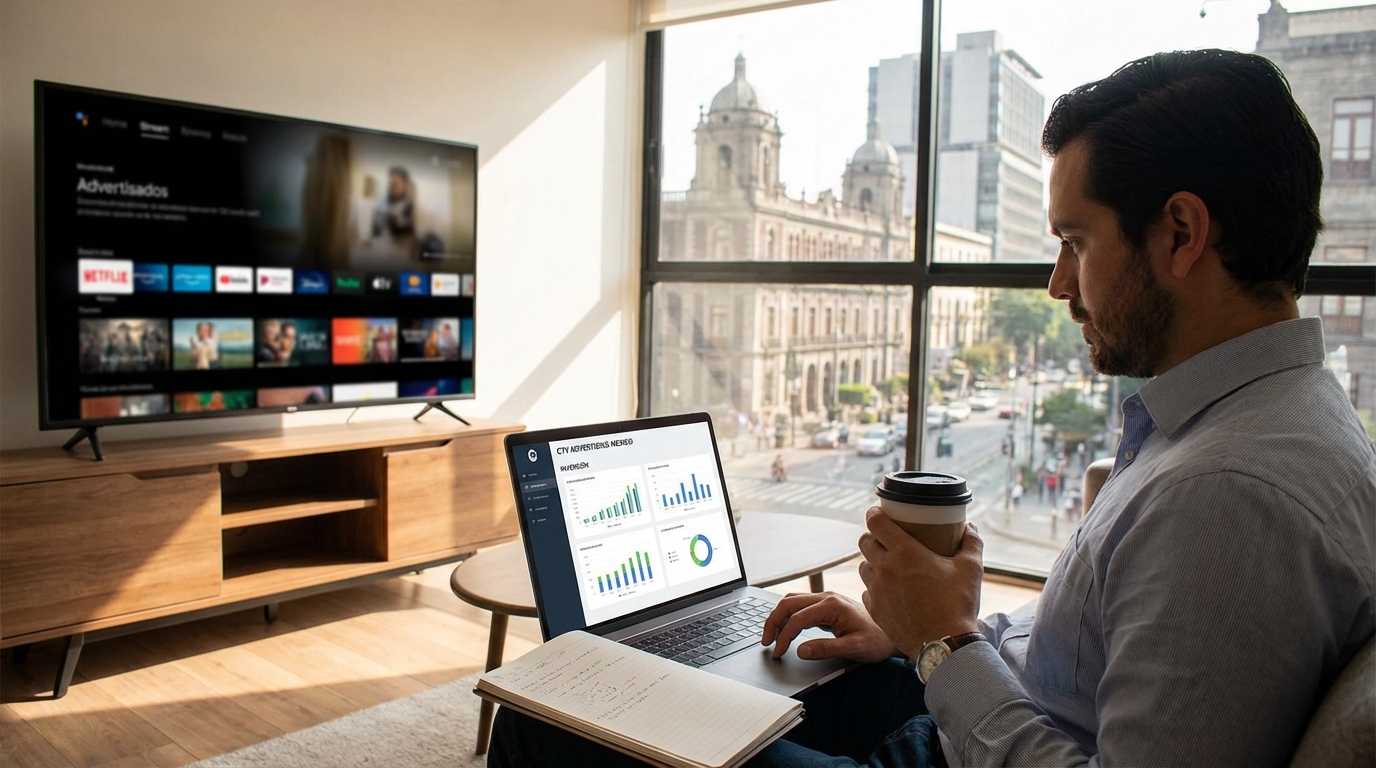
A few years ago, getting on "TV" required an agency, a massive budget, and a lot of patience. Today, local businesses, small e-commerce shops, and new brands are appearing on Roku, Pluto TV, and other connected TV channels with campaigns that go live in a matter of minutes. And they are doing it using the same programmatic logic you already know from display and social media.
This is a major shift. By 2025, programmatic advertising already accounted for 79.5% of total digital advertising spend in Mexico, with an investment of 4.66 billion dollars and a 12.4% year-over-year growth. At the same time, overall digital advertising investment reached 81.72 billion pesos in 2024, equivalent to 58.2% of the country's total advertising spend. TV is no longer an isolated medium: it is now part of the digital ecosystem and is bought using the same logic of data, targeting, and automated bidding.
In the midst of this transformation, self-service platforms like Mashahave emerged, allowing SMBs and agencies to launch campaigns on Streaming TV without intermediaries, without long-term contracts , and without minimum spend requirements. For many businesses, this is the first time TV has felt as accessible as setting up a social media campaign.
What is programmatic TV advertising (and why is everyone talking about it)?
Programmatic TV advertising is the automated purchase of ad space in television content viewed over the internet: Smart TVs, devices like Roku, streaming apps, and connected TV (CTV) platforms. Instead of negotiating spot by spot with each channel, an algorithm decides in real time when and to which user to show your ad, based on your targeting and budget.
Unlike traditional TV, where you buy "blocks" on a specific channel and time slot, in CTV you buy audiences. The system cross-references behavioral data, interests, location, and content consumption habits to decide if it makes sense to show your ad to that person at that moment. The result: less waste and more measurable campaigns.
Programmatic advertising beyond Mexico
The boom is not exclusive to the Mexican market. Globally, a study reports that the worldwide programmatic advertising market grew from 6.06 trillion dollars in 2021 to 7.38 trillion dollars in 2022, with a compound annual growth rate of 21.77%. This trend sets the path: brands are moving toward models where data rules and media buying decisions are increasingly automated.
Television is not being left behind. In fact, it is one of the spaces where programmatic makes the most sense: it combines the visual and emotional impact of the big-screen video format with the precision of digital targeting.
Mexico: From traditional TV to Connected TV
In Mexico, streaming consumption is growing every day. Between free ad-supported platforms, subscription services, and apps from traditional channels that have already migrated to digital, Connected TV is becoming the new "prime time" for audiences that were previously only on broadcast or cable TV.
A Teads study in Latin America found that 64% of Connected TV users in the region are willing to watch ads in exchange for the platform being free. This is pure gold for brands: the user accepts advertising as part of the deal, as long as the content is relevant and the experience is not invasive.
The digitization of TV: massive reach with surgical precision
The great advantage of this "new TV" is that it keeps the best of the traditional medium (massive reach, video format, brand building) but adds the best of digital: targeting, real-time measurement, and constant optimization. The phrase that summarizes this transition in Mexico is clear: digitization reinforces television's role as a medium for broad coverage and brand building, but now empowered by the precision of digital targeting.
For a business that always saw TV as something out of reach, this combination opens up a massive opportunity: appearing alongside quality content, on big screens, and in high-attention contexts, but with the same logic and control already mastered in Facebook Ads or Google Ads.
Advantages of programmatic TV advertising for SMBs and agencies
The main revolution of programmatic TV is not just technological; it is about access. Previously, a local restaurant or a small online store wouldn't even consider TV as an option. Today, they can appear on Streaming TV with flexible budgets and hyper-local strategies.
These are some of the most powerful advantages for SMBs and agencies working with clients of all sizes:
- Advanced targeting: you can reach audiences by state, city, interests, types of content consumed, and even viewing habits (who watches sports, who watches soap operas, who watches news all day).
- Flexible budgets: you no longer need to invest millions to be on TV. Self-service platforms allow you to start with amounts that are attainable for small businesses and adjust on the fly.
- Real-time measurement: view impressions, full ad views, frequency, reach, and other live metrics. If something isn't working, it can be fixed almost instantly.
- Direct buying: SMEs can directly control their ad spend without relying on a traditional media department. Agencies also gain operational efficiency.
The power of programmatic versus traditional buying
The difference in dynamism is already noticeable in other digital formats. In the case of display, for example, programmatic advertising spend is projected to grow three times faster (15.9%) than non-programmatic advertising (5.3%) in 2024. Although that data refers to banners, it reflects a key point: advertisers are migrating toward smarter buying models, and TV will follow the same path.
Sticking only to traditional media buying means losing competitiveness. Programmatic TV allows your investment to be focused on the right audience, instead of paying for thousands of people who will never be your customers.
Masha and self-service platforms: TV at your fingertips
In the past, to advertise on TV, you had to talk to a sales executive, negotiate rates, sign long contracts, and wait weeks to see your campaign go live. Today, self-service platforms like Masha simplify that entire journey, turning it into a process as simple as setting up a campaign in any other digital tool.
Masha is designed so that any business in Mexico can advertise on Streaming TV without the headaches: it’s a platform where you create your account in a few minutes, choose your audience, upload your video, set your budget, and you're done. All without intermediaries, long-term contracts, or mandatory minimum investments.
What you can do from a single platform
With a solution like this, you are in control. Some of the things you can handle from the same dashboard include:
- Set up your campaign in just a few clicks: the workflow is designed for SMEs, not technical experts. It is intuitive and guided.
- Choose where you want to appear: connected TV, streaming apps, specific devices, and combinations thereof.
- Define your targeting: by state, city, interests, and even content consumption habits, so you don't waste impressions.
- View live metrics: a real-time dashboard that lets you understand how well you're reaching your audience and make adjustments if needed.
This democratizes TV. It’s no longer about being a giant brand with a sophisticated media department; it’s about truly understanding your customer and using a simple tool to reach their most important screen: the one in the living room.
How to set up your first programmatic TV campaign step by step
Going from "I'd like to be on TV" to having a campaign running on Streaming TV is simpler than it seems. The key is to follow a clear structure and keep your business goal in sight.
A typical workflow looks like this:
- 1. Define your goal: do you want to generate brand awareness, site visits, app downloads, bookings, or leads? That determines the type of creative and the targeting.
- 2. Know your audience: pin down who your customer is: where they live, what content they watch, what they're interested in, and what time of day they usually consume connected TV.
- 3. Create a clear and direct video: You don't need a big-budget production. What matters is that your value proposition is understood in the first few seconds and that you close with a clear call to action.
- 4. Choose your targeting: select states or cities, content types, and other relevant criteria. The more aligned it is with your actual customer, the better your performance will be.
- 5. Define budget and duration: start with an investment you feel comfortable with to learn the ropes. Then, scale what works.
- 6. Launch and monitor: check your dashboard daily or every few days. See which segments perform best and, if your platform allows it, optimize in real time.
Quick tips to improve results from day one
Some practical advice that makes a big difference from your very first campaign:
- Think big screen: make sure your text is legible, your logos are visible, and the audio is clear. On CTV, people are several feet away from the screen.
- Don't overdo the text: your ad should tell a simple story. One strong idea, one clear benefit, and a punchy closing.
- Test multiple versions: If you can, create two or three variations of your ad by changing the calls to action, offers, or value propositions.
- Check frequency: showing the same ad to the same person a thousand times gets old. Adjust it to avoid ad fatigue.
Strategies to get the most out of programmatic TV
A programmatic TV campaign shouldn't live in isolation from the rest of your digital strategy. When integrated with other channels, it becomes a powerful driver of business results.
Some ideas to make the most of it:
- Synchronize messaging: use the same creative concept across connected TV, social media, and search, adapted for each format. This reinforces brand recall.
- Use TV to open the funnel: programmatic TV is ideal for generating consideration and brand searches. Then, re-engage that audience with remarketing campaigns on other channels.
- Segment by context: if you sell food, appearing alongside cooking content or culinary reality shows can be more relevant than a generic program.
- Analyze by region: Mexico is huge and very diverse. Analyze results by city or state, and shift budget to where you see the best response.
Measurement that actually matters to the business
It’s not just about seeing how many impressions were delivered, but about connecting that data to real results. Some key metrics to review include:
- An increase in brand searches during the campaign period.
- An increase in direct traffic to your website or visits to your physical store.
- An increase in sign-ups, bookings, or sales after reaching a certain level of reach on Connected TV.
When TV platform data is combined with web analytics and CRM, you can start to understand the profitability of every dollar invested and clearly justify continued investment in this channel.
Regulation, brand safety, and the future of programmatic TV in Mexico
As TV goes digital, the rules of the game are changing too. In Mexico, the government has proposed reforms to better regulate the types of messages that can be broadcast on licensed media. One example is the proposal to amend the Federal Telecommunications and Broadcasting Law to impose fines of between 2% and 5% of revenue on licensees that broadcast propaganda from foreign governments, except for cultural or tourism purposes, as reported by a recent analysis.
For brands, this underscores the importance of working with safe inventory (brand safety) and platforms that respect local regulations. The advantage of programmatic TV is that it allows for greater control over the type of content your ad appears in and which programming categories you want to avoid.
What’s next for the coming years?
Everything points toward convergence: the line between “traditional TV” and “digital TV” is blurring. It is highly likely that media plans will integrate Streaming TV screens as a standard component, on par with social media, search, and online video.
For those who make the move now, the advantage is clear: learn early, understand which creatives work best for each audience type, and build a presence in an environment that is still less saturated than other digital channels.
What now? Next step: get on Streaming TV
If your business is already investing in digital, making the leap to programmatic TV advertising is more of a mindset shift than a radical change in skills. The logic is the same: segment well, create good messages, measure, and optimize.
The difference is the impact: appearing on the big screen in the living room, alongside content people actually want to watch, creates a "big brand" perception even if your company is just starting out. With self-service tools like Masha and a clear focus on business goals, TV is no longer a distant dream but another flexible, easy-to-manage channel with real-time metrics.
The time has come to transform your business's visibility and harness the power of streaming TV with Masha. In just a few minutes, you can launch your campaign with an investment starting at $2,000 MXN, paying only $0.01 per view. No more barriers of large budgets or long-term contracts. With Masha, select your audience, choose your streaming platforms, and monitor your ad's performance with real-time metrics. Ready to launch your first TV campaign? Masha gives you the power to play in the big leagues of advertising, no matter the size of your company. Start now and watch your brand grow!