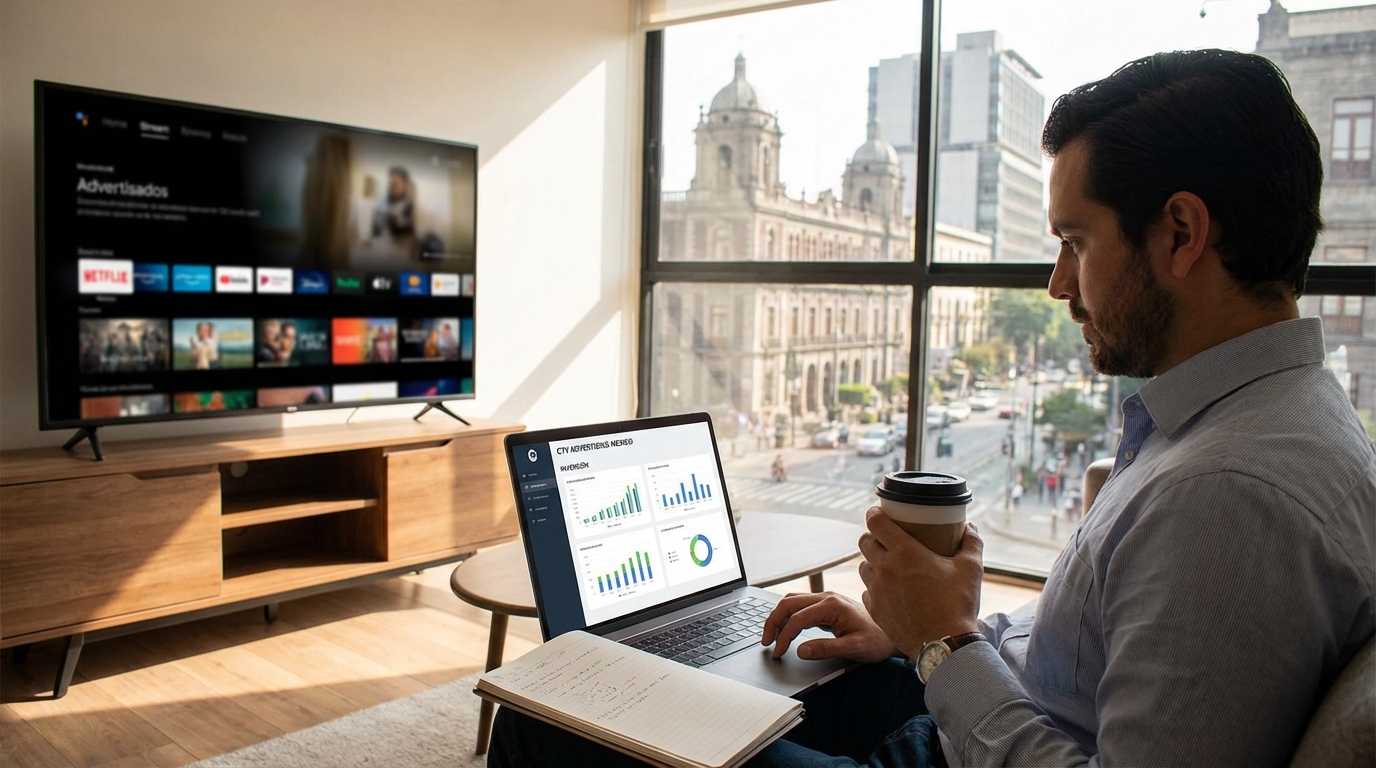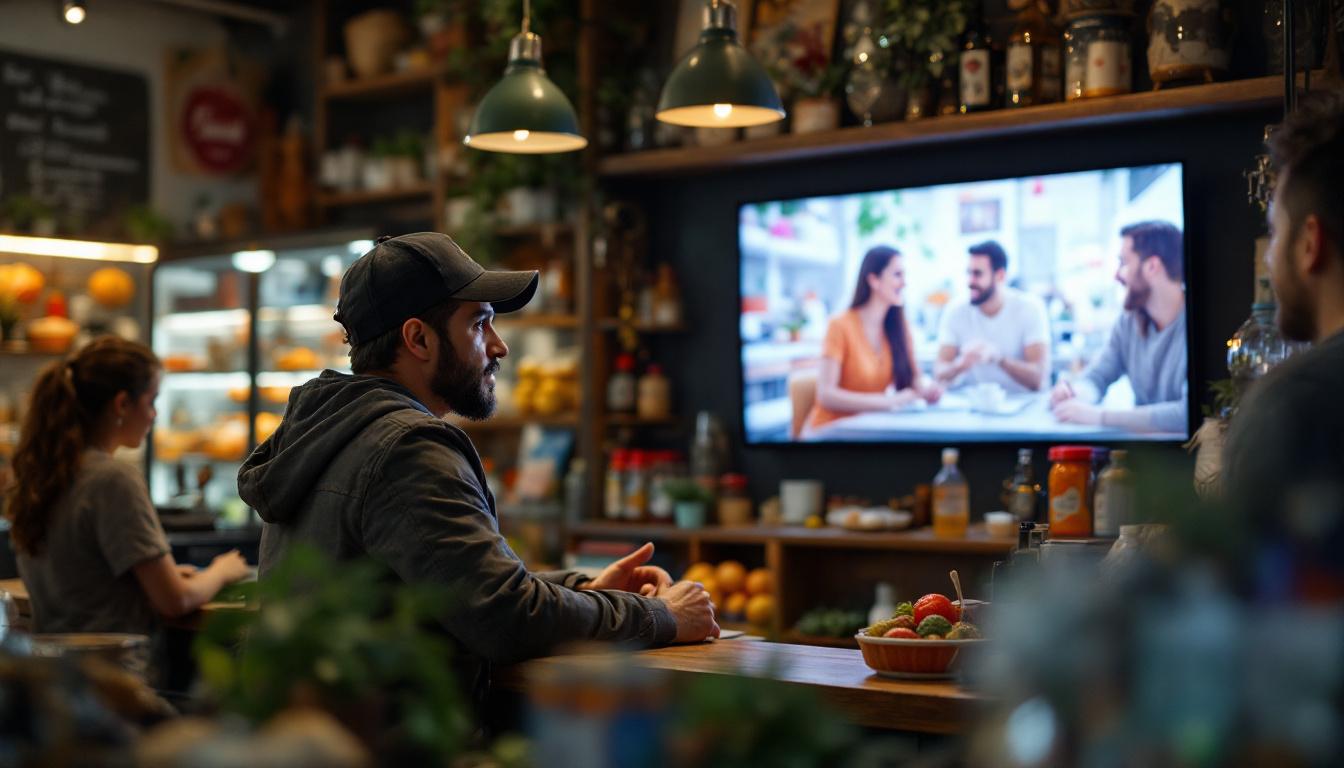
Many business owners in Mexico have asked themselves the same question while watching a soccer match or a series: "Could my brand ever be on TV?" For years, television felt like exclusive territory for banks, soft drink companies, and major chains. But with the arrival of connected TV and streaming, that landscape has changed completely. Today, advertising on TV is no longer an unattainable luxury, especially for SMBs.
In fact, nearly 70% of small and medium-sized Mexican businesses already invest in digital advertising, according to data from Amazon Ads. This means that most are already taking steps in marketing, but many still believe that television is out of their league. The reality is different: with the right combination of traditional TV, connected TV (CTV), and self-service platforms, a small business can appear on their customers' big screens without spending a fortune.
Why is TV still key for SMBs in Mexico?
Television, in its various formats, remains the medium that generates the most attention in the home. While people jump between apps on their phones, they dedicate time to watching specific content on TV: matches, reality shows, news programs, and series. Those moments of concentrated attention are gold for any local brand looking to position itself in the minds of its audience.
Furthermore, advertising does have a direct impact on sales. In Mexico, a Kantar study estimates that advertising contributes about 4% of the total sales generated by a brand in the short term—that is, in the weeks following the campaign according to Kantar. For an SMB, that percentage can be the difference between a slow month and a very good one.
There is also a clear signal that companies, both large and small, continue to see value in media: advertising investment in Mexico grew by about 18% in 2023, according to data from IAB Mexico, and one-fifth of that pie went to broadcast television according to IAB Mexico's analysis. If brands continue to bet on TV even during economic uncertainty, it is not out of habit: it is because it works as a demand driver.
Traditional Television vs. Connected Television (CTV)
Previously, talking about "being on TV" almost always meant buying spots on broadcast or cable television. Today, the concept has expanded: there is also connected TV (CTV), which includes streaming apps like Pluto TV, Roku, and other services that people watch on their smart TVs, phones, tablets, or computers. For an SMB, understanding this difference is key to investing their budget more effectively.
Traditional television (broadcast and cable) remains very powerful for generating massive reach and building reputation. But CTV opens another door: the ability to segment by interests, cities, states, and the type of content people watch, and most importantly, to measure in much greater detail how many times your ad was shown and to what type of audience.
In Mexico, connected television already has significant reach: it is estimated to have reached around 38 million people in 2023, offering a measurable and effective advertising platform, especially for SMBs looking to grow according to an analysis of CTV in Mexico. This makes streaming TV an ideal option to complement a presence on social media and search engines.
Benefits of CTV for small businesses
The big difference between CTV and traditional TV is that it combines the power of the big screen with the precision of digital marketing. For a small business, that means stopping the guesswork and starting to talk to the people who are actually likely to buy.
Among the clearest advantages are advanced targeting, real-time budget control, and the ability to view detailed campaign metrics. Self-service platforms like Masha allow SMEs to launch a Streaming TV campaign without intermediaries, with quick registration, direct management of their investment, and the peace of mind of being able to pause or adjust the campaign whenever needed.
TV advertising strategies for SMEs on a budget
You don't need a massive budget to make TV work. What you need is clear objectives and a solid strategy. The feeling that "TV is expensive" usually comes from thinking about national prime-time campaigns. But an SME can use TV, especially CTV, in a much more surgical and efficient way.
The first step is to define what you want to achieve: more visits to your store? More delivery orders? Positioning a new brand in your city? Pushing a specific launch? Based on that, you choose the formats, the type of TV, and the mix with other channels like social media, search engines, or email marketing.
A simple way to think about the strategy is to divide it into three parts: who you are talking to, what you are going to say, and where you are going to say it. With that clear foundation, it becomes much easier to take advantage of the benefits of connected TV and self-service platforms.
Define your audience as if they were a real person
Instead of thinking "I want to reach all of Mexico," it is better to start with something much more concrete. For example: "women in their late twenties to mid-forties who live in Monterrey and the metropolitan area, enjoy cooking content, and tend to shop online." The clearer the description, the easier it will be to use CTV targeting tools.
Modern platforms allow you to target by state, city, interests, and even content consumption habits. This helps ensure that every dollar invested has a higher probability of showing your ad to people who might actually be interested in your product or service.
Short, clear messages adapted for the big screen
TV advertising (traditional or connected) works best when the message is simple. One product, one idea, one call to action. Trying to cram your entire catalog into twenty seconds usually results in an ad that no one remembers.
It is a good idea to adapt the style of your social media videos to a more "televisual" format: good lighting, clear audio, a visible logo, and a closing with contact info or an easy-to-remember website. You don't need a super production, but you do need to ensure it looks and sounds good on a living room screen.
Combine TV with your other digital channels
TV has a significant effect on people's minds, but the final action almost always happens elsewhere: your website, WhatsApp, social media, or your physical store. That is why the best strategy is not to choose between television and digital, but to make them reinforce each other.
For example, a CTV campaign can help people remember your brand so that later, when they see you on social media or search engines, they are more inclined to click. That combination is one of the reasons why so many SMEs that invest in digital advertising say they have managed to attract new customers with their campaigns according to Amazon Ads data, where 92% report positive results.
How to measure results: from views to sales
One of the classic fears SMEs have about TV is: "How will I know if it worked?" In traditional television, you often rely on audience studies and general estimates. With CTV and self-service platforms, the story is different: there are live metrics, dashboards, and reports that show how many times your ad was viewed, in which cities, and on which devices.

Furthermore, the measurement ecosystem in Mexico is taking significant steps to ensure that brands, both large and small, have more reliable data. In 2024, the Alliance for Multimedia Measurement Quality in Mexico (ACAM) was created with the goal of improving the accuracy and reliability of audience and advertising metrics in the country as reported by El País. Initiatives like this help ensure that what you see in reports gets closer and closer to reality.
For a small business, measuring effectively doesn't mean drowning in complicated charts. It means answering simple questions: Did visits to my site or store increase during the campaign? Did searches for my brand go up? Did I receive more messages or calls mentioning the promotion airing on TV? By combining data from the CTV platform with your business data, you can get a fairly clear view of the impact.
Basic metrics worth tracking
You don't need to be a data analyst to get the most out of a connected TV campaign, but it is helpful to get into the habit of checking a few key indicators. Understanding this data helps you decide whether to maintain, pause, or adjust an ongoing campaign.
Among the most useful metrics are views (how many times your ad was shown on screen), reach (approximately how many unique people saw it), frequency (on average, how many times each person saw your ad), and geographic distribution (which cities or states the impressions were concentrated in). From there, you can make adjustments to targeting, scheduling, or messaging.
How to start advertising on Streaming TV step by step
The most intimidating part is usually the "first step." The good news is that today, you no longer need to negotiate with major media outlets or sign complicated contracts to appear on TV. Self-service platforms like Masha allow an SMB to register in minutes, set up their campaign with a few clicks, and start appearing on Streaming TV apps like Pluto TV, Roku, and other connected TV channels.
These platforms are designed specifically for businesses that don't have a huge marketing team. The interface is simple, the process is guided, and you can pay by card or bank transfer. Plus, there are no long-term contracts or rigid investment minimums, giving you the freedom to test short campaigns, learn, and then scale what works.
All of this is happening in a context where, despite the economic slowdown, advertising in Mexico continued to grow by around 4% in 2024, reaching a total spend of nearly 140.306 billion pesos, according to a recent report on the Mexican advertising market published by ExpansiónIn other words, brands that continued to invest in communication didn't slow down; on the contrary, they took advantage of the moment to gain ground. SMEs can do the same, but with more precise and flexible strategies.
A simple plan to launch your first campaign
To turn everything into something actionable, it's best to put together a small plan before jumping into any platform. It doesn't have to be a long document: it just needs to clearly state what you want to achieve and how you're going to measure it.
A practical outline could be: define a main objective (for example, increasing delivery orders in your neighborhood), choose an audience (geographic area and approximate profile), decide on a message (a single offer or clear benefit), prepare your video in a horizontal format suitable for TV, and set a test budget for a couple of weeks. With that ready, all that's left is to set up the campaign on a Streaming TV platform, check the real-time metrics daily, and make small adjustments along the way.
The opportunity for your business: from spectator to protagonist
The image of TV as an "untouchable" medium for small businesses is becoming outdated. Today, a local taco shop, a language school, a dental clinic, or an online store can appear on the same screen as big brands, but with a completely different investment logic: flexible, measurable, and focused on results.
The combination of connected TV, self-service platforms like Masha, and an increasingly solid measurement ecosystem opens a huge window for Mexican SMEs. Taking advantage of it doesn't require knowing everything about marketing; you just need to be willing to try, learn quickly, and adjust. Stopping being just a spectator and turning your business into a protagonist on the screen is one of the most powerful ways to get more people to know you, remember you, and, ultimately, buy from you.
Are you convinced it's time to take your business to the next level with TV advertising? With Masha, you can start your first CTV campaign simply and affordably. You don't need large budgets or to commit to long contracts; starting at $2,000 MXN and with prices from $0.01 per view, your brand can shine on the most popular streaming platforms. Sign up in less than 5 minutes, choose your audience, and monitor the impact of your ad with real-time metrics. Ready to launch your first TV campaign? Masha is here to democratize TV advertising and make your SME a protagonist on screens across Mexico.