Many businesses in Mexico still think that "being on TV" means signing long-term contracts, paying huge sums, and relying on intermediaries. Meanwhile, the way people watch content has completely changed: streaming now accounts for 43.8% of total television time in the United States, and that share has grown by 10 percentage points in just two years, according to Nielsen. That same transformation is opening the door to something that seemed impossible just a few years ago: advertising on television without a contract, right from your computer, with flexible investment, and without the headache of endless paperwork.
What does it mean to advertise on TV without a contract?
For decades, TV advertising worked the same way: fixed packages, multi-month commitments, heavy negotiation, and little control for small and medium-sized businesses. Advertising meant sitting down with a channel or an agency, signing long-term contracts, and accepting rigid conditions. If the ad didn't work, there wasn't much you could do until the contract expired.

Contract-free television changes that logic. It is based on Streaming TV and Connected TV (CTV) platforms where you pay only for the views or impressions you generate, without committing to long terms. You can activate and pause campaigns whenever you want, adjust your budget almost daily, and scale up only if you see results. You still legally agree to terms and conditions, but the rigid lock-in clauses and cancellation penalties are gone.
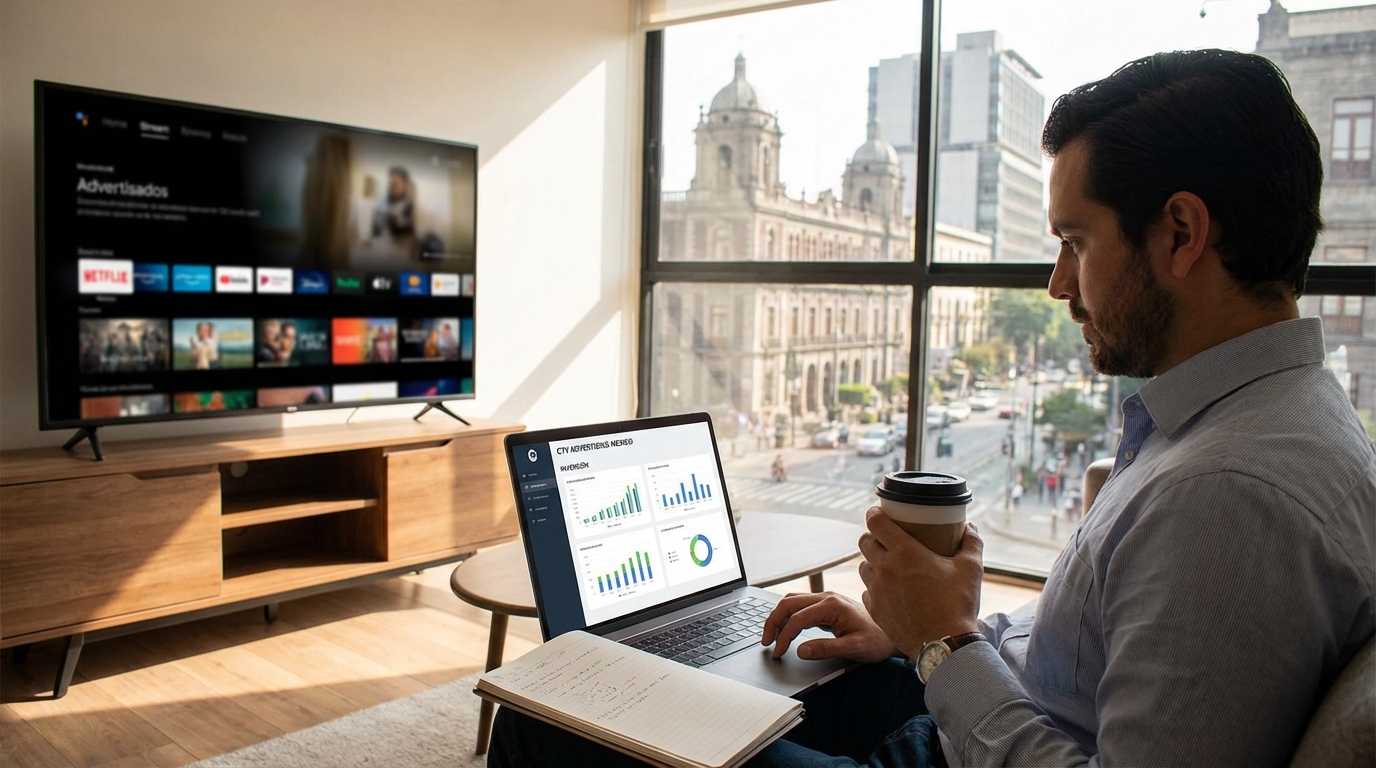
This model relies on self-service advertising platforms for CTV, such as Masha, designed so that any business can launch campaigns on its own. The process is as simple as creating an account in less than 5 minutes, setting up a campaign in under 10 clicks, targeting by city, state, interests, or viewing habits, and paying by card or bank transfer. All with no mandatory minimum investment, no intermediaries, and prices starting at $0.01 MXN per view.
Why Connected TV changed the game
Connected TV (CTV) is basically any "TV" content that comes through the internet: apps like Pluto TV on your smart TV, channels on Roku, or OTT platforms on your phone, tablet, or laptop. The device matters less than the fact that the content no longer depends on traditional signals, but on streaming.
This shift affects not only how television is watched, but also how advertising is bought. In CTV, ads are served digitally, using technology very similar to online advertising. This allows for audience targeting, real-time measurement, and on-the-fly campaign optimization. It is no coincidence that 87% of marketers consider CTV advertising to be as effective or even more effective than traditional television, according to data from Trade Desk.
For a small business, this combination is pure gold: the massive reach of television, but with the precision and control of digital campaigns. You don't have to buy giant "blocks"; you can start with small budgets, experiment with different audiences and formats, and keep only what really works. TV stops being an unattainable luxury and becomes just another channel in your marketing mix.
How contract-free TV advertising works, step by step
Although there is sophisticated technology behind it, the workflow for you is quite simple. Everything is done on a self-service platform, much like creating campaigns on social media, but focused on Streaming TV and CTV. The goal is for you to go from "zero" to an active campaign in a matter of minutes, without calls or negotiations.
The typical process looks something like this: first, you create your account (registration in less than 5 minutes). Then, you define a clear objective (for example: building brand awareness in a specific city or driving traffic to your online store) and set your total or daily budget. Next, you choose your targeting: states or cities where you want to appear, interests, the type of content your audience watches, and time slots. Once that's done, you upload your video, review the preview of your ad, and in less than 10 clicks, you can launch your campaign on connected TV.
From there, it all becomes a matter of data. Platforms like Masha show you live metrics: how many views you're generating, which devices your ad is being watched on, which audiences are responding best, and how much you're paying per thousand impressions or per view. If something doesn't convince you, you pause, edit targeting, or move budget without having to ask for permission or renegotiate contracts. It's TV advertising, but with the agility of the digital world.
Targeting and programmatic buying in CTV
The key to making all this work without long-term contracts is programmatic buying. Instead of manually booking slots on a channel, your ad enters automatic, real-time auctions. Every time a user who matches your targeting starts watching content, the platform decides which ad to show them based on bids, relevance, and available budget.
This model has grown so much that, in Europe alone, it was estimated that programmatic television could move around 1.4 billion euros in 2019, according to an analysis by Carlos Gonzalo. This data reflects that it is no longer an experiment, but a standard in the advertising market. The interesting thing is that the same tools used by big brands are now within reach of SMEs and local businesses, with much more contained investments.
For you, this translates into control. You can decide what type of content you want to appear in, avoid sensitive categories, and concentrate your budget on the audiences that really interest you. If you see that a certain city, age range, or type of program converts better, you simply push more budget toward it. All this, without signing a fixed contract with a specific channel.
Key benefits for SMEs and local businesses
The first major benefit of doing TV advertising without a contract is obvious: accessibility. You no longer need a huge budget or to commit to months-long campaigns. With platforms like Masha, you can start from $0.01 MXN per view with no mandatory minimum investment, which allows you to test without putting the business's finances at risk. If the campaign works, you scale; if not, you pause it without penalty.
The second benefit is the combination of reach and focus. In markets like Spain, 95% of the population between 16 and 75 years old consumes content on connected TV, with an average daily time of 156 minutes, according to a report by IAB Spain and Nielsen. Even if that data is from another country, it shows something key: the audience is already on CTV and spends a lot of time there. Latin America is following that same direction, so being present on Streaming TV today means anticipating where your customer will be tomorrow.
Furthermore, the way of making ads is also changing. A study by the Rey Juan Carlos University of Madrid together with Publiespaña found that unconventional advertising forms, such as program sponsorships or integration within content, generate better recall than traditional, old-school spots, as reported by Agencia SINC. In CTV, it is easier to experiment with these types of formats, test different creatives, and see in the data what sticks best in your audience's memory.
Finally, there is the benefit of measurement and total control. It's no longer just about "getting on TV" and crossing your fingers. With real-time metrics, you can see the performance of your campaigns by channel, device, time, or audience, and make data-driven decisions. This allows you to justify the investment to partners, bosses, or clients, and make the leap from "faith-based" advertising to measurable advertising, without giving up the visual impact of television.
How much it costs to advertise and how to optimize your investment
The most common billing model in connected TV is CPM (cost per thousand impressions), which, in everyday terms, is usually presented as cost per view. On a platform like Masha, you can start campaigns with a total investment of approximately $100 USD and pay as little as $0.01 MXN per ad view. This gives you a huge margin to test with low risk, rather than committing tens or hundreds of thousands of pesos from day one.
The key is to use that flexibility wisely. The ideal approach is to start with a test budget, distribute it across 2 or 3 different audience segments (for example, different cities or age ranges), and let the campaign run for a few days to collect data. Afterward, you review which segment gives you the best results in the metric that matters most to you: completed ad views, website visits, interaction with a QR code, or an increase in brand searches. With that, you reallocate your budget toward what works best.
It is also worth thinking about duration and frequency. 15 to 30-second ads are usually more user-friendly and easier to produce. If your budget isn't very high, it's worth setting frequency caps (for example, the maximum number of times you want to reach the same user within a certain period) so you don't "burn out" your audience. Remember: the idea isn't to be everywhere at once, but to be in front of the right people, as many times as necessary, at the most efficient cost possible.
Practical tips for launching your first contract-free campaign
Before thinking about the video, define what you want to achieve with your contract-free TV campaign. Are you looking for brand awareness? Filling a specific event? Generating online bookings or sales? A clear objective will help you choose the right targeting, messaging, and metrics. For example, if you want branding, you will be more interested in the number of completed views and reach; if you want direct action, it might be better to include a QR code or a short, easy-to-remember URL.
Creativity doesn't have to be a big-budget cinematic spot. Many SMEs perform very well with simple videos, recorded with good lighting, clear audio, and a direct message: who you are, what you offer, where to find you, and why they should choose you. A strong closing with a call to action (“order now,” “book your appointment,” “visit masha.mx”) makes a big difference. If you have the budget, you can make several versions of the same ad with small changes to the message or offer and test which one connects better.
It also helps to understand that people don't automatically hate advertising; what bothers them is irrelevant advertising. A study by IAB Spain showed that 76% of users would be willing to lower the cost of their connected TV service in exchange for advertising, as reported by MarketingNews. That is a good sign: if your ads are useful, clear, and well-targeted, the public tolerates and even values them. With platforms like Masha, you can take advantage of that favorable context: create your account in less than 5 minutes, launch your Streaming TV campaign in 10 clicks, and adjust it in real time until you find the formula that works best for you. Ready to launch your first TV campaign? Sign up for free, start with a small investment, and let the data show you the way.
Take the step toward advertising innovation with Masha and discover how easy and accessible it can be to advertise on streaming television. Forget about large budgets and long contracts; with Masha, you can start your campaign from $2,000 MXN and pay only $0.01 MXN per view. Sign up in less than 5 minutes, choose your preferred streaming platforms, segment your audience by location and interests, and monitor your campaign's success with real-time metrics. Masha is here to democratize TV advertising for SMEs in Mexico, proving that television is not exclusive to big brands. Ready to launch your first TV campaign?