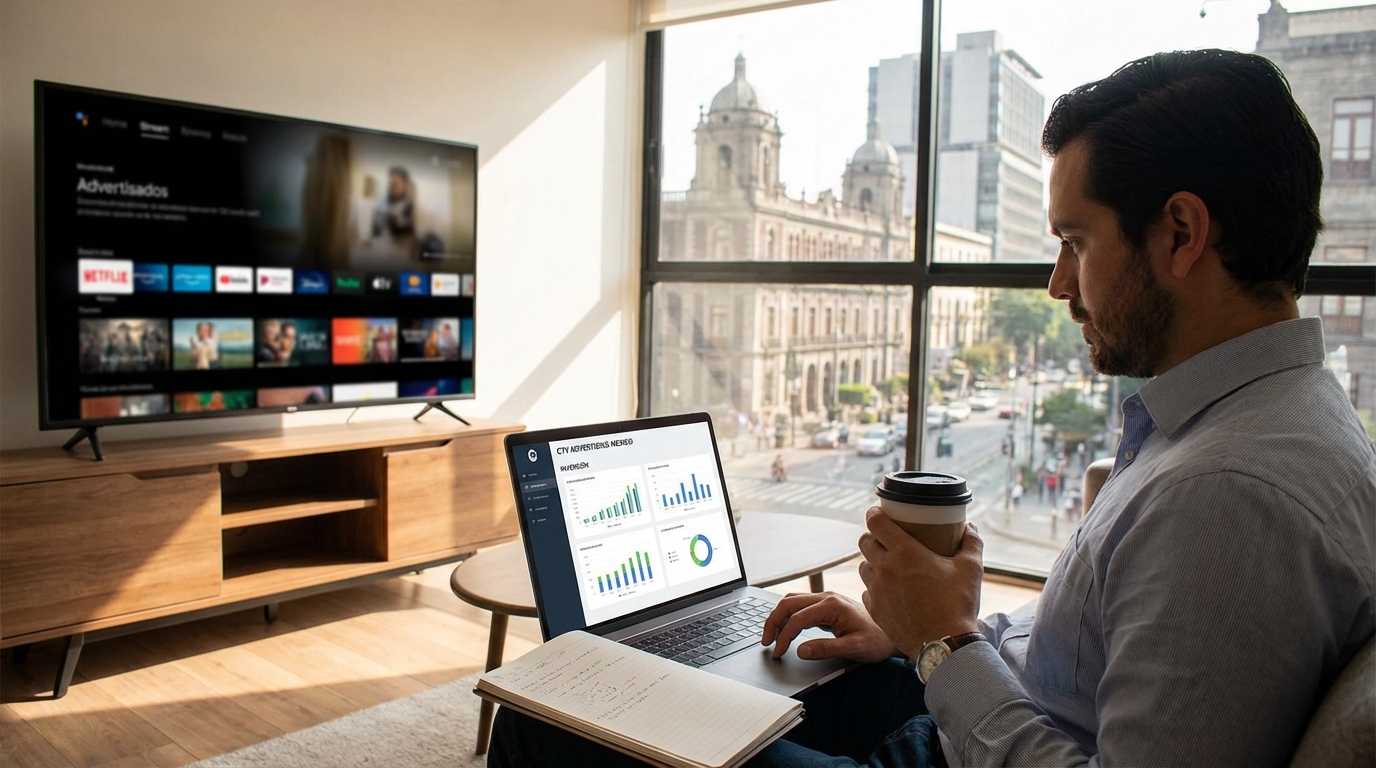
Your ad is on TV… but not on the usual channel; it’s on a Smart TV, inside a streaming app. You see the views climbing on your dashboard, but it’s not clear what it all means for your business: are you actually selling more? Do people remember your brand? Was it worth shifting budget from social media to connected TV?
The thing is, ad-supported streaming is no longer just an experiment for big brands. In the United States, 46% of streaming video platform subscribers pay for plans that include ads, according to data collected by MarketingDirecto.com. That means your customer is seeing ads while watching series, sports, or FAST channels—and your streaming metrics matter just as much as those of any other digital platform.
Why streaming has become key to your media plan
Advertising investment is shifting toward digital video at a breakneck pace. In 2022, digital video advertising surpassed traditional TV advertising for the first time, with nearly $75 billion invested and close to 30% of global display ad spend, according to an analysis compiled by Single Grain. This wave of investment isn't just coming from big brands: more and more small and medium-sized businesses are jumping into "internet TV."
Marketing teams are already adopting it as a staple of their media plans. Nielsen’s "2023 Annual Marketing Report" shows that 80% of marketing professionals in the EMEA region already include streaming channels in their mix, although only 54% feel that investment in OTT-TV and CTV is "extremely" or "very effective," as reported by Control Publicidad. That gap between usage and confidence has a clear explanation: many invest in streaming, but very few know how to properly read the metrics to optimize performance.
The basic metrics you need to master in Streaming TV and CTV
Before diving into complex topics like attribution models or advanced metrics, it’s worth mastering the basics. Streaming TV and CTV platforms speak the same "language" as other digital channels, but with important nuances. Understanding these indicators helps you stop looking at just "views" and start reading behavior.
In practice, the goal isn't to become a data analyst, but to know which numbers to check when your campaign isn't performing as expected. With that in mind, these are the essential metrics you should be clear on every time you launch a campaign on services like Roku, Pluto TV, or other connected TV apps.
- Impressions: how many times your ad was displayed. This is the raw volume. If impressions are very low, you have a reach or bidding issue (CPM too low, overly limited targeting, etc.).
- Reach: how many unique people saw your ad. You can have many impressions but low reach if you are showing the ad to the same audience repeatedly.
- Frequency: the average number of times each person saw your ad. A very low frequency may not generate brand recall; a very high one can cause ad fatigue and waste budget.
- VTR (View-Through Rate): the percentage of people who watched your ad to completion (or up to a key point). In Streaming TV, ads are almost always played in full, but when there is an option to skip, the VTR tells you how engaging your creative was.
- CPM (Cost per mille): how much you pay for every thousand times your ad is displayed. It helps you compare efficiency across platforms and targeting segments.
- CTR (Click-Through Rate): Pure CTV doesn't always generate clicks, but when your ad appears on mobile apps, the web, or devices with interactive remote controls, this metric helps you measure direct interest.
- View-Through Conversions: People who didn't click on the ad but later visited your site or app and completed an important action. These are key to understanding the real impact of "TV" on your business.
Relevance metrics: when attention time is worth more than a click
On streaming platforms, it’s not just about impressions and clicks. It also matters who brings the most value to the ecosystem: creators, shows, categories, and even ad formats. A 2024 study titled “Measures of relevance to the success of streaming platforms” proposes relevance metrics designed for platforms like Twitch, Spotify, or Netflix, based on principles of fairness and stability, as detailed in this academic paper on arXiv. Although it focuses on platform success, the logic behind it can help you better measure the contribution of your campaigns.
The idea of “relevance” goes beyond a simple play. It includes how much attention time is generated, which content triggers more sessions, which ads lead users to keep watching a channel or discover a new one, and which formats are perceived as less intrusive. For a brand, this translates into metrics like average watch time, video completion rate, repeat views, and subsequent engagement (brand searches, direct visits to your site). When you start measuring which creatives generate the most attention and recall, you optimize not just the cost, but the quality of the impact.
The metrics chaos: every platform measures differently
Anyone who has tried to compare results from two streaming platforms knows it’s not as simple as putting everything into an Excel sheet. Gabriela Gutiérrez, Director of Sales and Partnership Mexico at The Walt Disney Company, has pointed out the urgent need to unify metrics across platforms, agencies, and advertisers because “every platform measures differently, and that prevents us from comparing,” according to statements reported by PRODU. And it makes perfect sense: a “view” in one app doesn't always mean the same thing as in another.

For a small or medium-sized business, this fragmentation can be paralyzing. One dashboard talks about “completions,” another about “views,” and yet another about “unique devices.” Without a layer to unify criteria, it becomes complicated to make clear budget decisions. This is where self-service platforms like Masha are a huge help, because they normalize key metrics (impressions, views, reach, frequency, CPM) in a single dashboard and allow you to compare performance by campaign, segmentation, or creative without going crazy over technical definitions.
What to measure at each stage of your marketing funnel
Not all Streaming TV campaigns have the same goal. Some seek to build brand awareness, others to remind people of a promo, and others to drive traffic directly to your site or store. If you measure them all with the same KPI, it’s easy to conclude that “streaming doesn't work,” when in reality, you were using the wrong indicator.
At the awareness (brand awareness), the key metrics are reach, frequency, and video completion rate. What matters here is reaching as many of the right people as possible and ensuring they see your full message at least a couple of times. A competitive CPM and well-controlled frequency tell you if you are making the most of your budget.
In consideration and action a different type of analysis comes into play. Website traffic, post-view conversions, spikes in brand searches, and interactions across your other channels (social media, WhatsApp, etc.) start to carry more weight. If you run streaming campaigns while promotions are active, it is also worth checking the correlation between ad periods and sales: you won't always be able to attribute every sale to a specific ad, but you can observe clear trends when your campaigns are well-configured.
- Awareness: reach, frequency, video completion rate, CPM.
- Consideration: site visits, time on page, brand searches.
- Action: leads generated, sales, bookings, sign-ups, post-view conversions.
Using metrics to optimize: from data to decisions
Seeing nice numbers on the dashboard doesn't mean much if they don't translate into decisions. The key is to establish a rhythm for optimization: review, interpret, and adjust. It’s not about changing everything every day, but rather defining reasonable timeframes (for example, weekly) to evaluate if your campaign is on track to meet its goal.
On a self-service platform like Masha, where you can launch campaigns in under 10 clicks with no minimum investment or contracts, the healthiest approach is to start with a simple hypothesis: who your audience is, what creative you will show them, and how much you are willing to pay per thousand impressions. From there, observe: if reach is low, loosen the targeting or adjust bids; if frequency spikes, broaden your audiences; if the VTR drops in a certain segment, try a different creative or shorten the spot.
Real-time metrics are also a huge advantage. They allow you to quickly pause what isn't working and redirect budget to the winning segments. Testing two versions of the same ad, changing calls to action, or playing with different time slots or content types (news, entertainment, sports) becomes much easier when you see the impact almost instantly. This way, streaming stops being a "brand expense" and starts to be seen as a channel that can be optimized just like any other digital campaign.
Streaming trends that will change how we measure
The way people consume content is changing, and with it, the metrics that matter are changing too. A prime example is the rise of live events within streaming. In January 2025, an event hosted by KFC and Netflix drew over 170,000 online viewers, demonstrating the power of immersive advertising in streaming environments, as reported by El País. For campaigns like these, counting impressions is no longer enough: you need to measure time spent connected, interaction, participation in activities, and even live QR code scans.
There is also the growth of ad-supported plans on major platforms and the focus on content like sports, reality shows, or 24/7 themed channels. As live, on-demand, and interactive experiences blend together, metrics will tend to combine branding and performance: there will be more talk of incrementality, full-funnel contribution, and synergies with other media. Preparing means two things: getting used to reading cross-platform data (not just from an isolated source) and working with tools that simplify analytics so your team, even if it's small, can make decisions with confidence.
Start measuring your Streaming TV campaigns better
Advertising on Streaming TV and CTV is no longer a luxury reserved for big brands. Today, you can bid from $0.01 MXN per view, without long-term contracts or minimum investment requirements, and launch your campaign in a matter of minutes. Platforms like Masha allow you to segment by state, city, interests, and viewing habits, choose which apps to appear on, and view live metrics on a simple dashboard.
If your goal is to stop "throwing ads out there" and start building a measurable and profitable channel, the next step is clear: define what you want to achieve with each campaign, choose the right metrics for each objective, and rely on a tool that gives you clear data without the hassle. Ready to launch your first TV campaign and measure it the way it deserves? Create your account in less than 5 minutes, set up your targeting, and let the metrics guide you toward optimization, not stress.
Convinced it's time to take your business to the next level with streaming advertising? With Masha, you can start your first streaming TV campaign easily and affordably. No matter the size of your company, Masha offers you the ability to advertise on major streaming platforms with an investment starting at just $0.01 MXN per view. Sign up in less than 5 minutes, choose your audience, and monitor your campaign's success with real-time metrics. Ready to launch your first TV campaign? The time is now, and Masha is your partner in making it happen.