There comes a point in the growth of almost every business when the same question repeats: "Is it time to be on TV?" The idea is exciting, but also daunting. Not just because of the budget, but because the real cost of advertising on television in Mexico seems like a mystery reserved for big brands and media agencies.
The reality is different. The Mexican advertising market is growing, and television continues to play a key role. According to the 2025 Total Media Value Study, advertising investment in Mexico reached 140.306 billion pesos in 2024, a 4% increase over the previous year, driven largely by private initiative and the consolidation of the digital environment according to AVE, CiM, and IAB Mexico.
If you own an SME, an e-commerce site, a restaurant, or manage marketing for a growing brand, understanding how television advertising costs are calculated in Mexico is no longer optional. It is the difference between burning through your budget "blindly" or using TV (including Streaming TV) as a profitable, measurable, and accessible channel.
Current landscape of television advertising in Mexico
The first important piece of data isn't how much a spot costs, but why television continues to receive so much investment in the digital age. Brands aren't continuing to invest millions out of nostalgia, but because TV still offers something difficult to replicate: massive reach in a short time and a strong impact on brand perception. The big screen in the living room still carries enormous emotional weight in the consumer's mind.
In parallel, the ecosystem is transforming. Investment is no longer split only between broadcast and pay TV; now, Streaming TV and Connected TV (CTV) are entering strongly, where content arrives via the internet on smart TVs, streaming devices, cell phones, or computers. This intersection between traditional and digital is redefining how budgets are planned and how the return on every peso invested is measured.
For you, this means something very concrete: it is no longer about choosing "only traditional TV" or "only digital." The smarter question is how to combine formats: spots on broadcast TV to build reach and credibility, plus campaigns on Streaming TV to better segment, measure in real-time, and adjust creatives or audiences on the fly.
What factors influence the cost of advertising on television
When you ask, "How much does it cost to advertise on television in Mexico?", the honest answer is always "it depends." Not because someone wants to avoid giving you a number, but because the final price is built by adding up several factors. Understanding them helps you negotiate better, compare proposals, and, above all, avoid paying for things you don't need.
One of the most important factors is the type of channel. Appearing on a broadcast channel with national coverage doesn't cost the same as appearing on a pay channel with a more specific audience. Broadcast television charges for its massive reach; pay TV and Streaming TV are valued more for segmentation, affinity, and audience data. Added to this is the time slot: prime-time blocks (when people are in front of the screen in the evening) are the most expensive, while lower-audience time slots can offer you good frequency at a lower cost.
The length of the ad, the frequency with which you want to appear, and the time of year also play a role. During periods of high advertising demand, such as year-end campaigns or major sporting events, prices tend to rise because more brands are fighting for the same spaces. In addition, each channel puts together different packages: you can find everything from plans based on the number of insertions to more flexible schemes on Streaming TV platforms where you pay for impressions or effective views.
Broadcast TV vs. Pay TV vs. Streaming TV: costs and differences
To truly understand the cost of television advertising in Mexico, it is useful to separate the three major fronts: broadcast television, pay television, and Streaming TV/CTV. Each has different logic and pricing structures, and not all are suitable for the same goals or budgets.
Broadcast television remains a reach monster. In 2024, investment in broadcast television grew 15.3% compared to the previous year, consolidating itself as the main engine of growth in analog television according to the 2025 Total Media Value Study. This reflects that big brands continue to bet heavily on this medium when they need to reach millions of people in a short time. The cost per spot is usually high, but its reach justifies the investment when it comes to massive campaigns.
Pay television, on the other hand, works better when you care more about the audience profile than the raw volume. A channel specializing in sports, news, lifestyle, or children's content gives you a more specific audience, which can improve the efficiency of your investment if your product is very niche. Streaming TV and CTV take that logic a step further: you no longer buy just the channel, but audiences based on behavior, interests, geographic location, and content consumption habits.
In Streaming TV, you normally pay under models based on ad impressions. That opens the door to more flexible budgets and campaigns that fit the size of an SME, something unthinkable when the only option was to buy fixed spot packages on traditional television. Furthermore, because you can segment by state, city, and even viewing habits, the cost per relevant impact can end up being lower than a generic traditional TV spot.
How to estimate your TV advertising budget without losing your mind
Before asking for quotes or opening an account on a platform, you need to be clear about what you want to achieve. A campaign to position a new brand nationwide is not the same as a local campaign to fill tables at your restaurant or get more appointments at a clinic. Your goal defines how much it makes sense to invest, in what type of television, and for how long.
A good starting point is to define three things: who you want to reach, where that audience is concentrated, and what you want them to do after seeing your ad. If your audience is very local, a mix of Streaming TV segmented by city and digital social media campaigns might give you better results than betting on an expensive national channel. If your brand already has some recognition but you need to reinforce it, a combination of broadcast television during key periods and CTV to remind them of the message can work very well.
It is also a good idea to think about the budget in blocks. First, a base amount to test creatives and messages. Then, an optimization budget to push what works best. In traditional television, that optimization is slower because packages are contracted in advance. In Streaming TV and CTV, it is much more dynamic: you can adjust dates, segments, video pieces, and investment levels almost in real time, which makes the effective cost of your campaign much more controllable.
Streaming TV and CTV: making “TV-style” ads on an SMB budget
A few years ago, advertising on “TV” was practically the exclusive territory of big brands. Today, thanks to connected television and Streaming TV, any business can appear on the big screen at home without going through an agency, without long contracts, and without committing their entire marketing budget to a single bet. That is precisely the window of opportunity for SMBs and growing brands.

Self-service platforms like Masha are designed for this: to allow you to buy advertising on Streaming TV and CTV directly, without intermediaries and with a simple interface. You can register your account in a few minutes, set up a campaign in very few clicks, choose which platforms to appear on (for example, channels within Roku, Pluto TV, and other OTT apps), and launch your ad almost immediately. The key advantage is that you don't need to be a media expert; the platform guides you step by step.
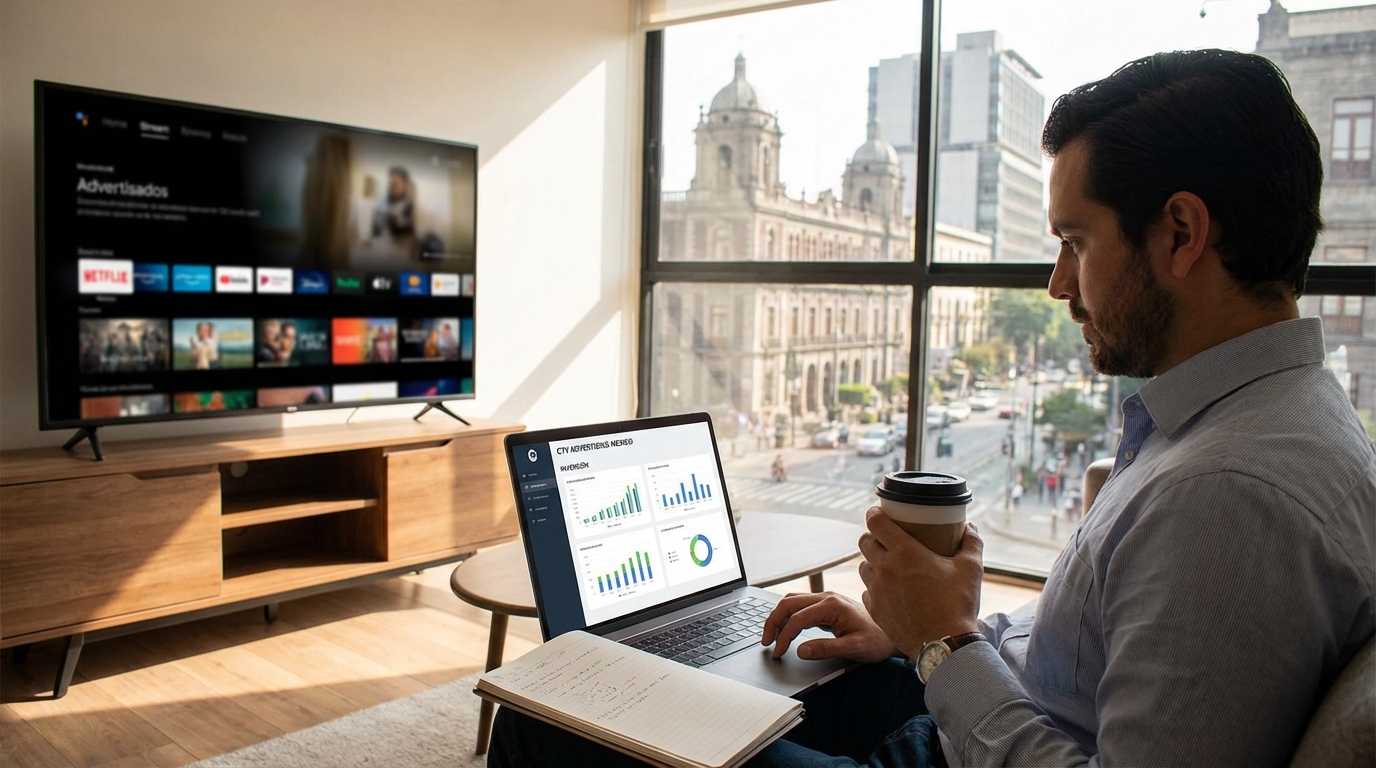
Another strong point is control. Instead of buying “a closed package” and waiting for a report at the end, in Streaming TV you see live metrics: impressions served, full views of your ad, devices where it was shown, times with the best performance, and cities where you are having the most impact. That information lets you optimize on the fly, turn off campaigns that aren't working, and redirect budget to those that are, which reduces the effective cost per result and gives you much more peace of mind as an advertiser.
Investment trends: why TV and the digital environment need each other
The moderate but constant growth of advertising investment in Mexico has an interesting takeaway: brands no longer think in terms of “TV vs. digital,” but rather in the combination of both. Total advertising investment recently exceeded 140 billion pesos, driven mainly by the private sector and the consolidation of the digital environment as a complement to traditional media according to the 2025 Total Media Value Study. Television, instead of losing relevance, is integrating into a broader ecosystem.
In practice, this translates into strategies where TV builds awareness and trust, while digital channels—including CTV—are in charge of refining the audience, reinforcing the message, and pushing for concrete actions: site visits, leads, online sales, reservations, app downloads. The right combination lowers the cost per result because each medium does what it does best.
For a small or medium-sized business, this trend opens the door to “riding the wave” without having to match the budget of big brands. The trick is to use TV-style formats, such as a well-produced thirty-second video, but distribute them intelligently: some broad reach at key moments, and the rest highly segmented on Streaming TV and digital campaigns where you can measure everything with precision.
Common mistakes when calculating your TV campaign cost
The first typical mistake is falling in love with a channel or program without checking if your audience is actually there. Paying a lot to appear on a very famous show does not always mean paying well. If the majority of the audience doesn't fit your ideal customer, the cost per potential buyer skyrockets, even if the cost per spot seems reasonable on paper. That is why it is always better to start with the audience and not the medium.
Another common mistake is underestimating the importance of creativity. An expensive TV commercial with a weak message almost always ends up costing more than it seems, because what is at stake is not just the cost of the airtime, but the impact you make on the viewer's mind. A good script, a clear story, and a concrete call to action can make a mid-sized campaign perform better than a massive, poorly produced one. The same applies to Streaming TV: even if you can target very well, if the ad doesn't hook the viewer in the first few seconds, your cost per result will rise.
Where to start? An action plan for your first campaign
If you have never invested in television, the most sensible recommendation is to start with something controllable and measurable. A good path is to combine a test on Streaming TV with clear targeting and a manageable budget, while continuing to work on more traditional digital channels like social media and search engines. This way, you can see how your audience responds to the TV-style format without committing your entire marketing budget to a single channel.
Self-service tools like Masha help with exactly that: they allow you to test connected TV ads without rigid minimum investments, without long-term contracts and without depending on an agency. From the platform, you choose geographic locations, interests, and content consumption habits, upload your video, define your campaign structure, and start seeing results in real-time on a simple dashboard. That visibility makes the cost of learning lower because you can correct mistakes quickly.
All of this makes even more sense when you consider that advertising investment in Mexico continues to grow, driven by the private sector and a digital environment that no longer competes with, but rather integrates with, traditional television and Streaming TV as reported by the 2025 Total Media Value Study. The opportunity is there: use the big screen to your advantage with smart strategies, realistic budgets, and platforms that bring television advertising to businesses of all sizes.
With Masha, making the leap to streaming TV advertising is easier and more accessible than ever. No matter the size of your business, you can start advertising with campaigns starting at $2,000 MXN, enjoying the flexibility of no minimum investment requirements and no long-term contracts. The registration process is fast, taking less than 5 minutes, and gives you total control to choose where and how your ad will appear, with the ability to target by geographic location and interests. Plus, with Masha, you get the benefit of seeing your campaign metrics in real-time, ensuring every cent spent counts, with prices starting at $0.01 per view. Ready to launch your first TV campaign? Masha is here to democratize TV advertising for SMEs in Mexico, proving that the big screen is also for brands like yours.