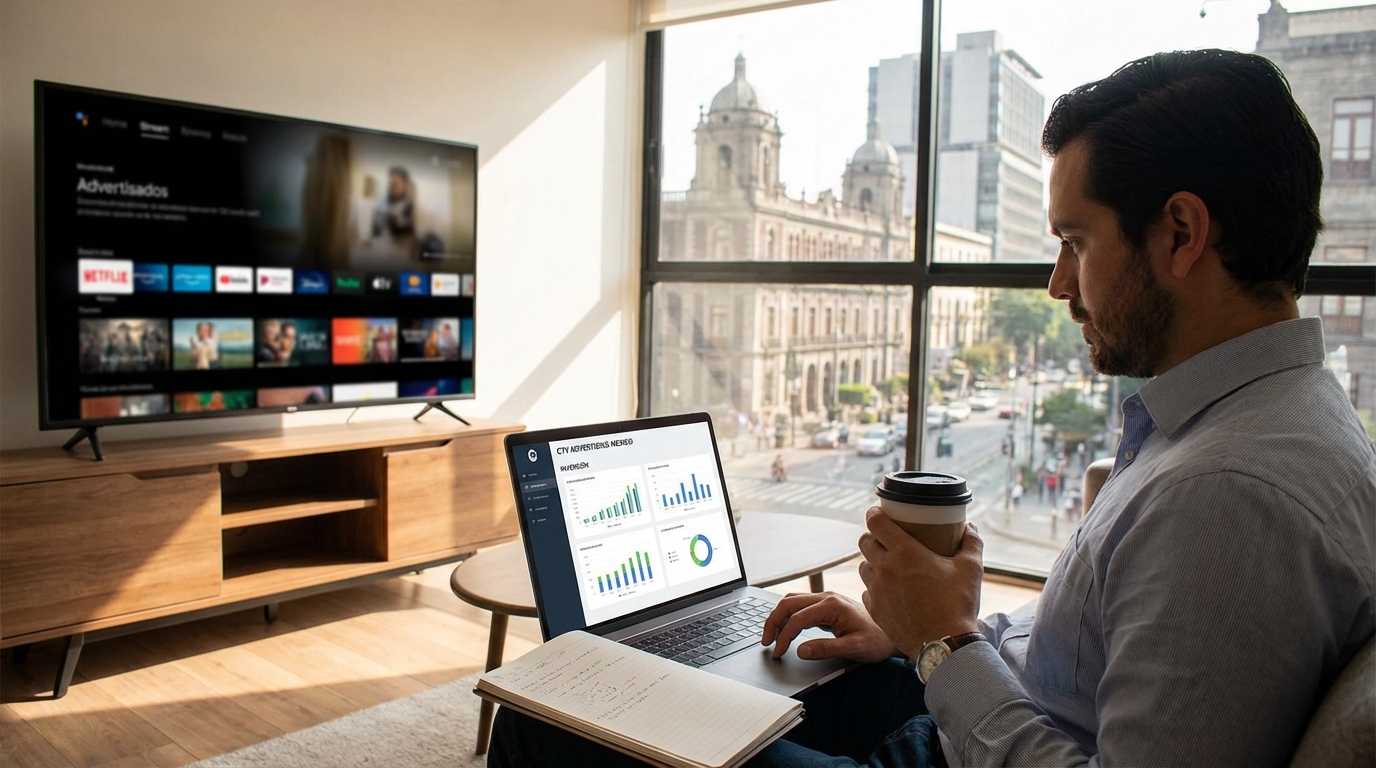
Think about the last time you binged a series, watched a Sunday movie, or caught a game “via an app” on your screen. It probably wasn’t on cable, but rather on a Smart TV or a device connected to the internet. That’s exactly where your brand can appear today, without needing a massive budget or having to deal with a traditional TV network.
Connected TV (CTV) and streaming are no longer niche in Mexico; they are part of millions of people’s daily lives. The best part for you is that now any business—from a neighborhood restaurant to a national e-commerce brand—can have its ad on that big screen where people are actually paying attention.
What is Connected TV (CTV) and how is it being watched in Mexico?
Connected TV is any TV content watched via the internet: Smart TVs, devices like Roku or gaming consoles, streaming apps on the TV, and even content cast from a smartphone. The difference from “traditional” TV is that here, content arrives through apps and digital platforms, not via antenna or cable. This opens the door to something key for marketing: targeting and measurement similar to digital advertising, but on the home’s big screen.
The context in Mexico now justifies taking this channel seriously. In 2024, 65% of Mexican internet users consumed connected TV, which is equivalent to more than 51 million people already watching content in this format, according to Comscore data reported by Marketing4eCommerce. And regarding devices, in 2024, 74.1% of households with a television in Mexico already owned at least one Smart TV, surpassing computers for the first time as an internet access device, according to INEGI figures reported by Xataka México. Simply put: the TV has become just another internet device, and your advertising can take advantage of it.
Why CTV is a huge opportunity for SMBs and local brands
It’s one thing for there to be many Smart TVs, but it’s another for people to actually use them to watch content. In Mexico, it’s happening, and in a big way. Among CTV users, 94% watch movies, 86% watch TV series, and 50% watch sports, with soccer being the king of broadcasts, according to a Comscore study on streaming in the country shared by Comscore. This means massive, engaged audiences with their attention fixed on the screen—something that is often lost in the infinite scroll of a smartphone.
The pie keeps growing. In August 2025, a 26.7% increase in CTV and streaming consumption was reported in Mexico, a leap that is redefining how digital advertising is bought and sold, according to an analysis by Marketing4eCommerce. For an SMB, this is gold: you can enter a channel that was previously exclusive to big brands, but now with flexible buying models and self-service tools that allow you to start with tight, well-measured budgets.
How advertising on Connected TV works
On CTV, your ads aren’t bought “by program” like on traditional broadcast TV, but rather programmatically. This means you upload them to a platform, define the type of audience you want to reach, and the system takes care of serving those ads on the apps and channels where that audience is watching content. You don’t need to negotiate with each channel; you work with a single platform that already has agreements with various streaming services and devices.
The other big difference is precision. You can target by location (states, cities, or zones), by interests, the type of content they consume, or even viewing habits. If you run a local restaurant, you focus your campaign on people who live nearby and are watching streaming content in the evenings. If you run a national e-commerce site, you can reach users interested in categories related to your product while they watch series or movies.
And most importantly: it shows in user behavior. 86% of CTV users in Mexico claim to have taken some positive action toward a brand after seeing an ad, whether it’s visiting their site, searching for them online, or considering a purchase, according to Comscore data cited by OneDigitalThis combination of massive reach and the ability to drive concrete action is exactly what many SMBs are looking for when they feel that social media advertising falls short.
Formats and moments where your ad can appear
On connected TV, your ads are typically short videos that appear before, during, or after content (pre-roll, mid-roll, or post-roll), much like what you already know from online video platforms. The big difference is the context: it’s the living room screen, people tend to be more relaxed and attentive, and there are usually several people watching at the same time.
There is also inventory on live TV channels within apps, sports broadcasts, FAST channels (free ad-supported streaming TV), and on-demand content. Depending on the buying platform, you can have some control over the type of content where your ad is displayed, which helps you maintain brand affinity and ensure you appear in appropriate contexts.
- Ads during commercial breaks on live channels within streaming apps.
- Videos before a movie or series begins.
- Commercial breaks during series marathons or sports broadcasts.
- Inventory on free ad-supported channels, which are widely consumed on Smart TVs.
Advantages over traditional TV for your marketing strategy
The first major advantage is accessibility. Getting on traditional TV usually requires high budgets, negotiations with broadcasters, and multi-week campaigns. With CTV, you can start with flexible budgets, define when you want your ads to run, and pause or adjust at any time. It is a model much more similar to advertising on social media or search engines, but with the power of the big screen.
The second advantage is data. In the TV of the past, the most you could get were general ratings and audience studies. In CTV, you see in near real-time how many people saw your ad, in which cities, with what frequency, and how much of the video was watched. This allows for optimization: if one segment performs better than another, you increase the budget; if a creative isn't engaging, you change it without having to wait until the end of the campaign.
Segmentation and budget control
If you run a local business, traditional TV is usually too broad: you end up paying for impressions in places where you will never make a sale. With CTV, you can limit your ads to specific states or cities, and even test different messages by region. This reduces waste and helps ensure every dollar is invested where there is the highest probability of conversion.
Budget control is also much more granular. You can define how much you want to invest per day or per campaign, and the self-service platforms you are shown estimates of how many views you could get with that amount. If you are testing for the first time, start with a comfortable amount and increase it as you see results, rather than committing to a large media package right away.
- Segment by state or city for regional businesses.
- Create separate campaigns for each type of product or service.
- Adjust your weekly budget based on performance.
- Test different creatives and keep only the one that converts best running.
Real-time measurement and optimization
One of the reasons many small brands are wary of TV is that they feel they "don't know what happened to their money." With CTV, the story changes. Platforms provide metrics on completed views, frequency, reach, peak performance times, and locations where your audience is concentrated. That information is perfect for making quick decisions, rather than waiting for monthly reports that arrive too late.
If you combine that data with what you see in your own business (increases in site traffic, brand mentions, messages asking about promos featured in the ad), you start to understand how much connected TV is contributing to your results. And, above all, you can keep refining: times, segments, messages, and creatives until you find the mix that generates the most sales or leads for you.
Step by step: how to launch your first CTV campaign
Going from "I'm interested in CTV" to "my ad is live" is much simpler than it seems. Today, there are self-service platforms, like Masha, designed specifically for SMBs and small agencies to buy streaming TV ad space without intermediaries, long-term contracts, or intimidating minimum investments. Everything is done through an interface very similar to other digital advertising tools.
The general logic is this: you prepare your video, define who you want to reach, choose the territories where you want to appear, set your budget and dates, upload your ad, and let the platform distribute it across the apps and connected devices that have available inventory. From there, you start seeing live metrics and can make adjustments as you go.
- Define your goal. Do you want more people to know your brand? Drive traffic to your site? Promote an opening or a specific deal? Having a clear goal helps you decide on the ad duration, main message, and proper targeting.
- Prepare your video ad. You don't need a big-budget film production. A good script, a clear message, a closing call to action (for example: “visit your-site.com” or “find us on social media”), and a design that looks good on a big screen are usually enough to get started. Make sure the logo and the offer are visible from the first few seconds.
- Choose your audience and location. On platforms like Masha, you can target by states, cities, interests, or viewing habits. If you have a dental clinic in Mexico City, it makes no sense to advertise nationwide; focus on your area of influence. If your brand sells online throughout the country, test different campaigns by region to see where they respond best.
- Set your budget and schedule. Start with a budget you're comfortable with and a campaign duration that allows you to collect data: several weeks is usually a good benchmark for understanding patterns. If you see that results are good, extend the dates or increase your investment; if something isn't working, adjust your targeting or creative assets.
- Launch, monitor, and optimize. Once live, check your metrics dashboard frequently: completion rates, cities with the most reach, and peak hours. Make small changes, such as shifting more budget to the best-performing regions or pausing an ad that has fewer completions than the rest.
- Connect your campaign with other channels. The magic multiplies when your CTV ad connects with your efforts on social media, search engines, or email marketing. Use the same creative concept, the same promotion, and the same landing page. That way, when someone sees you on connected TV and later finds you on Instagram or Google, they recognize your brand immediately.
If your team is small or you don't have a media department, a self-service platform is especially useful because it saves you from negotiations, contracts, and paperwork. You log in, create your account in minutes, upload your ad, and launch the campaign yourself, without depending on third parties for every adjustment.
Regulatory and brand safety considerations
Entering the connected TV space also means being mindful of the context where your brand appears and understanding, at least in broad terms, the regulatory environment. Although inventory is purchased digitally, many rules that apply to TV and advertising in general remain in effect: restrictions on certain sectors, protection of minors, content guidelines, and regulations regarding political or government propaganda.
A recent example of how the government is paying attention to what is broadcast is the proposal that, starting in April 2025, fines of between 2% and 5% of revenue be applied to concessionaires that broadcast propaganda from foreign governments that does not have cultural or tourism purposes, as reported by El País. Although this measure focuses on concessionaires, it shows the level of scrutiny that audiovisual content can face, including content distributed in connected environments. For your brand, the key is to work with platforms that prioritize brand safety, respect content policies and provide you with transparency regarding where your ads might appear.
If you combine this regulatory care with the technical advantages of CTV—segmentation, real-time measurement, and budget flexibility—the result is a channel that can play a central role in the marketing strategy of any Mexican company, large or small. The next step is in your hands: review your goals, prepare your video, and take the leap into the screen where your next customers are spending hours and hours today.
Ready to launch your first TV campaign? With Masha, your business can shine on the big screen of streaming television without complications or large investments. Sign up in less than 5 minutes and start advertising from $2,000 MXN, with a cost starting at $0.01 per view. Choose where you want to appear, segment your audience, and monitor the impact of your campaign in real time. Masha is here to help SMEs in Mexico take advantage of connected TV and transform their marketing, no matter the size of their brand. Take the leap into CTV with Masha and connect with your customers where they pay the most attention.