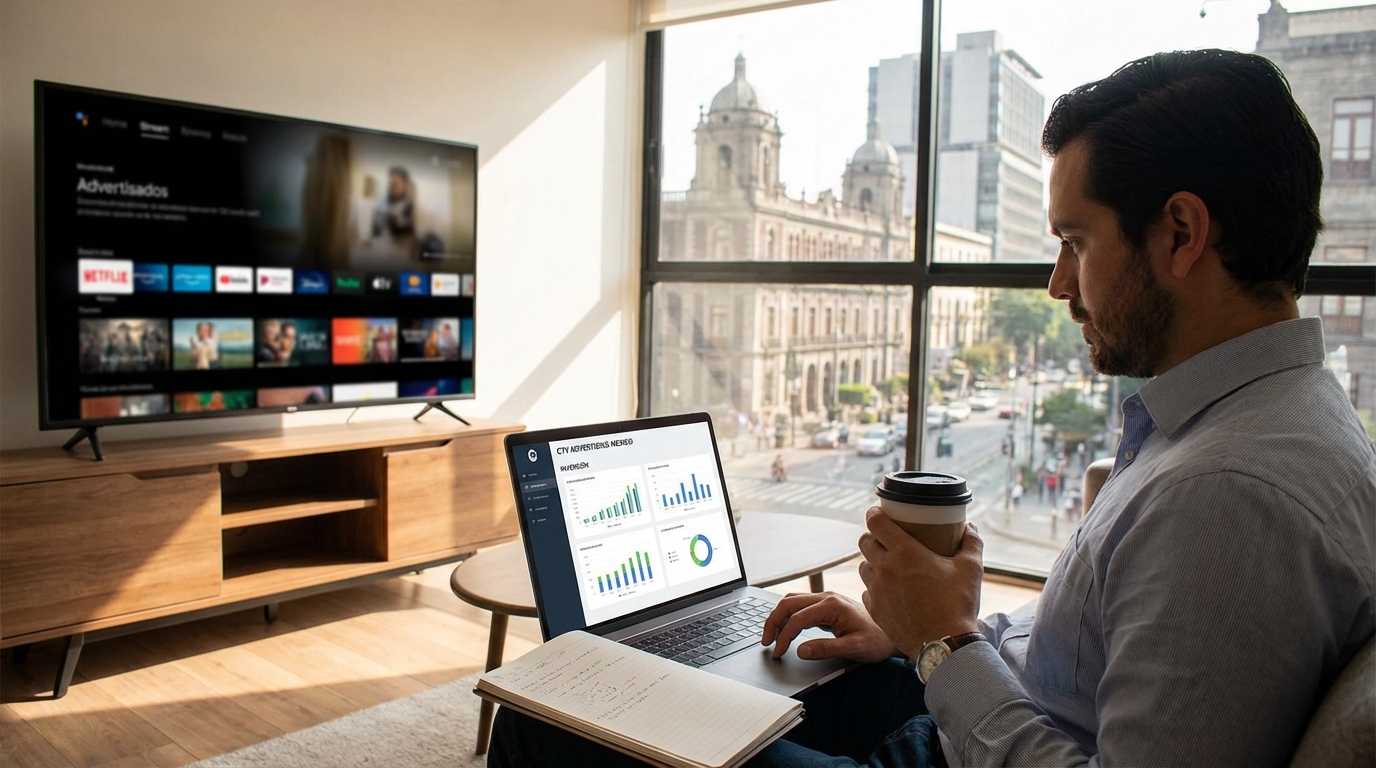
A few years ago, buying TV ads sounded like something reserved for banks, soda companies, and major chains. Today, many people sit in front of a Smart TV, open their favorite streaming app, and see ads for a local taco shop, a neighborhood clinic, or an entrepreneur’s online store. Television is no longer just for big brands, and that opens up a huge window of opportunity for those who know how to take advantage of it.
The numbers support this shift: the OTT video market in Mexico is projected to reach $2.82 billion in revenue this year, with a compound annual growth rate of 5.81% through the end of the decade, according to Statista estimates for the OTT Video market in Mexico. That combination of sustained growth and mass adoption of streaming platforms makes OTT ads one of the most compelling channels for Mexican brands right now.
What is OTT and why is everyone talking about it?
OTT (over-the-top) is basically any video content delivered over the internet, without going through a traditional cable or satellite provider. In practice, it is everything people watch on apps like Pluto TV, The Roku Channel, streaming services, free ad-supported channels, and many other platforms that live within connected TVs, mobile phones, tablets, or computers.
When we talk about OTT ads, we are referring to the video spots that appear within that ecosystem: before an episode, during natural breaks in a live program, or on free ad-supported channels. The interesting thing is that, although the user experience feels like "TV," it runs on digital technology behind the scenes: audience targeting, automated ad buying, and real-time metrics.
The streaming boom in Mexico and Latin America
Consuming video over the internet is already part of the daily routine in the country. A Comscore report showed that 67% of people in Mexico consume content through connected TV devices, with movies, series, and soccer standing out as the favorite formats, according to this Comscore report on streaming in Mexico. That figure reflects something anyone can see in their own home: the big screen is now, above all, an internet screen.
The trend is not limited to Mexico. It is estimated that there will be more than 101 million households in the region consuming content on OTT platforms, representing a 53.19% penetration rate among Latin American households, according to an analysis published by PRODU Magazine on OTT consumption in Latin America. This means that half of the households in the region already watch this type of content regularly.
For advertisers, this implies a change in mindset. Stop thinking only about "buying a channel" and start thinking about "buying audiences that spend many hours in front of the TV, but a connected one." OTT platforms allow you to reach those households with very specific messages, even when they are not watching traditional paid content.
Why OTT ads are so attractive to brands and SMBs
One of the great attractions of OTT ads is precision. Streaming advertising allows for segmentation by location, interests, the type of content people watch, and time of day—something almost impossible on traditional broadcast television. As an industry specialist explains, "the integration of advertising into streaming and OTT platforms has transformed digital marketing, allowing for precise segmentation, greater interactivity, and real-time measurement," according to a CincoDías publication on the advertising revolution of streaming platforms. That mix of TV + data is exactly what many brands were looking for.
Furthermore, the format is ideal for businesses that already create video content for social media. A fifteen- or thirty-second ad that currently only lives on Instagram or TikTok can easily be adapted to appear in front of an audience that is relaxed, focused on the big screen at home, and has fewer distractions. And thanks to self-service streaming advertising platforms, like Masha, allow SMBs to appear on connected TV without relying on large agencies or complicated processes.
Key OTT advertising trends for this year
The OTT ecosystem is moving fast. Between shifts in consumption habits, new technologies, and increased competition among platforms, there are several trends worth understanding before launching campaigns in this channel. Some directly affect advertising costs and how easily results can be measured, making them invaluable for anyone managing a marketing budget.
Connected TV at the center of the living room
Connected TV is cementing its place as the household's star device for consuming OTT content. Although mobile remains important, more and more families prefer watching series, movies, and sports from the living room on a big screen. This changes the context of the ad: people are more relaxed, often in company, and the creative piece can better leverage high-impact visual elements.
For brands, this means adapting the message to the “sofa moment”: clear stories, visible logos, simple calls to action, and a focus on brand building rather than immediate clicks. Even so, thanks to digital measurement, it is possible to see how many people watched the ad in its entirety, in which cities it performed best, and which devices generated the most reach.
Programmatic advertising and self-service buying
Another clear trend is the growth of programmatic advertising in Mexico. An OpenX analysis estimates that programmatic advertising investment in the country will reach approximately 5.68 billion dollars this year and could reach 8 billion in the coming years, positioning Mexico as the second-largest programmatic market in Latin America, according to this OpenX report on the programmatic revolution in Mexico. This growth is also reflected in how OTT ads are purchased.
For SMBs, this translates into platforms that are increasingly similar to those they already use for social media: intuitive dashboards, campaigns that activate when funds are loaded, flexible targeting, the ability to pause or adjust messages, and live metrics. Masha, for example, allows you to create Streaming TV and CTV campaigns in just a few clicks, without long contracts, without intermediaries, and with flexible investment, so that businesses of all sizes can try connected TV without hesitation.
More data, but with a focus on experience
The increase in available data is not only useful for better targeting but also for protecting the user experience. OTT platforms adjust ad frequency, avoid showing the same piece too many times, and seek formats that are less disruptive to the entertainment experience. For brands, this implies creating messages that connect quickly, respect the context, and provide some value, whether through useful information, humor, or empathy.
Continuous optimization also becomes key: reviewing reports in real time, identifying which creatives work best, which audiences respond most, and which time slots are worth reinforcing. A constant test-and-learn approach can make the difference between a campaign that just “appears on TV” and one that actually generates sales, traffic, or brand recall.
Regulation and brand safety: what you need to know
The growth of OTT has also caught the attention of regulators. In Mexico, the government proposed a reform to the Federal Telecommunications and Broadcasting Law that contemplates fines of between 2% and 5% of revenue for concessionaires that broadcast propaganda from foreign governments, which includes digital platforms, as reported by an El País article on the reform in MexicoWhile this measure focuses on political content, it sets the tone for an increasingly scrutinized regulatory environment.

For commercial advertisers, the message is clear: work with formal platforms, ensure compliance with content policies and make sure your ads appear in brand-safe environments. Placement control tools, sensitive content blocklists and transparent agreements with technology partners are part of the new best-practices manual for OTT.
How SMBs can leverage OTT ads
Small and medium-sized businesses are in an ideal position to enter OTT. Previously, appearing on TV meant slow processes, high investment minimums, and complicated negotiations with intermediaries. Today, an SMB can plan a campaign focused solely on its city or state, with an investment tailored to its reality and without signing long-term contracts.
Self-service platforms like Masha help with exactly that mission: they allow you to upload your video, choose geographic areas, define the type of audience you want to reach (hobbies, interests, content consumption habits), and launch the campaign almost immediately. All without convoluted technical jargon and with a dashboard where you can see live metrics: how many people saw the ad, on which devices, and what reach was achieved.
Practical steps to launch your first campaign
For an SMB that has never advertised on OTT, the first step is to choose a clear objective: do you want more people to know your brand, promote a specific offer, or drive traffic to your website or physical store? Once that is defined, you can adapt the video: keep messages short and clear, ensure the brand is visible from the first few seconds, and include a simple call to action (“find us at…”, “visit our site…”, “come see us at…”).
Next comes segmentation. Instead of trying to speak to “everyone,” it is better to start with specific areas where your business already has a presence or the capacity to meet demand. Segmentation tools by state, city, or audience type allow you to test, learn, and then scale. The important thing is to think of the campaign as something dynamic: you can adjust the message, change creatives, or shift budget based on the response.
Tips to get more out of your budget
A common mistake is to copy the same spot used for traditional TV without considering the digital environment. In OTT, leveraging metrics means testing several versions of the ad, playing with different calls to action, and analyzing what works best with each audience. Sometimes, a small change in the first sentence or the opening image can significantly improve performance.
It also helps to coordinate your OTT campaign with other channels. For example, launch streaming ads at the same time as a search or social media campaign, so that when a person sees the ad on TV and then searches for the product on their phone, they find the brand immediately. This combination reinforces brand recall and increases conversion possibilities without needing to multiply your budget.
Case study: from social media ad to big-screen ad
Imagine a local clothing store that already invests a bit in social media video ads but feels it is falling short in reaching new audiences. Instead of starting from scratch, it can take its best video assets, adapt the format for OTT (resolution, duration, clearer messaging), and use a self-service platform to place ads on connected TVs within its own city.
Over a few weeks, the brand can observe metrics like reach by area, viewing times, and performance by content type (for example, how well it performs on sports channels vs. entertainment channels). With that data, it can adjust the message, reinforce the audiences that respond best, and start to notice something key: it is no longer just being bought by those who follow it on social media, but also by people who had never seen its profile before but encountered the brand while relaxing and watching their favorite show in their living room.
What’s next: opportunities in the coming years
OTT adoption still has room to grow in the region. The figure of over 101 million Latin American households consuming content on OTT platforms, with a 53.19% penetration rate, suggests that the market is just entering a phase of maturity, according to projections gathered by PRODU Magazine on the number of OTT households in Latin America. As more people permanently switch from traditional TV to connected TV, OTT ads will stop being "innovative" and become a media plan staple.
For Mexican brands, the opportunity lies in getting in now, learning how the channel works, and building internal expertise before everyone is competing for the same spots. Starting with small campaigns, testing different messages, and relying on platforms that simplify the process makes advertising on Streaming TV stop being a distant dream and become a natural part of your marketing strategy. Whoever manages to combine the power of TV with the precision of the digital world will have a real advantage in the coming years.
With the landscape for OTT ads in Mexico showing a promising and accessible future, it’s the perfect time for your business to stand out. Masha offers you the opportunity to enter the world of streaming TV advertising with ease and at an affordable cost. Starting at just $2,000 MXN, you can segment your audience, choose your preferred platforms, and get real-time metrics, all with a sign-up process that takes less than 5 minutes. Don't miss the chance to get your brand on the big screen and take advantage of competitive pricing starting at $0.01 per view. Ready to launch your first TV campaign?