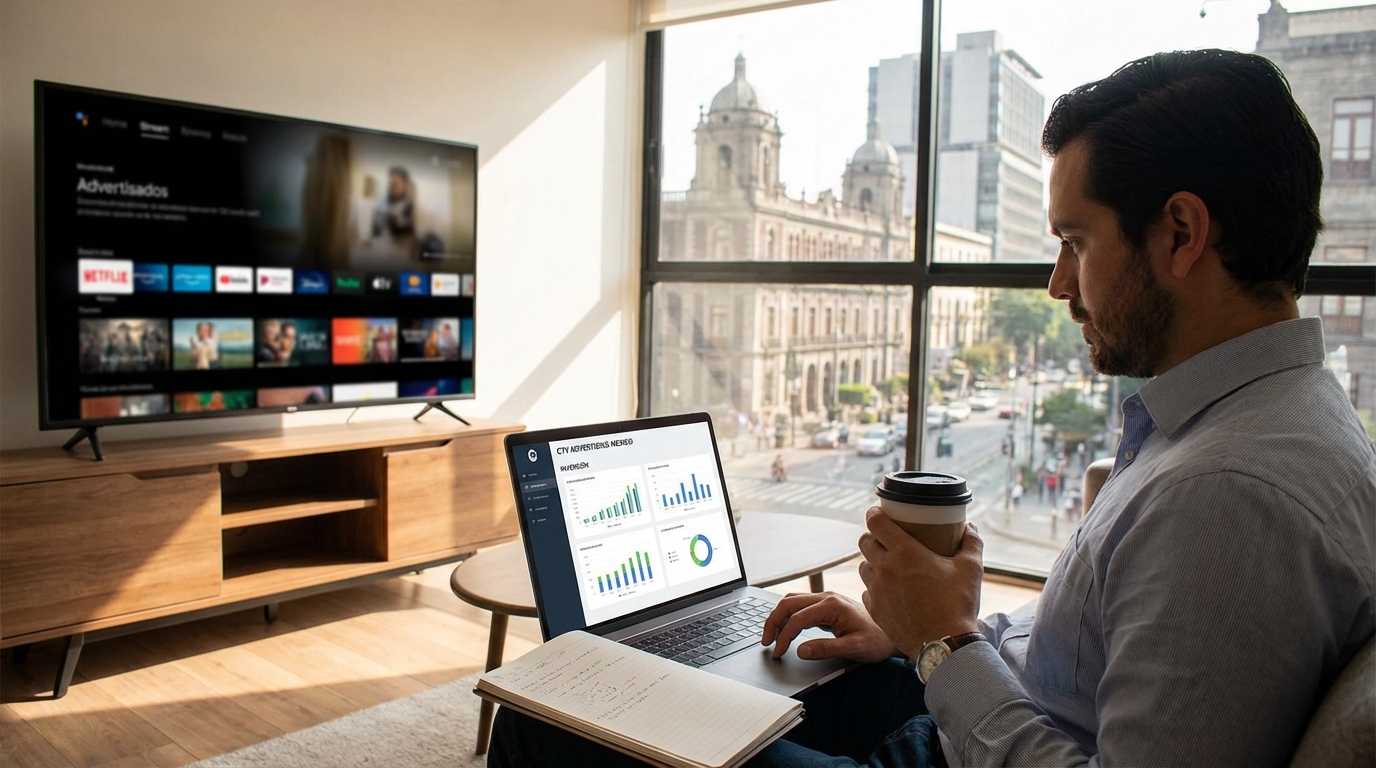
Turn on the TV in any Mexican home on a weekend and it is highly likely that instead of cable, you will see a streaming app open: soccer, a trending series, or a family movie. This isn't just a perception; it's a fact: 67% of Mexicans now enjoy content through Connected TV (CTV) devices, with movies, series, and soccer being the most-watched, according to Comscore. If your brand still doesn't have a clear Smart TV advertising strategy, you are leaving audience and results on the table.
Why Smart TV is already a mass channel in Mexico
Connected TV has moved beyond being a tech curiosity to become a mass consumption medium. In 2024, 65% of internet users in Mexico consumed connected TV, which is equivalent to more than 51 million people, according to data from Comscore and IAB Mexico. We are talking about a massive universe that you can reach with digital targeting, but on a large, shared screen.
The growth has been building for years. Back in 2021, 60% of households in Mexico had a Smart TV and 39% of those people considered streaming advertising attractive, according to data compiled by IAB Mexico. In other words, the audience is not only on the platform, but they are also open to watching ads if the content is relevant to them.
The pandemic accelerated this shift in habits. Digital tools became one of the main allies for brands to keep selling even during lockdown, as explained by Ana Jiménez, Managing Director of DynAdmic Mexico, when analyzing the growth of digital advertising on Smart TV during 2021. That momentum did not stop: today, Smart TV has consolidated itself as "the new sales floor" for thousands of businesses, from retail giants to neighborhood restaurants.
What makes Smart TV advertising different
The big difference is not just the video format, but the context. A Smart TV ad appears on a large screen, with the family gathered around, sound on, and attention more focused. It doesn't compete with notifications, messages, or open tabs as happens on a computer or cell phone. That is why many advertisers report better recall rates and more brand impact when they include CTV in their media mix.
A study by Teads showed that ads on the CTV home screen generate an attention rate of 48%, outperforming skippable YouTube pre-roll by 16%, according to results published by IAB Mexico and Teads. In practice, that difference in attention translates into more people remembering your ad, your brand, and your message.
Another key point is flexibility. Unlike traditional television, where you had to buy fixed packages and commit to large investments, Smart TV advertising is purchased using digital models: you can adjust dates, targeting, creatives, and budget in practically real time. And if you combine that with self-service platforms, small and medium-sized advertisers can get on "TV" without going through a massive media department.
Consumer habit changes that benefit your ads
On-demand content has trained Mexican audiences to watch what they want, when they want. This includes binge-watching series, streaming live sports, and accessing thematic channels—like movies, news, or cartoons—available around the clock. For your brand, this translates into something highly valuable: longer consumption sessions that are often shared among several people in the same room.
Comscore reports that the most-watched content on CTV in Mexico includes movies, series, and soccer, with 67% of Mexicans enjoying content on these types of devices, according to their recent analysis of the country's streaming market.. If your product aligns with entertainment, sports, family, home, food, or personal finance, you can place your message in contexts that are highly relevant to your ideal audience.
Furthermore, the fact that so many people watch Smart TV together changes the logic of impact: a single ad can influence the purchasing decision of an entire household. Advertising a delivery platform to someone scrolling through TikTok on their phone is not the same as showing an appetizing spot right when everyone is deciding what to have for dinner in front of the TV.
How to design your Smart TV ad strategy step by step
Before opening a platform and uploading your video, it is worth having a clear strategy. Smart TV ads work best when designed with the big screen and specific goals in mind, rather than just being a "copy-paste" of social media campaigns.
The first step is to define what you want to achieve: brand awareness in your city, traffic to your e-commerce site, registrations for a course or event, or an increase in delivery orders? From there, you choose key metrics: completed video views, site visits, redeemed codes, brand searches, etc. If you are a small business, it is best to start with one primary goal (e.g., website visits) and one secondary goal (brand recall or growth in searches for your name).
Next comes segmentation. On Smart TV, you can segment by location (states, cities, or even neighborhoods), interests, and viewing habits. For a local restaurant, for example, it makes sense to limit the campaign to the city where it delivers and to content related to food, lifestyle, and nightlife. For an online course brand, a national approach with segmentation by educational and professional interests might work better.
Creatives designed for the big screen
The most common mistake is recycling a vertical social media spot or a video intended to be watched without sound. Smart TV requires different rules: clear messages, a logo visible from a distance, large text, and few elements on screen. The key phrase should appear in the first few seconds, just like the main benefit. Many people jump in and out of streaming apps, so every impression counts.
It also helps to think of your ads as short stories, not just an animated flyer. A scene the audience recognizes—a family in front of the TV, someone working from home, a group of friends watching the game—creates an immediate connection. And if your business is local, showing streets, areas, or landmarks from your city increases relevance and makes the ad feel "close to home."
Frequency, duration, and formats that actually work
On Smart TV, 15- to 30-second formats usually work best, with a very clear main message and a simple call to action: "order on our app," "visit our site," "find our nearest store." Ads that are too long tend to cause fatigue, especially if the frequency is high.
The ideal approach is to find a balance: enough frequency for people to remember your brand, but without saturating them. That is why it is key to use platforms that allow you to see real-time metrics, adjust your bidding, and change creatives if you notice the campaign is "burning out" quickly or if one version of the ad is performing significantly better than another.
Segmentation and measurement: the true superpower of CTV
In traditional television, you knew which program you were on, but not exactly who was watching or what they did afterward. Smart TV changes the rules: you can segment very specific audiences and measure results almost at the level of the digital campaigns you are already familiar with.
A Comscore study in Mexico revealed that 86% of CTV users claimed to have taken at least one positive action toward a brand after seeing an ad, cementing connected TV as a key channel for engaging with active audiences, according to data published by IAB Mexico. A "positive action" can be visiting your website, searching for your brand, following you on social media, downloading your app, or even making a direct purchase.
The key is to set up your campaign correctly: choose locations where you can actually provide service, interests related to your product, times when your ideal customer is watching TV, and creative assets that include a clear call to action. Then comes the fun part: analyzing metrics like impressions, completed views, reach, frequency, and—when you connect your website or app—visits, sign-ups, and attributed sales.
How to get started without blowing your budget: an example with Masha
Until recently, advertising on "TV" sounded like something only big brands with massive agencies could do. The good news is that has changed. Self-service platforms like Masha allow small and medium-sized businesses to launch Streaming TV and CTV ad campaigns without intermediaries, without long-term contracts and without rigid minimum spend requirements.
With Masha, you can create an account in just a few minutes, upload your videos, choose the cities or states where you want to appear, adjust interests and viewing habits, and launch your campaign very easily. The platform works with cost-per-impression models (CPM) and offers costs per view starting at very accessible amounts, designed so that even businesses just starting out can test the channel without taking on too much risk.
Another strong point is the live metrics dashboard. Instead of waiting for monthly reports, you see in real time how many people watched your ads, on which devices, which formats perform best, and how your budget is being distributed. With that information, you can pause, increase your budget, change targeting, or upload new creative assets based on what works best. The idea is to take the "fear of TV" away from small advertisers and turn it into a channel as manageable as a social media campaign.
Upcoming CTV trends in Mexico (and how to take advantage of them)
The streaming market in Mexico is not just mature; it is in full expansion. In 2024, it generated $6.7537 billion in revenue and is expected to reach $21.663 billion by 2030, reflecting very strong growth in CTV adoption, according to projections compiled by Marketing4ecommerce. In practice, this means more platforms, more advertising inventory, and more formats available for brands.
You can expect greater sophistication in targeting: audiences based on content consumption behavior, more cross-screen remarketing options (seeing an ad on TV and then a reminder on mobile), and better attribution tools. For the advertiser, this opens the door to comprehensive campaigns where the Smart TV stops being an "extra" and becomes a central piece of the strategy.
To take advantage of these trends, it is best to start early, even with small budgets. Those who enter early learn faster which creative assets, targeting, and formats work for their business. That way, when CTV inventory in Mexico becomes even more competitive, your brand will already have experience, historical data, and a refined strategy. Ultimately, Smart TV is not just a new channel: it is the opportunity to put your brand on the most important screen in the house, in an accessible, measurable way designed for the type of Mexican consumer who today lives between streaming apps and on-demand content.
The era of connected television is here, and your business cannot afford to be left behind. With Masha, you have the power to bring your brand to streaming screens across Mexico simply and affordably. Forget the high costs and complexity of traditional TV advertising. Starting at just $2,000 MXN, you can begin reaching your target audience with the flexibility to segment by location and interests, and the advantage of monitoring your ad performance in real time. No matter the size of your company, Masha gives you the opportunity to compete on the big stage, with prices starting as low as $0.01 per view. Ready to launch your first TV campaign? The future of Smart TV advertising is just a few clicks away.