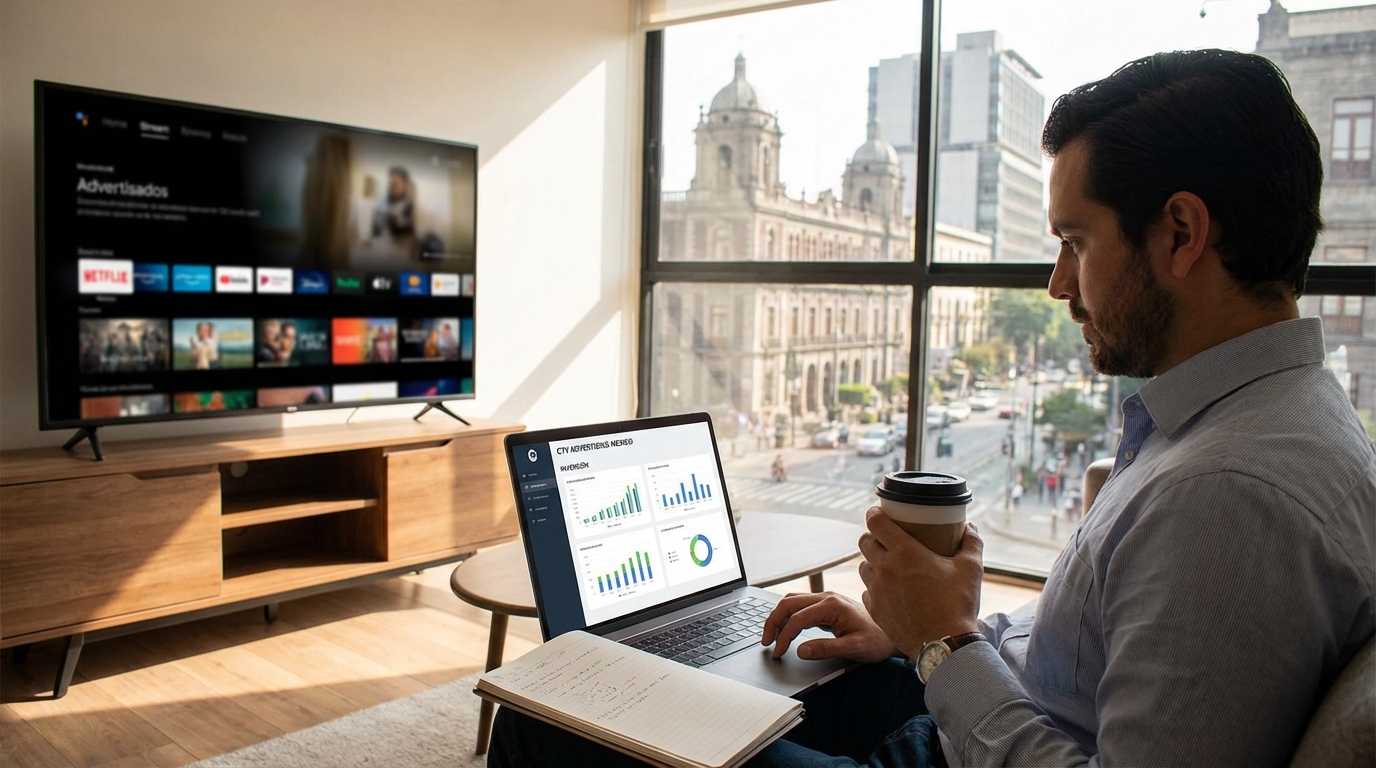
Many businesses have already noticed that their usual ad spots just don't "feel" the same anymore. There are fewer calls, less direct traffic, and at the same time, everyone is talking about the new series on a streaming platform. It’s not your imagination: consumption has shifted from traditional television to connected TV and streaming, and marketing budgets are moving right along with the audience.
In the United States alone, streaming already accounts for 43.8% of total television time as of March 2025, up 10 points from two years ago, according to recent Nielsen data. And the ad-supported streaming market (AVOD) is on track to surpass traditional TV advertising revenue by the end of 2025, according to projections for the U.S. market.
For an SMB or a local business, this isn't just a fun fact. It’s a clear signal: continuing to invest only in broadcast or cable TV is like insisting on advertising in the newspaper while your customers live on social media and streaming platforms. The good news is that today there are real, measurable, and attainable alternatives (without needing a massive budget) to be on your audience's "big screen"... but using digital tools.
The audience shift: from cable TV to streaming
The logic is simple: people watch content where it’s most convenient for them. The user, not the channel, is now in control. Between free ad-supported platforms (AVOD), paid subscriptions, and smart TV apps, the menu is huge. That’s why the time that used to be split among a few channels is now fragmented across dozens of streaming apps.
When streaming accounts for nearly half of all time spent in front of the TV, as shown by the 43.8% streaming share in March 2025 in the United States according to Nielsen, the impact on brands is direct: every dollar that stays only in linear TV goes less far. It’s not that traditional TV is dead, but it has lost its exclusivity as the "king" medium for mass reach.
The way content is funded is also changing. The "watch free TV and see ads" model has made a strong comeback in a digital format. Ad-supported streaming (AVOD) is on track to surpass classic television advertising in revenue by the end of 2025 according to U.S. market projections. This means that major advertisers are already moving to these platforms. The advantage for SMBs: it is now possible to join the game without buying a million-dollar prime-time spot package.
CTV for SMBs: what it is and why it’s right for you now
Connected TV (CTV) sounds technical, but it’s actually what everyone watches at home: TV content delivered via the internet to devices like smart TVs, Roku, Fire TV, consoles, or even mobile phones. The key difference from traditional TV is that behind those screens, there is technology that allows for precise targeting and measurement, much like a digital campaign.
Advertisers have already caught on. The Nielsen 2025-2026 Upfronts/NewFronts report estimates that investment in CTV advertising will grow by about 10% annually through 2027 according to this analysis. When an investment channel grows at that rate, there is usually a reason: better results, better data, or both.
For an SMB in Mexico, the biggest barrier has always been access. Previously, advertising "on TV" meant talking to an agency, signing long contracts, and allocating intimidating budgets. Today, self-service platforms like Masha have changed the game: you can run ads on Streaming TV and CTV (Pluto TV, Roku, and other OTT apps) starting at $0.01 MXN per view, with no contracts, no minimum spend, and a live metrics dashboard. It’s the same big screen, but with digital rules and conditions that are friendly for small and medium-sized businesses.
- Target by state, city, interests, and content consumption habits.
- Pay for impressions or views, not for fixed "packages."
- Turn campaigns on and off whenever you need to, without being tied to a full season.
How does buying CTV ads work?
Instead of booking a fixed block on a specific channel, your CTV ads are distributed programmatically. This means a system decides, in fractions of a second, which ad to show each user based on the profile you configured: location, interests, type of content they watch, etc. You define the audience; the platform takes care of finding those people across different apps and devices.
That is why it is normal not to see your own ad at home, even if you are advertising on the same platform you use. If your campaign is targeted to a specific state, age range, or interest, only people who meet those criteria will see the spot. From the advertiser's side, the value lies in being able to track in real time how many impressions you are generating, which devices are performing best, and how to optimize days, times, or creative assets.
- Sign up for Masha in less than 5 minutes.
- Upload your video, set your budget, dates, and targeting.
- Launch your campaign in under 10 clicks and check live metrics from a simple dashboard.
AVOD and native formats: two allies to pay less and sell more
The AVOD (Advertising Video on Demand) model is the classic "free content in exchange for watching ads." Platforms using this scheme have gained ground rapidly. In fact, AVOD penetration increased by 63% since 2022 according to the Nielsen Upfronts/NewFronts 2025-2026 report. When so many people adopt these types of platforms, a huge inventory of ad spaces opens up, with more accessible costs than a traditional prime-time spot.

For a business, AVOD is attractive because it bridges two worlds: massive reach on big screens and digital targeting tools. Instead of blasting the same ad to the entire country, you can focus only on the cities where you have branches, or on audiences interested in your category. Less waste, higher probability of real impact.
Alongside AVOD, another key player in 2025 is native advertising. It is estimated that the global native advertising market will reach approximately 400 billion dollars in 2025 according to estimates cited by America Retail. The logic is clear: ads that resemble the content (without being deceptive) feel less intrusive and tend to generate a better response. In video, this translates into brand integrations, mentions within content, section sponsorships, and more.
Examples of formats that work well
Creativity rules, but certain formats have already proven to be especially effective for SMBs when combined with Streaming TV and other digital platforms. Adapting the message to the context often makes the difference between an ad that "feels like an ad" and one that is perceived as useful or entertaining content.
- 15-second short spots with a direct message (who you are, what you offer, how to contact you) designed for AVOD.
- Testimonial-style videos that can be used on both CTV and social media, building consistency and trust.
- Channel or category sponsorships within free streaming platforms, ideal for brand positioning in niches (for example, “family movies,” “sports,” or “news”).
- Native content pieces where the content provides value (tips, recipes, advice, stories) and the brand is integrated naturally.
How to shift your budget from traditional TV to new alternatives
Moving from a plan based almost entirely on broadcast or cable TV to a mix that includes CTV, AVOD, digital audio, and native formats doesn't have to be a leap into the void. The smartest approach is to migrate in stages, testing, measuring, and adjusting. The advantage is that new channels allow you to experiment with small amounts without committing your entire budget.
The first step is to understand which part of your current TV investment is actually generating results. Often, the problem isn't “TV” as a medium, but the lack of clear measurement. By moving to CTV and streaming, you can connect your campaigns with digital metrics: site visits, leads, app downloads, brand searches. That makes it much easier to defend your budget to management or partners.
It also helps to recognize that, globally, investment is shifting toward digital video and audio channels. Various market analyses point to strong growth in areas like connected TV and digital audio for 2025, indicating that this is not a passing fad but a fundamental shift. Riding that wave early usually translates into better costs and less direct competition in certain niches.
- 1. Define clear objectives: direct sales, store traffic, lead generation, local positioning, etc.
- 2. Set aside a percentage of your budget to test CTV and AVOD over several months (not just a one-off campaign).
- 3. Replicate your key message in video for Streaming TV and in short versions for social media and native formats.
- 4. Compare results: cost per view, cost per lead, lift in brand searches, site visits.
- 5. Reallocate resources toward the channels and creatives that demonstrate better real performance, not just “estimated reach.”
Quick checklist for your 2025 plan
Before finalizing your 2025 media plan, it’s worth reviewing a few simple points that can save you a lot of headaches. It’s not about reinventing your entire strategy, but rather avoiding being stuck in the past while your audience is already living on other channels.
- Does your mix include at least one Streaming TV or CTV channel with location-based targeting?
- Do you have at least one creative specifically designed for the big screen (not just a cut-down of a social media video)?
- Can you see real-time metrics for your video campaigns (impressions, views, reach)?
- Are you testing at least one native advertising or sponsored content format?
- Do you know how much it costs you today to acquire a new sale through video (on any channel)?
From zero to your first Streaming TV campaign with Masha
All of this sounds good, but the real challenge begins with execution. That is where a self-service platform like Masha makes entering the world of CTV as routine as launching a social media campaign. Your content appears on major Streaming TV platforms in Mexico and Latin America, such as Pluto TV, Roku, and other OTT apps, but you control the budget, dates, and targeting from a single dashboard.
Furthermore, the context works in your favor. Investment in channels like connected TV and digital audio continues to expand: various market analyses project significant investment increases for 2025 in CTV (between 50% and 70%) and in digital audio (between 25% and 40%) according to estimates compiled by HMG. Being present in these channels today puts you on par with what major brands are already doing, but with a flexible and accessible structure.
With Masha, the workflow remains simple and hassle-free:
- No contracts: you aren't tied to long-term commitments; you can pause or adjust whenever you need to.
- No minimum spend: you start with small amounts and scale only if you see results.
- Pricing from $0.01 MXN per view: total clarity on how much you pay for exposure.
- Live metrics: see how your campaign is performing in real time and make changes on the fly.
- Precise targeting: states, cities, interests, and viewing habits to reach the people who are actually likely to buy from you.
For a local business, an e-commerce store, or a growing brand, this means that "advertising on TV" is no longer a luxury reserved for giants. It is just another tool in your digital marketing toolkit, accessible with your credit card and a few clicks. If your goal for 2025 is to stop relying solely on traditional TV and dive into the world of streaming, the path is clear: combine CTV, AVOD, and native formats, measure everything you can, and adjust quickly.
Ready to launch your first TV campaign? Create your Masha account, upload your video, and in less than 10 clicks, you'll be appearing on Streaming TV in front of the people you actually want to reach.
The TV marketing revolution is at your fingertips with Masha. If you are ready to take your business to the next level and take advantage of the opportunities offered by streaming television in 2025, Masha is your perfect partner. With the ability to launch campaigns starting at $2,000 MXN and a cost per view as low as $0.01 MXN, you can say goodbye to huge budgets and long-term contracts. Sign up in less than 5 minutes, choose your streaming platforms, target your audience, and monitor your results in real time. Don't miss the opportunity to make your brand shine in the streaming era. Ready to launch your first TV campaign?