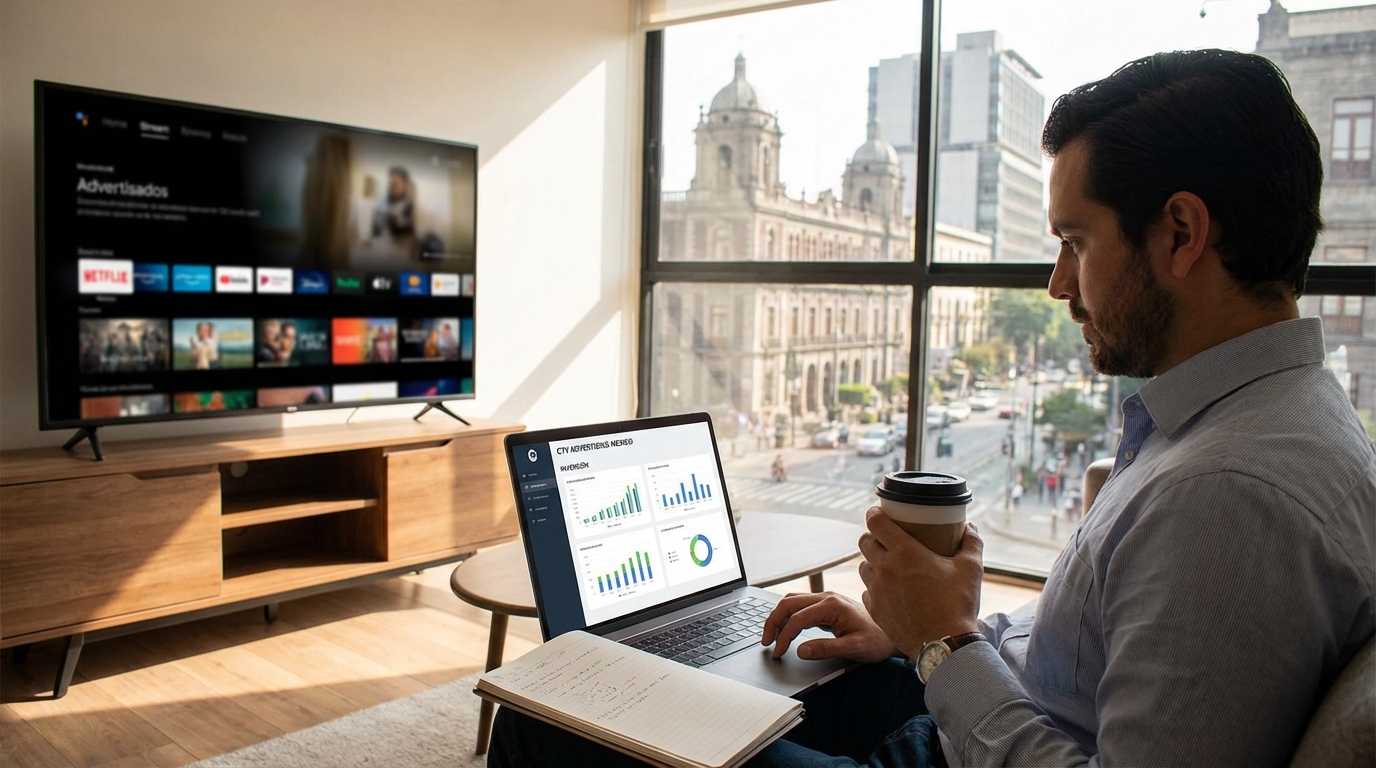
Democratizing television: Goodbye to million-dollar budgets
For decades, advertising on television was a privilege reserved for corporations with deep pockets. Mexican SMEs watched commercials from big brands and assumed that channel was completely out of their reach. The reality was brutal: months-long contracts, minimum investment requirements exceeding one hundred thousand pesos, and endless negotiations with intermediaries who took a significant cut of the budget.
That narrative changed radically with the arrival of connected TV and platforms like Masha, which allow TV advertising starting at $0.01 per view. That is not a typo or a temporary promotion. It is the result of a technological transformation that finally puts the big screen within reach of businesses of any size. Local restaurants, law firms, clothing stores, and startups now compete on the same playing field as the brands that once dominated the television space without competition.
The interesting thing is that this change does not sacrifice quality for price. Your ad appears on the same streaming platforms where people spend hours watching their favorite series. The difference lies in how that advertising space is purchased and who has access to it.
The myth of prohibitive costs in traditional advertising
The traditional television advertising model operated on a simple but exclusionary logic. Television networks sold space in large blocks, with rates that varied according to the time slot and the program's rating. A 30-second spot during prime time could cost anywhere from 200 thousand to several million pesos. And that was just the beginning.
You had to add the production of the commercial, which easily added another hundred thousand pesos if you wanted something decent. Contracts typically required multi-month commitments and minimum broadcast frequencies. For an SME with a marketing budget of 50 thousand pesos per month, television simply did not exist as a viable option.
This model created a self-fulfilling prophecy. Small businesses never tried to advertise on TV because "everyone knew" it was incredibly expensive. Television networks had no incentive to create accessible options because their business model depended on large clients with predictable budgets. The vicious cycle kept millions of companies out of the most influential mass communication medium for entire generations.
How programmatic technology enables ads starting at $0.01
The Programmatic advertising broke that cycle. Instead of buying fixed slots in specific programs, you now buy individual impressions through automated auctions that happen in milliseconds. Every time someone opens a streaming app, an algorithm determines which ad to show based on the viewer's profile and advertiser bids.
This system has several revolutionary advantages. First, it eliminates intermediaries. You don't need a media agency to negotiate with the TV station, nor a sales representative to sell you inflated packages. Second, it allows for extreme granularity: you can buy exactly the impressions you need, not one more, not one less. Third, it democratizes access because the system does not discriminate based on budget size.
The price of $0.01 per view is not magic or a subsidy. It is the result of efficient markets where the supply of streaming advertising inventory exceeds demand. CTV platforms have millions of slots available every day, and algorithms find buyers for each one at prices that reflect true market value. For certain audience segments and time slots, that price can literally be a penny.
Masha: Your strategic partner for conquering the small screen
Understanding that streaming advertising is accessible is one thing. Executing an effective campaign is something else entirely. This is where self-service platforms come in, translating the technical complexity of programmatic advertising into interfaces that anyone can use.
Masha's proposal is straightforward: advertise on streaming TV in 10 clicks. No sales calls, no quotes that take weeks, no contracts that tie you down for months. You enter the platform, define your audience, upload your creative, set your budget, and launch. The entire process takes less time than preparing a PowerPoint presentation.
This simplicity is no accident. It is designed specifically for businesses that don't have marketing departments with programmatic buying specialists. The owner of a gym chain can launch a campaign just as easily as the marketing director of a mid-sized company.
Intuitive platform for SMBs and entrepreneurs
Masha's interface eliminates the technical jargon that makes digital advertising intimidating. You don't need to know what a DSP is, how header bidding works, or what CPM means. The platform translates everything into simple questions: Who do you want to reach? Where are they? How much do you want to invest?
Registration takes less than five minutes. There are no credit checks or approvals that take days. Once inside, the dashboard shows exactly what you need: active campaigns, budget spent, impressions generated, and performance metrics. Everything in real time, without waiting for weekly reports from an agency.
For digital agencies managing multiple clients, the platform offers management tools that simplify operations. You can create separate campaigns for each client, control individual budgets, and generate custom reports. It’s the same logic you already know from platforms like Meta Ads or Google Ads, applied to the world of connected TV.
Total control over your investment and targeting
One of the historical frustrations with traditional advertising was the lack of control. You bought a package and prayed it would work. If it didn't deliver results, you had lost the money and couldn't do much about it until the next buying cycle.
With Masha, control is granular and in real time. You can pause a campaign that isn't working at any moment. You can redistribute budget between different segments based on the results you see. You can test different creatives and stick with the ones that generate the best response.
The minimum investment of $2,000 MXN means you can experiment without risking your quarterly budget. You launch a small campaign, learn what works with your specific audience, and scale what delivers results. This iterative approach was impossible when entry minimums were in the six figures.
Smart targeting: Reaching the right home
Traditional television offered rudimentary targeting. You could choose the channel and the time slot, assuming that certain types of people watched certain programs. A commercial during the evening news probably reached adults interested in current events. One during Saturday morning cartoons reached families with children. It was better than nothing, but tremendously imprecise.
Connected TV changed the rules because every device is associated with behavioral data. Streaming platforms know what content each household consumes, what apps they have installed, and what searches they have performed. This information allows for targeting that used to be science fiction.
Audiences by interest, location, and behavior
With Masha, you can define your audience with surgical precision. Selling camping gear? You can target households that have shown interest in outdoor activities. Have a restaurant in Guadalajara? You can limit your ads to specific zip codes in the metropolitan area. Offering financial services? You can segment by socioeconomic status and life stage.
Segmentation options include:
- Geographic location by state, city, or specific area
- Interests based on content consumption behavior
- Demographic data such as age, gender, and household composition
- Viewing habits and content preferences
- Devices used to access streaming
This granularity means every dollar invested has a higher probability of reaching someone relevant to your business. You aren't paying to show your ad to millions of people who will never be your customers. You are paying to reach exactly those most likely to be interested in what you offer.
Real-time campaign optimization
Performance data arrives while the campaign is running, not weeks later. You can see how many impressions you've generated, what percentage of viewers watched the ad in its entirety, and how performance varies across different audience segments.
This visibility allows for optimizations that maximize return on investment. If you notice your ad performs better with audiences aged 35 to 45 than with 18 to 25-year-olds, you can adjust the targeting immediately. If a certain geographic region generates better results, you can concentrate your budget there.
The system also learns automatically. The platform's algorithms identify performance patterns and adjust impression distribution to favor the segments that generate the best results. It’s like having a data analyst working 24/7 to improve your campaign.
Benefits of Connected TV versus social media
Social media dominated the digital marketing conversation over the last decade. Facebook, Instagram, TikTok, and YouTube offered what seemed like the holy grail: massive audiences, precise targeting, and detailed metrics. But the landscape is shifting, and many advertisers are discovering that Connected TV offers advantages that social networks simply cannot match.
Greater brand prestige and authority
There is something psychological about seeing a brand on television. Although it is technically the same screen where you watch TikTok, the consumption context is completely different. When someone is watching a series on their smart TV, they are in passive entertainment mode, receptive to messages that do not aggressively interrupt their experience.
A Connected TV ad conveys legitimacy. The subconscious perception is that if a brand can advertise on TV, it must be serious and established. This prestige effect is hard to quantify but very real. Businesses that start advertising on CTV report that customers mention having seen their commercials "on TV," with a tone of positive surprise.
Social media, by contrast, suffers from saturation and skepticism. Users have developed ad blindness after years of being bombarded. Infinite scrolling trains the brain to ignore promotional content. Connected TV offers a respite from that ad fatigue.
Higher completion rates and less clutter
On YouTube, you can skip the ad after five seconds. On Instagram, a swipe takes you to the next piece of content. On TikTok, the average attention span per piece of content is measured in fractions of a second. Connected TV works differently.
Streaming ads are typically non-skippable. The viewer sees your entire message, from beginning to end. Completion rates on CTV exceed 90%, compared to less than 30% on platforms where skipping is an option. This means your message has time to unfold, to tell a story, and to build an emotional connection.
Less clutter also works in your favor. While a social media user might see dozens of ads in a 30-minute session, a streaming viewer sees far fewer. Each impression carries more weight because it isn't competing with dozens of simultaneous messages for the viewer's attention.
Steps to launch your first campaign with Masha today
Theory is all well and good, but execution is what matters. Launching your first Connected TV campaign is easier than you imagine. The entire process can be completed in an afternoon, and your ad can be on air the same day.
The first step is to create your account on the platform. Registration requires basic information: name, email, and billing details. There are no long questionnaires or approval processes that take days. In less than five minutes, you have access to the dashboard.
The second step is to define your campaign. Here, you decide who you want to reach by selecting the targeting options that best fit your ideal customer. The platform shows you reach estimates based on your selections, helping you calibrate whether your targeting is too broad or too restrictive.
The third step is to upload your creative. If you already have a video produced, simply upload it. If you don't have material, Masha offers AI-powered generation tools that can create video ads from your existing assets. You don't need to hire a production company to get started.
The fourth step is to set your budget and schedule. You decide how much you want to invest and how long you want the campaign to run. The system shows you projections for impressions and reach based on your investment.
The fifth step is to launch and monitor. Once your campaign is active, the dashboard shows you real-time metrics. You can make adjustments on the fly based on the results you observe.
The future of accessible advertising in Mexico
The Mexican Connected TV market is in full expansion. More and more households have smart TVs, and streaming consumption grows year after year. This trend means more available ad inventory and prices that will remain competitive for advertisers of all sizes.
For Mexican SMEs, this moment represents a historic opportunity. For the first time, they can compete in the same medium as big brands, with budgets that fit their reality. The myth that television is only for corporations with millions of pesos no longer applies.
Digital agencies that incorporate CTV into their service offerings will have a significant competitive advantage. Their clients will be able to diversify their strategies beyond saturated social networks, accessing audiences in contexts of higher receptivity.
If you've made it this far and still haven't tried connected TV advertising, now is the time to experiment. Masha lets you launch campaigns starting at $2,000 MXN, with no contracts or minimum spend requirements, and pricing as low as $0.01 per view. Get started here and discover why more and more Mexican businesses are taking over the big screen without the need for million-dollar budgets.