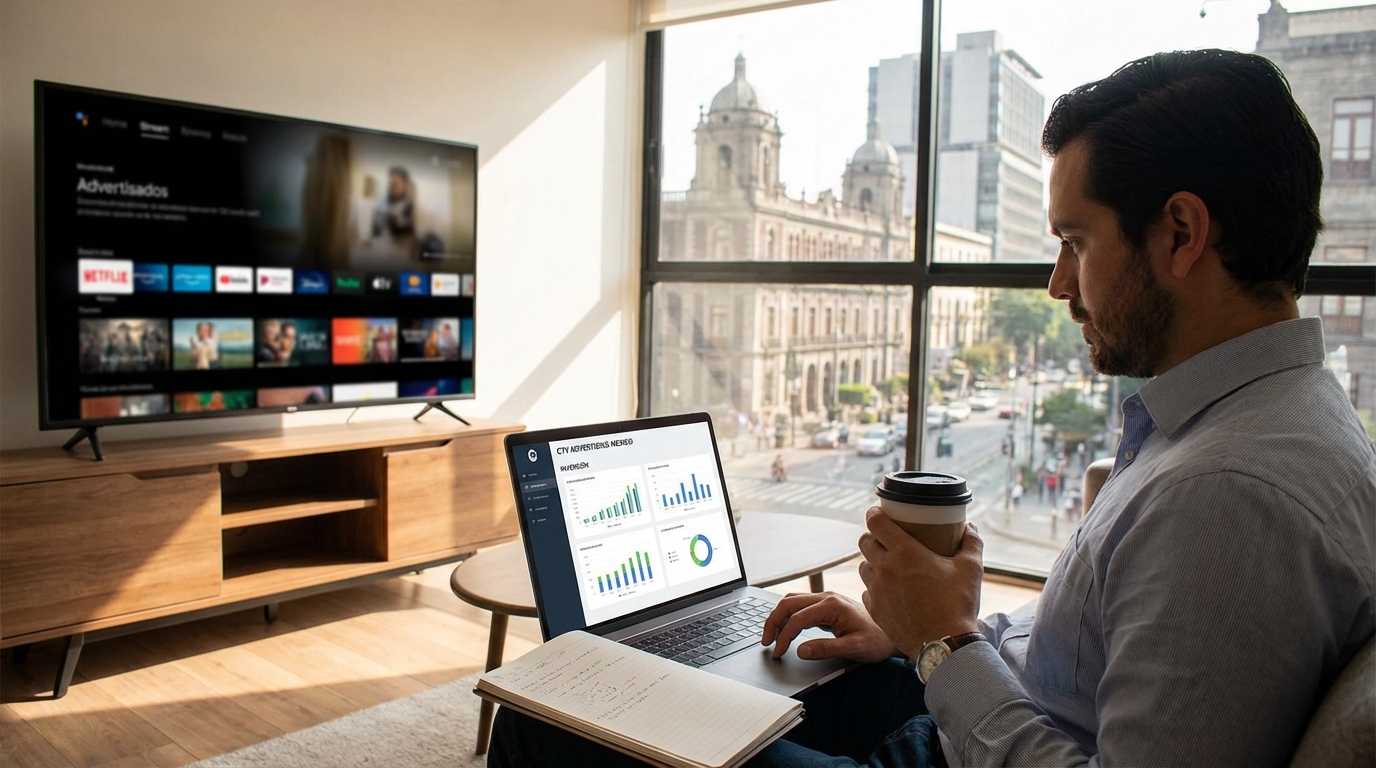
Most SMEs and local businesses still think that "being on TV" is only for big brands. However, while total advertising investment in countries like Spain reached 33.481 billion euros in 2024, with a 4.8% growth compared to the previous year and accounting for 2.1% of GDPaccording to the 15th AMES Report, an increasing portion of that money is moving toward more flexible and accessible formats, such as streaming TV and CTV. This opens a huge door for businesses that previously saw TV as a distant dream.
Why TV remains key, even with small budgets
Although the digital world continues to grow, television—in all its versions—remains one of the media with the greatest emotional impact and recall. An ad on a big screen, with good audio and in an entertainment context, achieves a level of attention that few formats can match. That combination of audiovisual format and relaxed consumption habits makes TV a powerful tool for building a brand.
The reality is that "television" is no longer just the traditional broadcast signal. Today it includes cable, streaming platforms, and connected TV (CTV). In fact, global investment in digital video advertising surpassed television advertising for the first time in 2022, and the gap is expected to continue growing in the coming yearsaccording to Statista data. For those with a small budget, this is good news: digital video and CTV usually offer buying models that are more flexible and offer much more precise targeting.
While big brands fight for the best spots during massive events and prime time, smaller businesses can take advantage of connected TV and streaming spaces to appear exactly in front of their ideal audience, paying only for the views or impressions that actually matter to them. That is the key to making TV stop being "expensive" and start being a manageable investment.
Types of television and which one suits you if you are budget-conscious
Not all "TV screens" cost the same or work the same way. Understanding the differences helps you choose the most profitable combination for your business, rather than trying to be everywhere. The idea is not to copy what big brands do, but to use TV strategically and adapt it to your size and goals.

The main decision involves three options: traditional television (broadcast and cable), streaming television (platforms like Netflix, Pluto TV, etc.), and connected TV/CTV (content watched on smart TVs or connected devices, where ad space is purchased programmatically). Each has distinct advantages in reach, targeting, and cost per impact.
Traditional television: when it still makes sense
Broadcast and cable TV remain useful for campaigns seeking massive reach in a short time, for example, national launches or promotions that apply to many points of sale. A 2018 academic study found that traditional national ads increase perceived quality, perceived value, and recent consumer satisfactionaccording to this analysis of campaigns in the United States. In other words, seeing a brand "on regular TV" still conveys seriousness and trust.
The problem for an SME is that buying spots on traditional TV usually involves fixed packages, negotiations with intermediaries, and higher investment commitments. That doesn't mean it's off-limits for small businesses, but it is only advisable to enter when there is a clear reason: for example, a very strong local promotion in a city where a regional channel has a large audience.
Streaming and on-demand platforms: the TV you choose to watch
The big shift is in how people consume content. In Spain, for example, six out of ten households access streaming services, with Netflix dominating the marketaccording to recent data on the “streaming wars”. In Latin America, the trend is very similar: more and more people are watching series, movies, and channels online, whether on their living room TV or other devices.
For a business with a limited budget, the advantage of streaming is clear: many of these ad spaces are purchased digitally, using pay-per-impression or pay-per-view models, and with much finer targeting. You no longer need to pay for an entire channel's audience; you can reach only users in specific areas, with certain interests or consumption habits.
Connected TV (CTV): television with a digital brain
CTV combines the best of both worlds: the visual impact of the big screen and the targeting and measurement capabilities of digital advertising. Your ads appear on streaming platforms and free ad-supported channels, but they are bought programmatically, just like a social media campaign, only with TV-quality standards.
This is where self-service platforms specialized in Streaming TV, such as Masha, are particularly interesting for Mexico and Latin America. They allow an SME to enter connected TV without intermediaries, without long-term contracts and without hard-to-reach minimum investments. Everything is configured online, with a simple interface designed for people who are already used to managing campaigns on social networks or search engines.
Concrete strategies to maximize your TV budget
Choosing the right type of TV is just the first step. True efficiency comes from how you plan the campaign, how you segment, and how well you monitor the results. The good news: almost everything learned in digital marketing can be applied to connected TV and streaming video.
If every dollar counts, the goal is not just to “be on TV,” but to ensure that presence translates into more visits, more leads, or more sales. This is achieved by combining good targeting, clear messaging, and constant measurement to make adjustments along the way.
Segment as if it were a digital campaign
One of the biggest advantages of CTV and streaming is that they allow for targeting beyond age and gender. You can define your audience by geographic location, interests, the type of content they consume, or even the frequency with which they watch certain genres. For a local business, this means stopping the payment for an entire country and focusing on the cities or areas where you actually make sales.
Instead of buying a generic package on a channel, a more economical strategy is to invest in specific audiences: for example, people who watch food and lifestyle content in certain cities if you are a restaurant, or users interested in sports and technology if your business sells electronics. Fine-tuned targeting reduces waste and increases the chances that each impression generates real interest.
The right message: simple, clear, and memorable creative
When the budget is limited, the ad's creativity has to work twice as hard. You don't need a super-production for a spot to work; what you need is a clear message, a concrete value proposition, and an easy-to-remember call to action. Often, a simple video that shows the customer's problem and how the product solves it works better than an over-produced ad.
An effective approach for small businesses is to combine three elements: show the brand and what it does in the first few seconds, highlight a key benefit (time savings, convenience, proximity, trust), and close with a direct call to action (visit a website, scan a QR code, call, or send a message). The simpler it is to understand, the easier it is for the audience to remember what to do after seeing the ad.
Combine traditional TV, CTV, and digital video intelligently
It’s not about choosing “only traditional TV” or “only digital.” Many brands achieve better results by mixing a bit of mass reach with highly targeted campaigns on CTV and digital video. In fact, projections indicate that television advertising spending in the United States will fall by 9.3% between 2023 and 2027, with an annual reduction of 5.6 billion dollars during that periodaccording to estimates by Publift. That money doesn't disappear: it migrates to digital video and CTV formats.
For an SMB, this means there is more inventory available on connected platforms and the pressure from big brands on certain traditional television slots could decrease. An efficient strategy can be to use traditional TV only at key moments (for example, very specific brand campaigns) and maintain a constant presence on CTV and streaming, where costs per impression are usually more manageable and targeting allows for better refinement.
Streaming TV and CTV: how to do affordable television in practice
The theory sounds good, but what matters is how to put it into practice. The advantage of streaming and connected television is that you no longer need a huge agency or relationships with traditional media to get started. There are self-service platforms designed specifically for SMBs and small agencies in Latin America, which allow you to create streaming TV campaigns almost as easily as you create a social media campaign.
In a context where digital marketing spending grew by 5.6% in 2024 to reach 4.342 billion euros, with a significant weight of internet advertising—sponsored links, corporate websites, and social media—according to the same AMES report, the next natural step is to add connected TV to that digital mix. This way, you take advantage of changing consumption habits without losing the visual power of television.
Advantages of using a self-service platform for Streaming TV
A platform like Masha, focused on democratizing access to advertising on Streaming TV and CTV in Mexico and Latin America, lowers many of the traditional barriers. Instead of relying on an intermediary, you can choose the cities or states where you want to appear, define your target audience by interests and viewing habits, upload your video, and activate the campaign in a few steps.
Among the most important advantages for someone watching their budget are: no long-term contracts required, the ability to start with small and flexible investments, and offering real-time metrics. Having a dashboard where you can see how many times the ad has been shown, which platforms it appeared on, and how the exposure frequency behaves helps you quickly adjust the campaign, pause it if something isn't working, or reinforce the audiences that respond best.
How to structure your first streaming TV campaign on a budget
To maximize budget performance, it is best to start simple but well-thought-out. First, define a clear objective: do you want more people to know your brand in your city, visit your website, or take advantage of a specific promotion? That objective will guide the type of creative, the length of the ad, and the targeting.
A practical outline for a first affordable campaign could be the following: focus on a few key geographic areas (for example, the neighborhoods where you already have the most customers), choose streaming platforms with good penetration in your market, and limit the number of creative versions so as not to spread the budget too thin. Then, frequently review the metrics on the self-service platform to detect which segments work best and redirect spending toward them.
Measuring results and optimizing: the real trick to making TV affordable
The difference between an "expensive" TV campaign and a "profitable" one often lies in measurement. In the digital space, SMBs are already used to tracking clicks, conversions, and cost per result. The good news is that this same logic can be applied to CTV and streaming, even if the metrics change slightly (completed views, exposure frequency, effective reach within the target audience).
An IAB Spain report showed that 70% of SMBs in Spain believe digital advertising helps them acquire new customers, compared to a 54% average in Europeaccording to this study on European SMBs. That confidence comes precisely from the ability to measure and optimize. Bringing that mindset to Connected TV advertising—testing, measuring, and adjusting—is what ultimately stops TV from being a luxury and turns it into just another channel within your digital strategy.
How to start doing affordable TV advertising for your business today
Uncertainty in traditional media, fueled by global factors such as tariffs, wars, or economic instability, is pushing many brands to rethink their investment strategiesas warned by the 15th AMES Report from the Spanish Marketing Association. For SMBs and local businesses, this can be an opportunity: while large companies shift budgets around, smaller players can occupy new spaces in CTV and streaming with highly focused strategies.
Taking the first step doesn't have to be complicated. A simple path is: define a concrete goal, prepare a clear and honest video about your value proposition, choose a self-service platform specializing in Streaming TV that operates in your country, segment by areas where you can actually meet demand, and activate a test campaign with a budget you are comfortable with. Then, with metrics in hand, decide whether to scale or adjust.
Television is no longer an exclusive club for large corporations. With the right CTV and Streaming TV tools, any business currently investing in social media or search can make the leap to the big screen without breaking the bank. The key is to think like a digital marketer: segment well, measure everything, and optimize constantly. That is where television advertising stops being a high expense and becomes a smart investment.
Convinced that television is the next step for your business but worried about the costs? With Masha, you can leave those worries behind. Our platform transforms how SMBs in Mexico access TV advertising, allowing you to launch streaming TV campaigns starting from just $2,000 MXN. Sign up in less than 5 minutes, choose your streaming platforms, segment your audience, and monitor your results in real time, all with a starting price of $0.01 per view. Ready to launch your first TV campaign? Masha is here to make television advertising easy, accessible, and effective for your business.