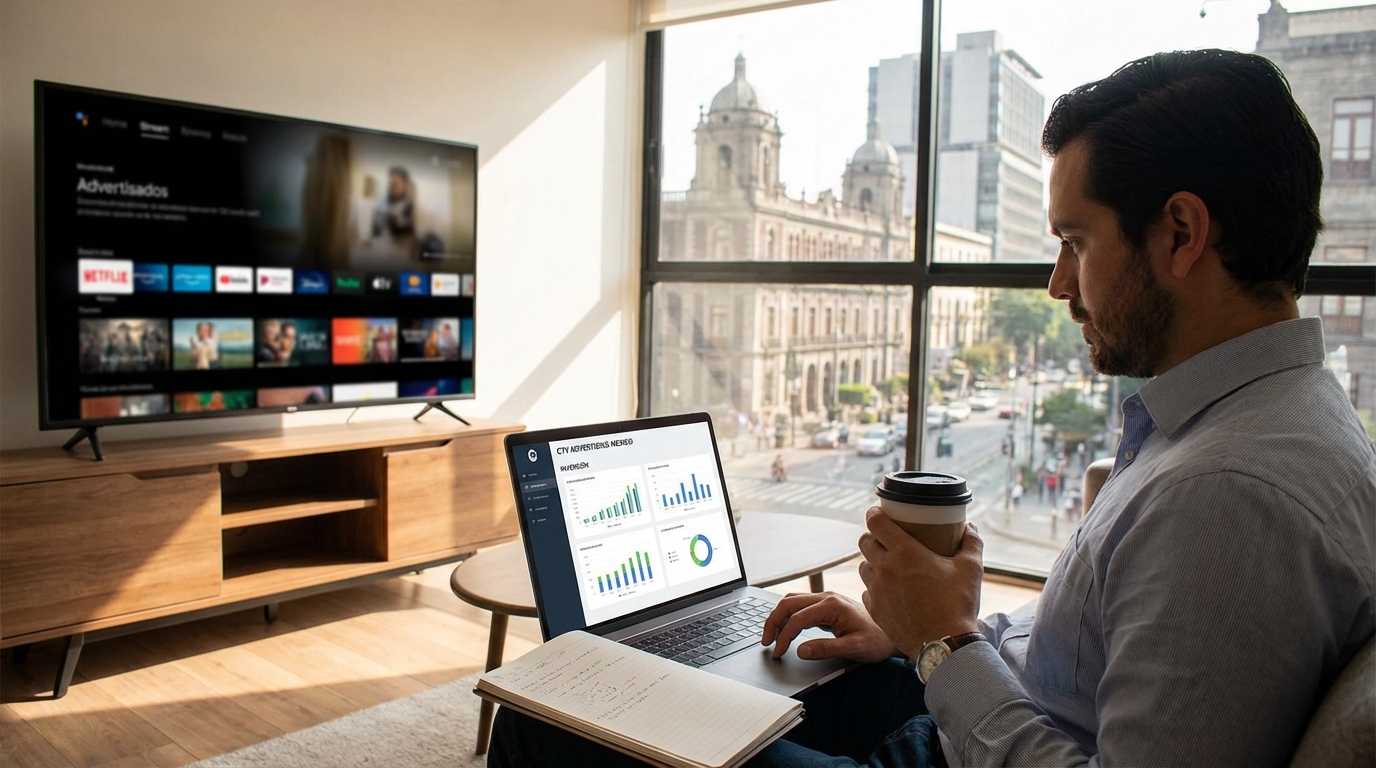
The paradigm shift: From traditional television to streaming
Just five years ago, if a digital agency wanted to include television in its media mix, the conversation ended quickly. Entry costs were prohibitive, contracts were rigid, and measurement was practically an act of faith. Today, that reality has changed completely, and many mid-sized agencies still haven't caught on.
Streaming TV advertising is cheaper than you think, and that is not an empty promise. The numbers back it up: while a 30-second spot on broadcast television during prime time can cost between 150,000 and 500,000 Mexican pesos for a single airing, CTV platforms allow you to start campaigns from 2,000 pesos. The difference is not marginal; it is transformative.
Streaming is no longer the future; it has become the dominant present of audiovisual consumption in Mexico. According to data from IAB Mexico, more than 70% of Mexican households with internet access regularly consume content on streaming platforms. This means your audience has already migrated, and continuing to invest exclusively in traditional media is like putting up billboards on abandoned highways.
The interesting thing is that this change doesn't just benefit big brands. For the first time, mid-sized businesses and boutique agencies can access the same premium inventory that was previously reserved for corporations with million-dollar budgets. The democratization of television media has finally arrived.
Demystifying the costs of Streaming TV advertising
The perception that advertising on television requires huge budgets comes from decades of a closed and opaque model. Traditional broadcasters operated like exclusive clubs where only those who could pay the full cover charge got in. Streaming has changed the rules of the game.
The current reality is that you can launch a CTV campaign with the same budget you would allocate to a mid-sized Facebook Ads campaign. I am not exaggerating. The barriers to entry have practically disappeared, and what used to require weeks of negotiation can now be set up in minutes.
Buying models: CPM vs. traditional fixed investment
In traditional television, you buy airtime without any real guarantee of who will see your ad. You pay for the possibility of reaching your audience, not for actually reaching them. It’s like renting a billboard and hoping the right people drive by.
The CPM model in streaming TV works completely differently. You pay for every thousand impressions effectively delivered to your target segment. If your ad isn't shown, you don't pay. It’s that simple. CPMs on CTV platforms in Mexico range between $80 and $250 pesos, depending on the targeting and the inventory selected.
This difference has profound implications for media planning. With a budget of $50,000 pesos in traditional television, you barely buy a couple of spots in off-peak hours. That same budget in CTV can generate between 200,000 and 600,000 highly targeted impressions. The efficiency is incomparable.
Accessibility for small and medium-sized businesses
For years, Mexican SMEs were excluded from the television medium. Not for lack of interest, but due to insurmountable structural barriers: six-figure minimum investments, mandatory annual contracts, and purchasing processes that required specialized intermediaries.
Platforms like Masha have completely eliminated these barriers. You can register in less than five minutes, set up a campaign in ten clicks, and launch it the same day. No long-term contracts, no prohibitive minimum investments, and prices starting at $0.01 per view. This isn't just marketing; these are the actual conditions of today's market.
For a digital agency managing mid-sized client accounts, this opens up possibilities that were previously unthinkable. Now you can include streaming television in proposals for local restaurants, law firms, private schools, or any business you previously considered out of reach for this medium.
Factors that determine your campaign pricing
Not all CTV campaigns cost the same, and understanding which variables affect the price will help you optimize your budget. The good news is that you have control over most of these factors.
Premium inventory on recognized platforms like Pluto TV or Roku has higher CPMs than inventory on lesser-known apps. However, the price difference is usually justified by better audience quality and safer environments for your brand. The cheapest option isn't always the most effective.
Advanced targeting and its impact on the budget
Targeting is where CTV truly shines compared to traditional television. You can define your audience by specific geographic location, interests, consumption habits, and even the type of content they prefer to watch. This precision comes at a cost, but it also dramatically reduces waste.
A campaign targeting men aged 25 to 45 interested in sports in Mexico City will have a different CPM than a mass campaign without targeting. More specific targeting generally implies higher CPMs, but also significantly better conversion rates.
The trick is to find the right balance. Over-segmenting can reduce your reach to impractical levels and unnecessarily drive up the cost of the campaign. Under-segmenting wastes impressions on irrelevant audiences. Experience will show you the sweet spot for each type of client.
For agencies managing multiple accounts, it is worth documenting which targeting combinations work best for each industry. A Japanese restaurant in Guadalajara has very different needs than an English school in Monterrey.
Ad formats: From pre-roll to pause ads
Your ad format also influences the cost and effectiveness of the campaign. Pre-roll ads, which appear before the content, usually have the highest completion rates because the viewer is committed to watching the content that follows.
Mid-roll ads interrupt the content and can create some friction, but they also capture the attention of viewers already hooked on what they are watching. Pause ads are an interesting option because they appear when the user has actively paused the content, which implies they are paying attention to the screen.
Duration also matters. 15-second spots are more economical than 30-second ones, but they don't always tell your full story. For awareness messages, 15 seconds may be enough. To explain a more complex product or service, you will need more time.
A little-known advantage is that some platforms allow you to create ads directly within their interface using generative AI tools. This significantly reduces production costs, which historically represented another major barrier to accessing television as a medium.
Return on Investment: Why every dollar goes further in digital
The most compelling argument for streaming advertising isn't just the lower barrier to entry, but the superior return generated by every dollar invested. The combination of precise targeting, real-time measurement, and continuous optimization creates an ecosystem where advertising efficiency reaches levels impossible in traditional media.
When you compare the effective cost per result, not just the cost per impression, CTV often outperforms established digital channels like display or even social media video. The consumption context matters: seeing an ad on a big screen while enjoying your favorite series makes a greater impact than seeing it on a phone while mindlessly scrolling.
Real-time results measurement
In traditional television, your campaign results arrive weeks later through audience studies based on statistical samples. Essentially, you are flying blind throughout the entire campaign and only find out if it worked once it’s already over.
CTV operates completely differently. From the moment your campaign is live, you can see metrics in real time: impressions delivered, completion rates, frequency per user, and geographic distribution. This visibility allows you to make informed decisions while the campaign is still running.
If you detect that a certain segment is responding better, you can reallocate budget toward that group. If a specific format has low completion rates, you can pause it and test alternatives. This agility was unthinkable just a few years ago and represents a huge competitive advantage for agencies that know how to leverage it.
Reducing impression waste
Advertising waste in traditional television is legendary. Industry studies estimate that between 40% and 60% of impressions on broadcast TV reach people outside the defined target. You are paying to reach people who will never buy your product.
In CTV, targeting dramatically reduces this waste. It doesn't completely eliminate off-target impressions, but it minimizes them to levels that traditional television simply cannot match. When you pay only for impressions delivered to your target audience, every dollar works harder.
This efficiency has a compounding effect. Less waste means you need a smaller budget to achieve the same results. A smaller required budget means more clients can access the medium. More clients in the medium means more data to optimize future campaigns. It is a virtuous cycle that benefits everyone in the ecosystem.
Leading platforms and entry options
The CTV ecosystem in Mexico includes several platforms with different features and audiences. Knowing the options will help you recommend the right mix for each client.
Pluto TV has positioned itself as a popular option due to its ad-supported free model, which attracts massive audiences. Roku offers access to multiple streaming apps and has a loyal user base that consumes content regularly. Other platforms like Samsung TV Plus and Vix also represent valuable inventory depending on the audience profile you are looking for.
Market fragmentation can seem complicated, but unified buying platforms simplify the process. Instead of negotiating with each platform individually, you can access inventory from multiple sources through a single interface. Masha, for example, allows you to plan, create, and launch campaigns across various premium streaming platforms without the need for intermediaries or lengthy negotiations.
For agencies just starting to explore CTV, my recommendation is to begin with one or two platforms, learn how your audience responds, and gradually expand to other options. Don't try to cover the entire ecosystem from day one.
Strategies to maximize your Streaming TV budget
Having access to CTV is only the first step. Maximizing your return on investment requires strategy and continuous learning. These are the tactics that consistently generate the best results.
First, define clear objectives before setting up any campaign. Are you looking for awareness for a new brand? Consideration for a specific product? Traffic to a landing page? Each objective requires different settings for targeting, frequency, and campaign duration.
The optimal frequency varies depending on your goal, but generally, you want each user to see your ad between 3 and 7 times during the campaign period. Fewer than 3 exposures rarely generate sufficient recall. More than 7 can lead to ad fatigue and negative associations with your brand.
Test different creatives from the start. Don't assume you know which message will resonate best with your audience. Launch at least two or three different versions and let the data tell you which one works. Modern platforms make these A/B tests easy, without technical complications.
Consider the seasonality of your industry. CPMs tend to rise during peak seasons like Black Friday, Christmas, and back-to-school because more advertisers are competing for the same inventory. If your product isn't seasonal, taking advantage of off-peak times can give you significantly greater reach with the same budget.
Finally, don't treat CTV as an isolated channel. Integrate your streaming campaigns with the rest of your digital strategy. A user who saw your ad on television and then sees a retargeting ad on social media is much more likely to convert than one exposed to only a single channel.
Streaming TV advertising is no longer a luxury reserved for large corporations. With platforms that allow you to start from $2,000 pesos, with no contracts or minimum investment requirements, any agency can add this medium to their arsenal. If you want to explore how it works in practice, platforms like Masha allow you to create your account in minutes and launch your first campaign the same day. The time to experiment with CTV is now, while many competitors still believe that television is out of their reach.