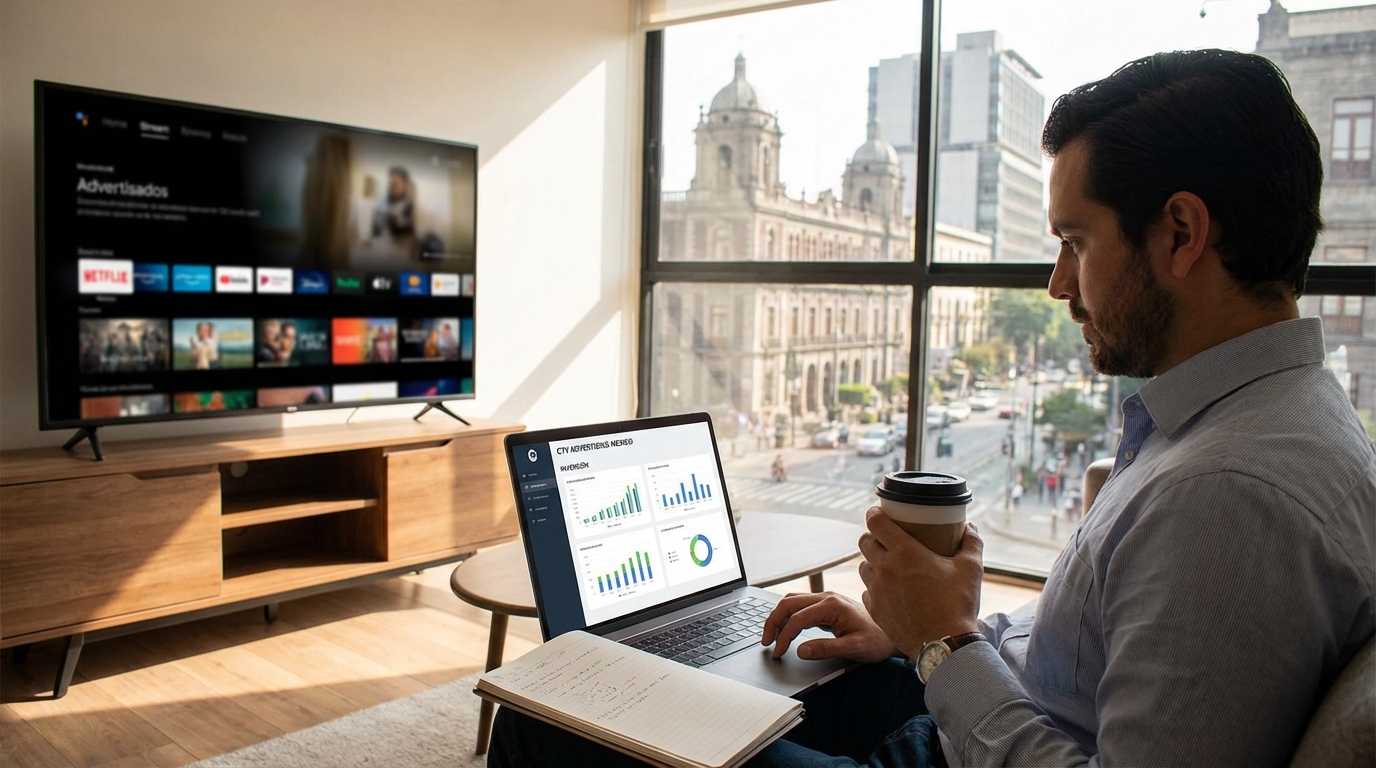
The New Landscape of Streaming TV and Real-Time Measurement
Advertising on traditional television worked for decades under an uncomfortable premise: you invested large amounts of money and hoped for results. There was no way to know for sure how many people actually saw your ad, let alone if they took any action afterward. That model is obsolete. Connected TV has completely transformed the equation, and live metrics have become the deciding factor for maximizing ROI in streaming TV.
What once required weeks of post-campaign analysis now happens in real time. You can see exactly how many people completed your video, at what point they stopped watching, and what actions they took afterward. This transparency changed the game for businesses of all sizes, especially for SMBs that cannot afford to waste budget on strategies that don't work. The ability to adjust campaigns on the fly, optimize targeting, and redistribute budget based on actual performance represents a competitive advantage that simply didn't exist five years ago.
Key differences between traditional television and streaming
Broadcast and cable television operate on audience estimates based on statistical samples. A measurement company selects representative households, installs monitoring devices, and extrapolates that data to the total universe of viewers. The problem is clear: you are making investment decisions based on approximations, not real data from your target audience.
Streaming works in a completely different way. Each ad impression generates specific data on the device, geographic location, exact time of viewing, and subsequent user behavior. There are no estimates or extrapolations: you have concrete information about every person who saw your ad. This difference seems technical, but its practical implications are enormous for any business that wants to measure the real impact of its advertising investment.
Targeting also operates on another level. While traditional TV allows you to choose time slots and channels with general demographic profiles, streaming allows you to target specific audiences by interests, consumption habits, precise location, and digital behavior. A restaurant in Guadalajara can show its ad exclusively to people within a 15-kilometer radius who have shown an interest in gastronomy, something impossible on conventional television.
Why live metrics are the engine of modern ROI
Real-time metrics eliminate the uncertainty factor that has always accompanied television advertising. When you can see your campaign's performance while it's active, you have the ability to correct errors before they turn into significant losses. An ad that isn't generating engagement can be modified or paused immediately, while one with good performance can receive more budget.
This capacity for continuous optimization directly impacts return on investment. Instead of waiting until the end of a campaign to discover what worked and what didn't, you can iterate constantly. Live data shows you patterns that would otherwise go unnoticed: perhaps your ad performs better on Tuesday nights, or your audience in Monterrey responds more than the one in Mexico City. With that information, you redistribute resources toward what generates results.
Access to live metrics also democratizes TV advertising. Previously, only large corporations could afford the risk of television campaigns because they had the budget to absorb losses. Now, a small business can start with minimal investments, measure real results, and scale only when it proves the strategy works.
Essential KPIs to Evaluate Success in Streaming
Not all metrics carry the same weight. Some indicators provide a superficial view of performance, while others reveal the true impact of your investment. Knowing the difference between these two types of KPIs is essential for making informed decisions and avoiding the trap of vanity metrics that look good in reports but don't translate into business results.
Reach and effective frequency metrics
Reach measures how many unique people saw your ad at least once. It is a basic but crucial indicator for understanding the scale of your campaign. However, reach alone doesn't tell the whole story. A campaign might reach a million people, but if each one only saw the ad once in passing, the actual impact will be limited.
This is where effective frequency comes in: the number of times a person needs to see your message for it to generate recall and action. Advertising effectiveness studies suggest that the optimal frequency varies by objective, but generally ranges between three and seven exposures. Fewer than three times may be insufficient to generate recall; more than ten can lead to ad fatigue and a negative brand perception.
The balance between reach and frequency depends on your specific goals. If you are looking for awareness for a launch, prioritize broad reach. If you want to drive conversions for a known product, focus on frequency with more segmented audiences. Streaming platforms allow you to control both variables with precision, something traditional television never offered.
Video Completion Rate (VTR) and engagement
The video completion rate, known as VTR, measures what percentage of viewers watched your ad in its entirety. This indicator is particularly revealing because it distinguishes between a served impression and an effective impression. It is not the same for someone to watch the first three seconds of your spot before getting distracted as it is to hold their attention for the full thirty seconds.
A healthy VTR in streaming TV generally exceeds 85%, significantly higher than other digital formats like pre-roll on YouTube or social media videos. This difference is due to the nature of consumption: when someone is watching content on their TV, the experience is more immersive and ad interruptions are perceived similarly to traditional TV.
Engagement goes beyond full viewing. It includes actions such as website visits after seeing the ad, brand searches, social media interactions, and, eventually, conversions. Connecting these dots requires proper attribution tools, but the information they provide is invaluable for understanding the true impact of your investment.
Direct attribution and post-impression conversion
Attribution is likely the most complex and important aspect of measurement in streaming TV. It is about connecting ad exposure with concrete consumer actions. When someone sees your ad on Pluto TV and three days later visits your website and makes a purchase, how do you know that conversion was influenced by the ad?
There are several attribution methods. Direct attribution occurs when the user interacts immediately with the ad, for example, by scanning a QR code or visiting a specific URL mentioned in the spot. Post-impression conversion is more subtle: it tracks users who were exposed to the ad and subsequently took an action, even without direct interaction.
Attribution windows also matter. A seven-day window will capture different conversions than a thirty-day one. The choice depends on your sales cycle: fast-moving consumer goods can use short windows, while services with longer decision-making processes require extended windows to capture the true impact of the advertising.
In-flight optimization strategies
The real advantage of streaming over traditional TV is not just in the measurement, but in the ability to act on that data while the campaign is still active. This real-time optimization can mean the difference between a profitable campaign and one that consumes budget without generating results.
Real-time bidding and segmentation adjustments
Streaming TV platforms operate on programmatic buying models where the price per impression fluctuates based on demand, available inventory, and competition for specific audiences. This means you can adjust your bids based on observed performance. If certain audience segments are generating a better ROI, it makes sense to increase your bid to secure more impressions within that group.
Segmentation can also be refined on the fly. Perhaps you started your campaign targeting adults aged 25 to 45 interested in technology, but the data shows that the 35 to 45 group is responding significantly better. You can adjust your targeting to focus resources on that more receptive subgroup.
Geographic adjustments are equally valuable. If your campaign covers all of Mexico but certain cities show higher conversion rates, redistributing your budget toward those areas maximizes your return. This flexibility was unthinkable in traditional TV, where you bought airtime and hoped for the best.
A/B testing applied to dynamic creatives
A/B testing in streaming TV allows you to compare different versions of your ad to identify which one generates better results. You can test variations in the message, the call to action, visual elements, or even the length of the spot. The platform distributes the different versions among comparable audience segments and measures the performance of each.
The key is to test one variable at a time. If you change the message, colors, and music simultaneously, you won't know which element drove the difference in performance. Controlled tests with specific changes provide actionable insights to optimize future creatives.
Dynamic creatives take this a step further. They allow you to personalize ad elements based on the viewer: showing different products based on location, adapting the message based on the time of day, or including specific offers for different segments. This personalization increases relevance and, consequently, engagement and conversions.
Calculating ROI: From Ad Spend to Real Profitability
Return on investment in advertising seems like a simple calculation: divide the revenue generated by the cost of the campaign. In practice, determining which revenue was actually generated by the advertising requires more sophisticated methodologies, especially when multiple channels contribute to the final result.
Multi-channel attribution models in video campaigns
Most consumers interact with a brand through multiple touchpoints before making a purchase. They might see your ad on streaming, then search for you on Google, visit your social media, and finally buy after receiving a promotional email. Which channel gets the credit for that conversion?
The last-click model attributes the entire conversion to the final touchpoint, but this underestimates the role of channels that generate initial awareness. The first-click model does the opposite, ignoring the influence of subsequent interactions. Linear models distribute credit equally among all touchpoints, while time-decay models give more weight to interactions closer to the conversion.
For streaming TV campaigns, a position-based model is usually more appropriate. It assigns more credit to the first and last touchpoints, recognizing both the value of generating awareness and closing the conversion, while distributing the rest among intermediate interactions.
Analyzing Customer Lifetime Value (LTV) acquired via streaming
Immediate ROI doesn't tell the whole story. A customer acquired through streaming advertising may have a significantly higher long-term value than their first purchase. Customer Lifetime Value, or LTV, projects how much that customer will generate throughout their entire relationship with your business.
Calculating LTV requires historical data on customer behavior: purchase frequency, average ticket size, retention rate, and contribution margin. With these elements, you can estimate the present value of future revenue that each new customer will generate.
When you incorporate LTV into your ROI calculation, campaigns that seemed marginally profitable can reveal themselves as highly valuable. An acquisition cost of 500 pesos might seem high for a first purchase of 300 pesos, but if that customer has a projected LTV of 5,000 pesos, the investment is clearly profitable.
Technological tools for data transparency
Effective measurement requires the right technological infrastructure. Streaming TV platforms provide dashboards with basic metrics, but maximizing ROI generally requires integrating these tools with your existing tech stack.
Conversion pixels allow you to track actions on your website and connect them to ad exposures. Integration with your CRM helps you understand what type of customers you are acquiring and how they compare to other channels. Business intelligence tools can consolidate data from multiple sources to create a unified view of performance.
Platforms like Masha offer live metrics directly within their interface, allowing you to monitor your campaign's success in real time without the need for complex technical configurations. This accessibility is particularly valuable for businesses that do not have dedicated analytics teams.
Data transparency also means understanding exactly where your ads appear. The best platforms allow you to see which apps and content served your impressions, giving you control over brand safety and contextual relevance.
Future Trends in Digital Audience Measurement
The measurement ecosystem is evolving rapidly. Privacy regulations are limiting the use of cookies and other traditional identifiers, driving the development of measurement solutions based on aggregated data and statistical modeling. Platforms are investing in technologies that preserve user privacy while maintaining the ability to measure advertising effectiveness.
Artificial intelligence is transforming campaign optimization. Algorithms can analyze patterns in large volumes of data to predict which combinations of audience, creative, and timing will generate the best results. This intelligent automation enables optimizations that would be impossible to execute manually.
Cross-device measurement is also maturing. Consumers view content on multiple screens, and connecting those experiences to understand the full journey is becoming increasingly feasible. Platforms that succeed in unifying the user view across devices will offer significant advantages in attribution and optimization.
For businesses looking to take advantage of these opportunities without the hassle, platforms like Masha simplify the process. With just 10 clicks, you can launch your campaign on top TV and music apps, with investments starting at $0.01 per view and live metrics to monitor