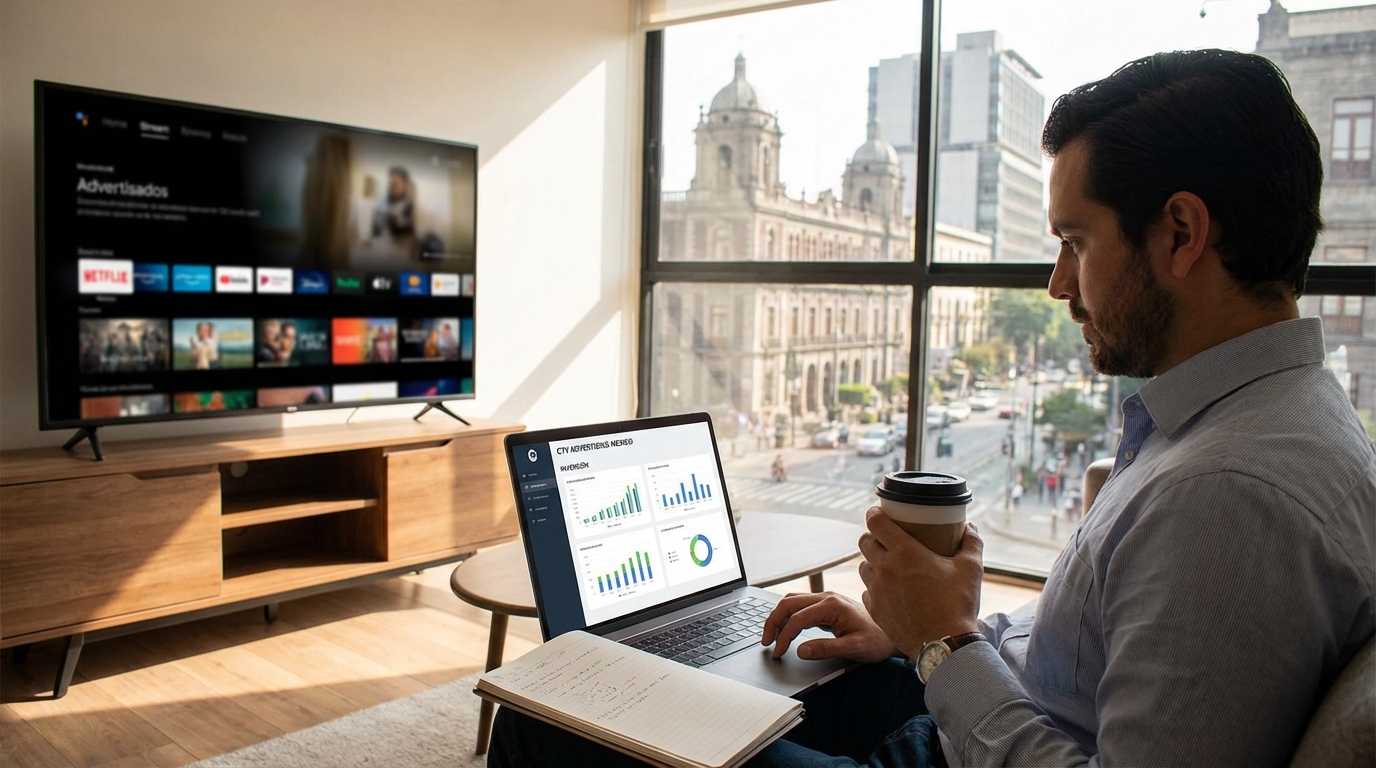
In Mexico, there are still brands that sign off their campaigns with a very clear phrase: “if I’m not on TV, I don’t exist.” And the truth is, they aren’t that far from reality. Total advertising investment in the country has been growing for three consecutive years, exceeding 134 billion pesos in 2023, with digital advertising leading that momentum, according to recent data from the Mexican market. Amidst this digital boom, television—in all its forms—remains a strong pillar within the media mix.
The question is no longer whether TV is “dying,” but what role it should play today alongside connected TV, streaming, and online advertising. Audiences have changed their habits, but they haven’t stopped watching content on big screens. It’s just that now they do so by jumping between broadcast channels, cable systems, streaming apps, and ad-supported platforms.
For anyone making marketing decisions in Mexico, understanding this new television ecosystem is key: how much traditional TV contributes, how strong CTV (Connected TV) is becoming, and how to combine them with digital to generate real results, not just pretty GRPs in a presentation.
Current landscape of TV advertising in Mexico
The Mexican advertising market is in a phase of sustained expansion. Total investment is growing, and the digital segment is accelerating the fastest, with a 14% increase in 2023, driven primarily by video and search formats, which grew by 15% in the same period, according to a report on digital advertising investment growth. This changes the conversation: television’s competition is no longer just “another channel,” but an increasingly sophisticated digital ecosystem.

In this context, TV remains a high-reach medium, ideal for building quick awareness and brand positioning. Major launch campaigns, massive events, key seasons (Christmas, World Cup, elections), and mass-market consumer products continue to find a strategic ally in the home’s big screen, only now it shares the spotlight with other devices.
It is also important to understand that “television” no longer means just broadcast signals. Today, the term encompasses broadcast TV, pay TV (cable, satellite), and everything that happens on internet-connected screens: streaming apps, FAST channels, platforms with hybrid models (subscription + ads), and more. This mix requires media planners to think less about isolated “channels” and more about the “screens” that accompany the user throughout the day.
Broadcast and pay TV: is it still a good bet?
The weight of TV in the media mix
Although digital investment is growing strongly, broadcast and pay TV still account for a significant portion of the advertising pie. In 2022, TV as a whole received about 40% of total advertising spending in Mexico, a drop of nearly four percentage points compared to the previous year, according to investment distribution statistics by medium. The share is adjusting, but its weight remains very high compared to other channels.
That data sends a clear message: traditional TV is no longer growing at its previous pace, but it isn’t disappearing either. Rather, it is repositioning itself within the media mix, forcing brands to use it more strategically: choosing moments more carefully, negotiating more intelligently, and combining it with digital to squeeze every last rating point.
Strengths that traditional TV maintains
Broadcast and pay TV retain attributes that other media struggle to match. Their ability to generate massive, real-time conversation—a reality show premiere, a soap opera finale, a decisive match—remains a magnet for campaigns seeking cultural impact and rapid awareness. Furthermore, for many segments of the population, broadcast TV continues to be the primary source of entertainment and information, especially outside of major cities.
Another point in its favor is credibility. Many consumers still perceive that "if a brand is on TV, it’s serious," which isn't always the case with what appears on social media. For this reason, for the third consecutive year, broadcast TV has shown growth in investment and is solidifying its position as an important piece of advertising strategies, especially for advertisers who need to strengthen brand reputation and national presence.
There are also advances in formats: sponsorships integrated into content, segments, live mentions, experiences with on-screen talent, and packages that include presence on the broadcasters' digital platforms. All of this helps TV move beyond being seen as just "20-second spots" and become a more flexible communication platform.
Connected TV (CTV): From the living room to performance
The streaming boom on big screens
Connected TV is no longer a promise; it is now an established habit in Mexican households. 65% of internet users in Mexico regularly access streaming content from their smart TVs, according to an analysis on how Mexico leads in Connected TV usage. This means that a good portion of long-form video consumption is moving toward connected platforms, but on the same screen that has always been in the living room.
For advertisers, this transition opens up very interesting possibilities. You are no longer just buying "programs" or "channels," but audiences defined by interests, behaviors, and more precise demographic data. You can target by content type, time of day, specific audiences, and even segments built with first- or third-party data, all within the TV screen.
How users react to advertising on CTV
The other good news is that advertising on CTV is not just seen; it also generates action. 39% of connected TV viewers in Mexico state that they learn about new products after seeing an ad, and 37% say they search online for the product they saw on screen, according to a study on consumption habits and attitudes toward ads on CTV. In other words, CTV doesn't just build branding; it also drives traffic and immediate interest.
This behavior makes CTV a very powerful middle ground between traditional television and digital performance. You get the visual impact of the big screen, with the ability to better measure, optimize campaigns, control frequency, and link results to business indicators. It is no longer just about "being on connected TV," but about designing creative assets tailored to that context: agile pieces, clear messages from the first few seconds, and calls to action that invite users to scan a QR code, search for a brand, or visit a website.
When combined well with search and social campaigns, CTV acts as an intent trigger. The user sees the ad in the living room, picks up their phone, and within seconds, is browsing the brand's site or e-commerce store. That is where it is worth aligning branding and performance teams to leverage the full potential of this screen.
Integrating TV, CTV, and digital: practical strategies
Defining the role of each screen
Before thinking about formats and rates, it is helpful to be clear about the role each screen will play within the strategy. Broadcast TV is ideal for gaining massive reach in a short time and building brand recall. Pay TV allows you to reach specific niches or audiences with a certain socioeconomic level, thematic affinity, or geographic location. CTV adds advanced segmentation and measurement capabilities, while digital (online video, social, display, search) closes the loop with direct interaction, leads, and measurable sales.
When these roles are defined from the beginning, you avoid plans where all media try to do the same thing. Instead, each one handles a part of the funnel: traditional TV sparks conversation and awareness; CTV reinforces the message with segmentation; and digital captures interest and converts it into concrete actions.
Best practices for planning and measurement
An effective strategy isn't just about "being everywhere"; it's about coordinating impact. It’s worth playing with campaign waves where TV leads the way in the first few weeks, while CTV and digital intensify as the purchase moment or a major event approaches. Frequency control is key: seeing an ad too many times in a short period can be tiresome, but seeing it in an orderly way, across different screens and formats, reinforces recall without causing saturation.
Regarding measurement, the recommendation is to build a dashboard where television, CTV, and digital are not analyzed in silos. You can work with indicators such as incremental reach (how many extra people CTV contributes compared to traditional TV), cost per reach point, brand searches during the campaign, site visits, and, when possible, sales attributable to exposure across different screens. The more connected the data, the easier it will be to justify the budget to management or finance.
Trends and recommendations for the coming years
What’s next for TV advertising in Mexico
The Mexican market is heading toward an increasingly natural coexistence between traditional TV, CTV, and digital formats. Digital investment will continue to gain ground—it has already been growing at a double-digit rate, with a 14% increase in 2023 driven by video and search—according to the report on advertising market growth in Mexico. This puts pressure on broadcasters to innovate in commercial solutions, measurement, and more flexible formats for advertisers.
The strengthening of addressable TV is also expected: the ability to show different ads to users watching the same content, thanks to data and connectivity. Along with that, there will be more "shoppable" experiences: clickable ads in CTV environments, QR codes that lead directly to an offer, e-commerce integration, and campaigns that close the entire cycle within the brand's ecosystem.
Actionable tips for Mexican brands
For those managing marketing budgets in Mexico, the key is to stop thinking in terms of TV vs. digital and start designing strategies centered on people and consumption moments. It is useful to map which screen your target audience spends the most time on, what type of content they watch, and at what moments they are most willing to take action after seeing an ad.
It is worth setting aside a portion of the budget to test formats on CTV, without abandoning broadcast TV when the goal is to reach large volumes of the population. Adapting creative assets for each screen (rather than repeating the same spot everywhere) and aligning branding and performance goals helps make your investment go further. And, above all, measure constantly, compare results by campaign, and adjust quickly.
Television in Mexico is not disappearing; it is changing shape. Brands that understand this shift and learn to coordinate traditional TV, CTV, and digital as a single system will have a clear advantage over those who continue to plan as if everything could be solved with a single prime-time spot.
If you are ready to adapt to the new era of television advertising and want to harness the power of CTV for your business, Masha is your perfect partner. With Masha, launching your campaign on streaming platforms is easy, fast, and affordable, with campaigns starting at $2,000 MXN and prices from $0.01 per view. There are no minimum investments or long-term contracts, and you can segment your audience by location and interests, with metrics available in real time. Join the TV advertising revolution and make your brand visible to SMEs in Mexico. Ready to launch your first TV campaign?