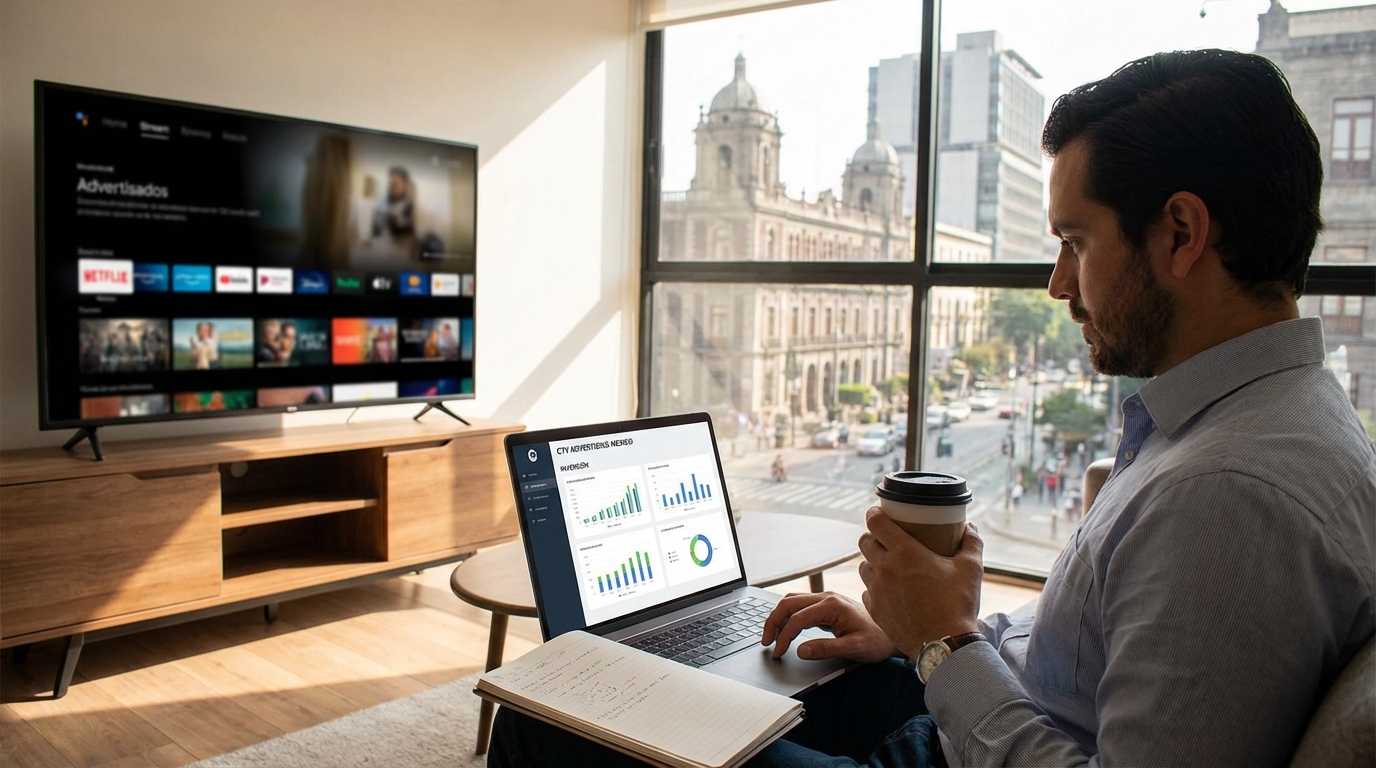
Streaming TV Landscape in Mexico: Opportunities for SMEs in 2025
Streaming consumption in Mexico continues to grow, and small and medium-sized enterprises are facing an opportunity that five years ago seemed exclusive to major brands. The video streaming market in Mexico generated $6.75 billion in 2024 and is projected to reach $21.66 billion by 2030, according to data from Cocktail Marketing. This figure is not just an impressive number: it represents millions of Mexicans who now consume content differently, with flexible schedules and more focused attention than traditional television.
For Mexican SMEs, this means access to audiences that were previously out of reach. Streaming TV advertising no longer requires million-dollar budgets or endless negotiations with television networks. Platforms like Masha have democratized this access, allowing you to launch campaigns starting at $2,000 MXN without long-term contracts. If your business has yet to explore Connected TV advertising, this guide will provide the full picture to help you make informed decisions in 2025 and 2026.
Growth of Video on Demand (VOD) consumption in the Mexican market
The growth of streaming in Mexico has been explosive. In the first seven months of 2024 alone, streaming content consumption grew by 26.7%, as reported by Cocktail Marketing. This rate of adoption suggests that by 2025-2026, penetration will be even higher, especially in metropolitan areas where connectivity has improved substantially.
What is interesting for advertisers is the profile of the Mexican streaming consumer. 67% of users in Mexico consume content through CTV devices, and 47% prefer to watch ads rather than pay for subscriptions, according to data from Sustainability Leaders. This willingness to watch ads in exchange for free or more affordable content creates fertile ground for SMEs looking for visibility without spending a fortune.
Key differences between traditional TV advertising and Connected TV (CTV)
Traditional television operates on a buying model based on ratings and specific time slots. You buy space in a particular program, hoping your target audience is watching. With CTV, the model changes radically: you don't buy a time slot; you buy access to a specific audience, regardless of what they are watching or when.
The practical differences are substantial. In traditional TV, you need high minimum investments, contracts lasting weeks or months, and measurement is only an approximation. In CTV, you can start with accessible budgets, pause or adjust in real time, and measure exactly how many people watched your ad in its entirety. For an SME that needs to optimize every dollar invested, this flexibility is essential.
Dominant Advertising Platforms and Formats in the National Territory
The streaming ecosystem in Mexico has diversified considerably. We are no longer talking just about Netflix or Amazon: there is a wide range of options with different monetization models and audience profiles. Understanding this landscape will help you choose where to allocate your advertising budget.
Advertising options on Netflix, Disney+, and Amazon Prime Video for local businesses
Netflix launched its ad-supported tier in Mexico in 2023, and by 2025, it has refined its targeting options. Netflix's ad inventory tends to be premium, with higher CPMs but audiences with high purchasing power. Disney+ follows a similar model, with particular strength in family audiences and sports content through ESPN.
Amazon Prime Video offers a unique advantage: integration with Amazon purchase data. If you sell products that are marketed on Amazon, you can create audiences based on actual shopping behavior. For e-commerce or retail SMEs, this targeting capability is hard to match on other platforms.
The rise of FAST channels: ViX, Pluto TV, and Samsung TV Plus
FAST (Free Ad-Supported Streaming Television) channels have gained rapid ground in Mexico. ViX, owned by TelevisaUnivision, combines local content with international programming and offers more accessible advertising options than premium platforms. Pluto TV and Samsung TV Plus function like free linear television with thematic channels, ideal for reaching audiences looking for experiences similar to traditional TV but via streaming.
These FAST platforms usually have lower CPMs and lower entry requirements. For an SME testing streaming advertising for the first time, they represent a lower-risk entry point. Masha facilitates access to this inventory without the need to negotiate directly with each platform, consolidating the purchase into a single interface with prices starting at $0.01 per view.
Advanced Targeting Strategies for the Mexican Audience
Targeting is where CTV truly shines compared to traditional television. It is not just about choosing a channel or program: you can define exactly who you want to reach based on location, demographics, interests, and consumption behavior.
Geographic targeting by states and metropolitan areas (CDMX, MTY, GDL)
Mexico has marked regional differences in consumption habits and purchasing power. A campaign that works in CDMX may need adjustments for Monterrey or Guadalajara. CTV advertising allows you to segment by state, city, and even specific zones within metropolitan areas.
For businesses with limited physical presence, this granularity is key. A restaurant in Polanco does not need to show ads in Tijuana. A gym chain in Nuevo León can concentrate its budget on the neighborhoods where it has branches. This geographic precision eliminates the wasted impressions that characterize traditional TV, where you pay for national reach even if you only operate in three states.
Using demographic and behavioral data to optimize the budget
Beyond geography, CTV allows you to segment by age, gender, socioeconomic level, interests, and browsing behavior. If you sell pet products, you can target households with pets specifically. If you offer financial services, you can focus on people who have shown interest in investment or credit topics.
Digital channels accounted for 58.2% of total advertising investment in Mexico in 2024, reaching 81.72 billion pesos according to Marketing4eCommerce. This data shows that Mexican advertisers now recognize the value of digital targeting. CTV combines the visual impact of television with the targeting capabilities of digital marketing.
Planning and Budgeting: How SMEs Can Invest Efficiently
Budget planning for CTV requires understanding the available buying models and typical costs in the Mexican market. With this information, you can design a strategy that maximizes your investment without compromising effectiveness.
Buying models: Direct buying vs. Programmatic buying
Direct buying involves negotiating directly with each streaming platform. You get guaranteed placements and sometimes exclusivity on certain content, but it requires high minimum volumes and negotiation processes that can take weeks. This model works for large brands with dedicated media teams.
Programmatic buying automates the process through platforms that aggregate inventory from multiple sources. You define your audience, budget, and goals, and the system optimizes your ad distribution in real time. For SMEs, this model is more practical because it allows you to start with smaller budgets and scale based on results. Masha operates on this principle, allowing you to launch campaigns in minutes without intermediaries and with transparent pricing that includes access to premium inventory.
Estimated cost per thousand impressions (CPM) in the Mexican context
CPMs in CTV vary considerably depending on the platform, format, and targeting. In Mexico, typical ranges for 2025 fluctuate between $80 and $250 MXN per thousand impressions on premium platforms like Netflix or Disney+. FAST channels typically offer CPMs between $40 and $120 MXN.
Advertising investment in Mexico will grow by more than 10% heading into 2026 due to the FIFA World Cup, according to projections by Adlatina. This increase in demand could push CPMs higher, especially for sports content. For SMEs, this means that securing inventory and establishing relationships with platforms now can result in better terms before demand spikes.
Measuring Results and Return on Investment (ROI)
Measuring the impact of TV advertising has always been the medium's Achilles' heel. CTV changes this radically by offering precise metrics and clearer attribution between ad exposure and consumer actions.
Essential metrics: Reach, frequency, and video completion rates
Reach measures how many unique people saw your ad. Frequency indicates how many times, on average, each person was exposed to it. The video completion rate (VCR) shows what percentage of viewers watched your ad in its entirety. This last metric is particularly valuable because, on CTV, users cannot skip ads as they can on YouTube.
A healthy VCR on CTV is usually above 90%, far superior to the 30-40% typical of digital video. This means your message is much more likely to be seen in full. For messages that require storytelling or product explanation, this difference is significant.
Attribution tools to link TV ads with digital sales
Attribution connects ad exposure with subsequent actions such as website visits, brand searches, or purchases. Modern attribution tools for CTV can track whether a device that saw your ad subsequently visited your site from another device in the same household.
Platforms like Masha offer real-time metrics that allow you to see your campaign performance while it's still running. You can identify which creatives are performing best, which segments are responding, and adjust your strategy without waiting for the campaign to end. This continuous optimization capability is impossible with traditional TV.
Steps to Successfully Launch Your First Streaming TV Campaign
Launching a CTV campaign for the first time might seem intimidating, but the process is simpler than you think. Here is a practical sequence based on what I have seen work for Mexican SMEs.
First, clearly define your goal. Are you looking for brand awareness, website traffic, or direct sales? Each goal requires different creatives and different success metrics. Don't try to achieve everything with a single campaign.
Second, identify your ideal audience. Use the data you already have from your current customers: where do they live, how old are they, and what interests do they share? The more specific you are, the better you can segment and the less budget you will waste.
Third, prepare your creative assets. CTV ads typically last 15 or 30 seconds. Your message must be clear from the first few seconds because, even though the user cannot skip the ad, they can still get distracted. A specific call to action at the end increases the likelihood of a response.
Fourth, set a realistic test budget. You don't need to invest thousands of pesos from the start. Begin with an amount that allows you to gather enough data to evaluate results, typically between $5,000 and $15,000 MXN for an initial two-week test.
Fifth, monitor and adjust. Review the metrics daily during the first week. If a segment isn't responding, reallocate budget toward those that are working. This agility is one of the greatest advantages of CTV over traditional TV.
If you are looking for an accessible way to get started with streaming TV advertising, explore Masha to launch campaigns starting at $2,000 MXN, with no contracts or minimum investment requirements, and real-time metrics that allow you to optimize every peso spent.