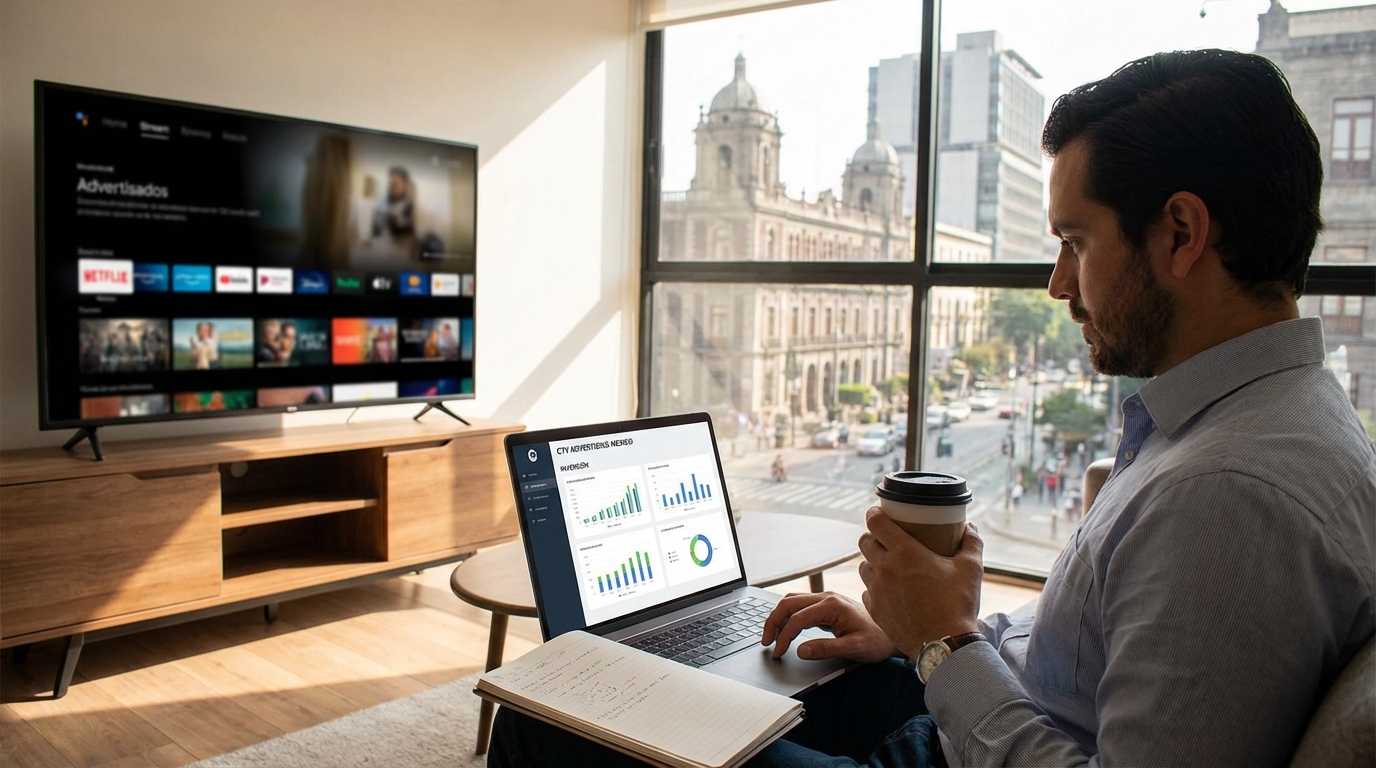
Many business owners in Mexico dismiss television as an advertising channel before looking at the actual numbers. The question of whether TV advertising is too expensive for your business deserves an honest answer, not one based on assumptions from twenty years ago. The truth is that the landscape has changed radically with the arrival of streaming and connected TV. Those barriers that once existed, such as investment minimums of hundreds of thousands of pesos or inflexible annual contracts, no longer apply to all television formats. With platforms like Masha, you can advertise on streaming TV starting at $0.01 MXN per view, with no contracts or investment minimums. This doesn't mean that traditional TV is accessible to everyone, but it does mean there is an alternative path that many are unaware of. Throughout this article, we will analyze the real costs, compare options, and show you how to determine if television makes sense for your specific budget.
Demystifying the cost of television: Investment or expense?
The difference between an investment and an expense lies in the expected return. When you pay your office electricity bill, it is a necessary operating expense. When you allocate money to advertising that generates measurable sales, we are talking about an investment. The problem with television is that it was historically difficult to measure that return accurately, which led many to automatically classify it as an expense.
Connected TV has changed this equation. Now you can track how many people saw your ad, on what device, at what time, and in what geographic location. This information transforms TV from a "spray and pray" medium into a channel with metrics comparable to digital ones.
The perception of price versus mass reach
There is a disconnect between what people think TV costs and what it can actually cost. Many entrepreneurs think in terms of millions of pesos because they associate television with Super Bowl spots or prime-time slots on major networks. That perception ignores the fact that the television ecosystem has multiple price levels.
A streaming TV ad can cost you the same as a moderate social media campaign. The difference is in the context: your message appears on the big screen, in an environment where the viewer is relaxed and receptive, not scrolling at high speed. The mass reach of television does not automatically imply a massive price tag. It depends on the channel, the time slot, the length of the spot, and the platform you choose.
CPM comparison: TV vs. digital platforms
CPM, or cost per thousand impressions, is the metric that allows you to compare apples to apples across different media. On social media, a competitive CPM in Mexico ranges from $50 to $150 MXN depending on the targeting and the industry. On traditional broadcast television, the CPM can vary between $80 and $300 MXN during regular time slots.
The surprise comes with streaming TV and CTV. Platforms like Pluto TV or Roku offer CPMs that compete directly with digital, sometimes even lower. With Masha, starting at $0.01 per view, you are talking about CPMs that can be significantly lower than those of Facebook or Instagram for similar audiences. The additional difference is the quality of attention: a TV ad does not compete with 15 other posts in a feed; it has the full screen to itself.
Factors that determine your campaign budget
Not all TV campaigns cost the same, and understanding which variables affect the price helps you make informed decisions. The final budget depends on several factors that you can partially control.
The duration of your campaign matters just as much as the daily amount. A two-week campaign with $5,000 MXN per day can generate better results than a two-month campaign with $500 per day, because you reach enough frequency for your message to be remembered. Frequency—that is, how many times the same person sees your ad—is critical in television.
Time slots and audience ratings
In traditional television, the time slot is everything. A spot at 3 in the afternoon costs a fraction of what it costs at 9 at night. Ratings determine the price because they indicate how many people are watching at that moment. Prime time means more eyes, but also budgets that only big brands can afford.
Streaming partially breaks this logic. People watch content at any time, and binge-watching means your ad can appear at 2 in the morning in front of someone who is fully attentive. There is no "junk time" in streaming because the content is on-demand. This democratizes access: you don't need to compete for the 8 PM slot to reach your audience.
Creative production vs. ad spend
A common mistake is to allocate the entire budget to the ad spend and forget about production. A poorly produced ad in the best time slot is a waste of money. The recommended ratio varies, but consider that an acceptable quality video for TV can be produced for anywhere from $15,000 to $100,000 MXN, depending on the complexity.
For small businesses, there are alternatives. You can use existing video from your social media adapted to the television format. Some platforms offer basic editing tools. The important thing is that the audio is clear, the image has sufficient resolution, and the message is understood in the first few seconds. You don't need a cinematic commercial to get started.
The Masha methodology: Efficiency in media buying
Traditional media agencies operate with models that include commissions, investment minimums, and processes that take weeks. This model works for large advertisers but excludes SMEs and local businesses that cannot commit hundreds of thousands of pesos.
Masha works differently. It is a self-service platform where you control everything: budget, targeting, creatives, and schedule. There are no intermediaries adding costs or account executives you need to convince. You upload your video, define your audience, set your budget, and launch. The entire process can take less than an hour.
Inventory optimization and strategic negotiation
Programmatic platforms like Masha access advertising inventory from multiple sources simultaneously. This means your ad can appear on Pluto TV, Roku, and other streaming apps without you having to negotiate with each one separately.
Programmatic technology also optimizes in real time. If a specific inventory is generating better results for your campaign, the system can automatically prioritize that space. This efficiency was impossible ten years ago and was reserved for large agencies five years ago. Today, any business can access it.
Smart targeting: Reaching the right audience without waste
The biggest waste in traditional advertising is paying for audiences that will never be your customers. A restaurant in Monterrey doesn't need its ad to reach Cancun. A language school for adults gains nothing by appearing in children's programming.
Targeting in streaming TV allows you to define geography down to the city level, interests based on viewing behavior, and specific time slots. You can choose to have your ad appear only in Guadalajara, only to people interested in business content, and only on weekdays. This precision reduces waste and maximizes every peso invested.
Available targeting criteria include:
- Geographic location by state or city
- Content categories your audience consumes
- Specific devices where you want to appear
- Time slots that align with your target audience
Combining these filters creates audiences that are far more relevant than traditional television, where you essentially pay to reach everyone watching a channel at a given time, regardless of whether they are your ideal customer or not.
Return on investment (ROI) and the impact on brand credibility
Measuring TV ROI used to require expensive brand lift studies or indirect sales correlations. Streaming has changed this by offering real-time metrics: completed views, unique reach, average frequency, and more.
The credibility gained from appearing on television has no direct equivalent in other media. When a potential customer sees your brand on their big screen, alongside professional content, the perception of legitimacy increases. It is the same effect traditional TV had, but now accessible to budgets that previously only covered flyers.
The halo effect: How TV boosts your other channels
Something interesting happens when a brand starts advertising on television: its other channels improve. Branded searches on Google increase. The CTR of social media ads goes up. The website conversion rate improves. This phenomenon is known as the halo effect.
The explanation is simple: television generates high-quality awareness. When someone sees your TV ad and later finds your post on Instagram, familiarity already exists. The initial barrier of distrust is lowered. The prospect is more willing to click, explore, and eventually buy.
Marketing studies have documented that multichannel campaigns including television generate up to 60% more conversions than those using only digital media. TV doesn't replace your digital strategy; it powers it.
How to get started on TV with flexible budgets
You don't need a six-figure budget to test TV advertising. With streaming TV, you can start with amounts that allow you to learn without taking on too much risk. We recommend starting with a two-to-four-week test using a budget you can afford to lose without impacting your operations.
The process for launching your first campaign on a platform like Masha is straightforward:
- Create your account in less than five minutes
- Upload your ad video in a compatible format
- Define your target audience using the available filters
- Set your daily or total budget
- Launch and monitor results in real time
During the first few weeks, focus on learning what works. Test different creatives if you have more than one. Adjust your targeting based on the data you gather. Live metrics allow you to optimize on the fly instead of waiting weeks for a report.
The flexibility of having no contracts means you can pause, adjust, or cancel whenever you want. If the numbers don't make sense for your business after two weeks, you simply stop the campaign. If they work, you scale. This model of controlled trial and error was impossible with traditional television.
For businesses that have never advertised on TV, streaming is the perfect entry point. You learn how the medium works, which messages resonate with your audience, and how to integrate television with your other marketing efforts, all without committing to huge budgets.
The question of whether TV advertising is too expensive for your business has a nuanced answer. Traditional prime-time TV probably is for most SMBs. But streaming TV and connected TV have opened a door that was previously closed. With options starting at pennies per view, with no minimums or contracts, the barrier to entry has practically disappeared. What was once exclusive to large corporations is now within reach of any business willing to experiment.
If you want to test how advertising on the biggest screens in the home works for you, Masha lets you launch your streaming TV campaign in just 10 clicks, with real-time metrics and no long-term commitments. Learn more here and find out if television makes sense for your strategy.