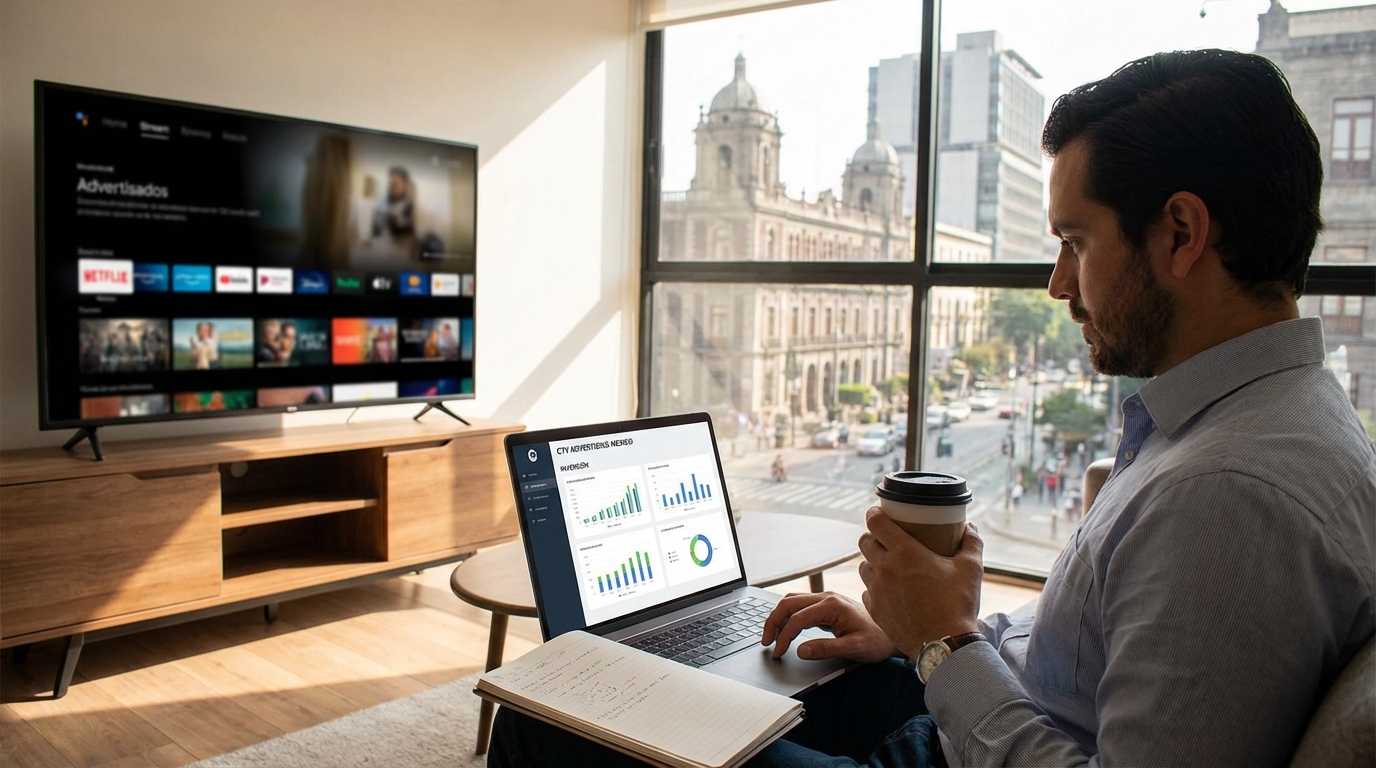
The evolution of digital marketing: From traditional TV to streaming
Just five years ago, the idea that a taco shop in Guadalajara or a boutique in Monterrey could advertise on television sounded absurd. TV advertising was reserved for Coca-Cola, Liverpool, and major automakers with million-dollar budgets. Today, that reality has completely changed, and the secret that big brands have jealously guarded is now within reach for your SME: streaming TV advertising.
The shift wasn't gradual. The pandemic accelerated a transformation that was already underway. Millions of Mexicans discovered they could watch quality content without relying on fixed schedules or endless commercials. Platforms like Netflix, Disney+, Pluto TV, and Roku settled into Mexican homes with a speed no one anticipated. And where there is an audience, there is an advertising opportunity.
The interesting thing is that this new ecosystem was born with different rules. You don't need to negotiate with TV network executives or sign annual contracts. You don't need a six-figure budget to appear on screen. Connected TV advertising democratized access to a medium that was exclusive to corporations for decades. The Mexican SMEs that understood this first are already reaping results their competitors can't even imagine.
Why SMEs are migrating to OTT and CTV platforms
The move toward OTT and CTV platforms is not a passing fad. It responds to compelling economic logic. Traditional television charges for massive impressions without guaranteeing that your ideal customer will see the ad. You pay for your pizza shop spot in Polanco to reach viewers in Chiapas who will never step foot in your restaurant. It’s money down the drain.
Streaming platforms changed this equation. You can segment by geographic location down to the city level, by specific interests, and by consumption behavior. An English academy in Querétaro can show its ads exclusively to parents with school-age children within a 20-kilometer radius. That level of precision was unthinkable a decade ago.
The cost of entry has also plummeted. While a 30-second spot on broadcast television during prime time can cost hundreds of thousands of pesos, streaming TV campaigns start at amounts accessible to any business. Platforms like Masha allow you to start campaigns from $2,000 MXN, with prices starting at $0.01 per view. There are no long contracts or minimum investments to tie you down.
Competitive advantages over social media advertising
Social media remains useful, but it faces serious challenges. Content saturation means your ads compete against thousands of posts every second. The average Instagram user spends less than two seconds on each post before scrolling on. Your message gets lost in a sea of memes, selfies, and cat videos.
Streaming TV advertising offers something social media cannot replicate: undivided attention. When someone watches an ad on Pluto TV or Roku, they are sitting in front of a large screen, likely with family or friends, in a mindset receptive to entertainment. They aren't multitasking or checking notifications. Your message has room to breathe.
Data supports this difference. Ad completion rates on CTV exceed 90%, while social media videos are rarely watched in their entirety. Brand recall is significantly higher when the message is consumed in a relaxed environment in front of the TV. For businesses selling products or services that require consideration, this advantage is decisive.
Precision targeting: Reaching the ideal customer with SMB budgets
The real magic of streaming TV for SMBs isn't in the ad format, but in the ability to direct it exactly to the people you care about. Traditional television operated on a shotgun model: you fired in every direction hoping some pellets would hit the target. Streaming operates with a precision rifle.
Each streaming platform collects data on its users. They know which genres they prefer, what times they consume content, what devices they use, and where they are located. This information allows for the construction of incredibly specific audience profiles. A seafood restaurant can target people who watch cooking shows, live in coastal areas, and have middle-to-high incomes.
Behavioral, interest-based, and geolocation targeting
Behavioral targeting analyzes what the user does on the platform. If someone consistently watches travel documentaries, they are likely interested in tourism. If they watch crime series, they might respond well to ads for home security systems. These patterns reveal intentions and preferences that the user never explicitly stated.
Interest-based targeting groups users according to thematic categories: sports, technology, fashion, personal finance, parenting. You can combine multiple interests to refine your audience. A sporting goods store could target people interested in fitness and running, excluding those who only watch sports as passive spectators.
Geolocation is particularly valuable for local businesses. You can limit your ads to specific states, cities, or even zip codes. A gym in the Roma neighborhood doesn't need to pay for impressions in Ecatepec. This geographic precision maximizes every dollar invested and eliminates the waste inherent in mass media.
Optimizing ad spend without audience waste
The pricing model in streaming TV favors SMBs. You pay for effective impressions, not theoretical reach potential. If your ad is shown to a thousand people who match your ideal customer profile, you pay for those thousand impressions. You aren't subsidizing the inefficiency of the medium.
Real-time optimization allows you to adjust campaigns on the fly. If you notice that a certain segment is responding better than another, you can redirect your budget immediately. Traditional television doesn't offer this flexibility. Once your spot is scheduled, there is no turning back until the contract ends.
Platforms like Masha simplify this process with intuitive interfaces. In less than five minutes, you can create an account, and in ten clicks, launch your first campaign. Live metrics show you exactly what is working. You don't need to wait weeks to receive reports from the broadcaster or hire an agency to interpret the data.
Key platforms to start streaming campaigns
Not all streaming platforms are the same or serve the same objectives. Understanding the differences will help you choose where to invest your initial budget. The key is knowing your audience and finding where they consume content.
Video advertising: YouTube, Netflix, and Disney+
YouTube remains the giant of online video. Its advertising inventory is massive, and its targeting options are sophisticated. For SMBs looking for volume of impressions at a low cost, YouTube offers an accessible entry point. The challenge lies in the competition for attention and the fact that many users enable ad blockers.
Netflix introduced its ad-supported tier in 2022, opening up a premium inventory that didn't exist before. Users who choose this plan agree to watch ads in exchange for a reduced price. This means receptive audiences who don't perceive advertising as an intrusion. Netflix's high-quality content associates your brand with prestigious productions.
Disney+ offers access to family audiences with high purchasing power. Brands selling products for children or family experiences find fertile ground here. Partnering with iconic characters from Disney, Marvel, and Star Wars creates a positive halo effect for advertisers on the platform.
Pluto TV and Roku are particularly interesting options for Mexican SMEs. They are free for the user, which means broader and more diverse audiences. Masha allows you to access this premium inventory without intermediaries, with transparent pricing and no hidden fees.
Digital audio: Spotify and the rise of podcasts
Digital audio deserves serious consideration. Spotify has over 200 million users on its ad-supported free tier. These users listen while working, exercising, or driving. Your message reaches them when their visual attention is occupied, but their ears are available.
Podcasts are experiencing explosive growth in Mexico. The intimacy of the format creates a special connection between the host and their audience. When a podcaster recommends a product, listeners perceive it as advice from a friend, not as advertising. Conversion rates in podcast advertising consistently outperform other digital formats.
Audio production is significantly more affordable than video. A well-produced audio spot can cost a fraction of a television commercial. For SMEs with tight budgets, digital audio offers a path to massive audiences without breaking the bank.
How to create high-impact ads with limited resources
Professional video production used to require expensive equipment, recording studios, and specialized editors. That barrier has practically disappeared. A modern smartphone captures video in high enough quality for streaming. Free or low-cost editing tools allow you to polish the final result.
What hasn't changed is the importance of the message. A technically perfect video with a boring message will fail. A video shot on a phone but with a compelling story can go viral. Creativity matters more than production budget.
Narrative formats that connect with the modern audience
The first three seconds determine whether the viewer will keep watching or ignore your ad. Forget long intros with logos and slogans. Start with something that captures immediate attention: a provocative question, a surprising image, or a problem your audience recognizes instantly.
The testimonial format works extraordinarily well for SMEs. A real customer sharing their experience generates more credibility than any corporate promise. You don't need professional actors. The authenticity of an ordinary person speaking naturally connects better than polished performances.
Transformation stories resonate universally. Show the before and after. The problem and the solution. The frustration and the relief. This basic narrative arc works because it reflects how humans have processed information for thousands of years. Your ad competes against entertainment content, so it must entertain as well.
Masha includes GenAI tools that make video and audio creation easy for those without production experience. You can plan, create, and launch campaigns from a single platform, reducing the friction that traditionally kept SMEs away from TV advertising.
Measuring success and return on investment in real time
One of the historical frustrations with television advertising was the inability to measure results accurately. You knew how many people potentially saw your ad based on ratings, but you had no idea how many actually paid attention or took action afterward.
Streaming TV solved this problem. Every impression is recorded. Every interaction is tracked. You can know exactly how many people watched your ad to the end, how many dropped off halfway through, and at what specific moment you lost their attention. This data granularity allows for constant optimization.
Essential metrics: Reach, frequency, and completion rates
Reach measures how many unique people saw your ad at least once. High reach means your message reached many different people. For awareness campaigns where you are looking to build brand recognition, reach is the priority metric.
Frequency indicates how many times on average each person saw your ad. Research suggests that it takes between three and seven exposures before a message sticks in memory. Too little frequency and your ad is forgotten. Too much frequency and you generate fatigue or irritation.
The completion rate reveals what percentage of viewers watched your ad to the end. In CTV, these rates typically exceed 90% because users cannot skip the ad as easily as in other formats. A low rate indicates issues with the creative content that you need to address.
Real-time metrics offered by platforms like Masha allow for informed decision-making without waiting weeks. If something isn't working, you detect it within hours and adjust. This agility was impossible in traditional television and represents a huge competitive advantage for agile businesses.
The future of connected TV advertising for local businesses
The trend is irreversible. Content consumption is migrating to streaming at an accelerated pace. Younger generations practically do not watch traditional television. By the time millennials and Gen Z have the greatest purchasing power, streaming will be the undisputed dominant medium.
SMBs that build expertise in CTV advertising today will have an advantage tomorrow. While their competitors continue to rely exclusively on saturated social media or flyers that no one reads, they will be capturing attention in the most influential medium in the home.
Technology will continue to democratize access. Production costs will keep falling. Targeting tools will become more precise. Artificial intelligence will simplify content creation. Everything points toward a future where any business, regardless of its size, can compete on the big screen.
The secret that big brands kept for decades is no longer a secret. Streaming TV advertising is within reach of your SMB today. The question is not whether you should explore this channel, but how much longer you can afford to ignore it while your competitors take the lead.
If you want to try streaming advertising without the hassle, Masha allows you to launch campaigns starting at $2,000 MXN, with no contracts or minimum investment requirements, and registration in less than five minutes. Learn more and discover how your business can appear on the screens of your ideal customers.