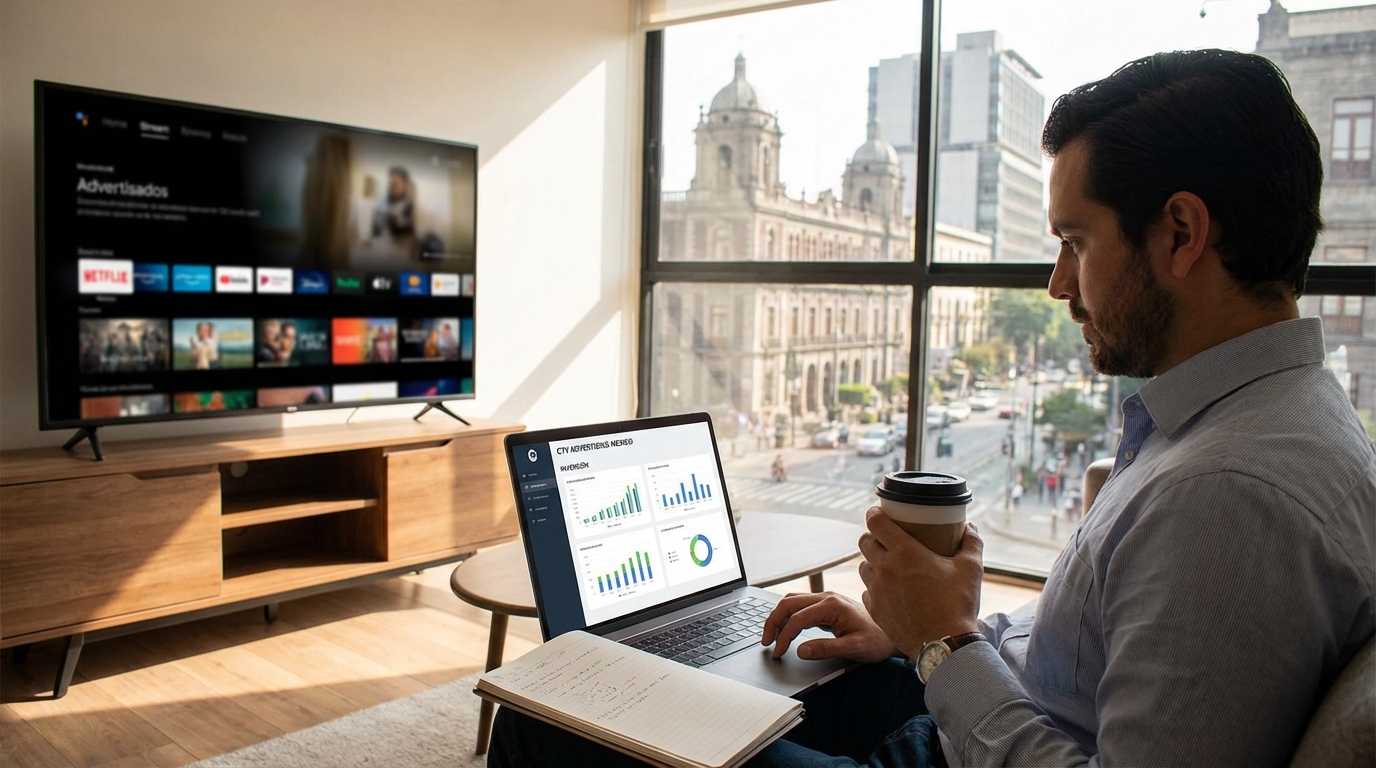
The marketing budget for a Mexican SME used to have a clear destination: social media, some Google Ads, and, if they were lucky, a spot on local radio. Television was reserved for big brands with deep pockets. That changed radically with streaming. Today, the cost of streaming TV advertising has been democratized to the point of allowing a restaurant in Guadalajara or a clothing store in Monterrey to appear on the same screens where people watch their favorite series.
But here is the question everyone is asking: how much does it really cost? The short answer is that it depends on multiple factors. The long answer requires understanding the entire ecosystem, from monetization models to the specific platforms available in Mexico. Global spending on OTT advertising will reach $207.5 billion in 2025, according to MediaPost, and a significant portion of that money comes from businesses that previously would never have considered television a viable channel. Mexico is no exception to this trend.
Current landscape and investment models in Streaming TV
The streaming advertising market is undergoing an accelerated transformation. Platforms that previously relied exclusively on subscriptions are now embracing ads as a revenue stream, while advertisers are discovering captive audiences that no longer tune in to broadcast television. This convergence creates unprecedented opportunities for those who understand the rules of the game.
Differences between AVOD, SVOD, and linear TV
AVOD stands for Advertising Video on Demand: free, ad-supported platforms where the user agrees to watch ads in exchange for free content. Pluto TV and Tubi are clear examples. Advertising inventory here tends to be more affordable because the model depends on the volume of impressions.
SVOD, or Subscription Video on Demand, includes services like Netflix and Disney+ in their ad-free premium versions. However, both platforms launched ad-supported plans that combine a reduced subscription fee with commercial breaks. The telling statistic is that in the third quarter of 2025, 40% of active Netflix accounts were using the ad-supported plan, according to MediaPost. This represents millions of potential viewers.
Traditional linear TV still operates with fixed commercial blocks, purchased weeks in advance with investment minimums that exclude most SMEs. The fundamental difference with streaming lies in flexibility: you can start, pause, or adjust campaigns in real time.
The rise of FAST channels in Mexico
FAST stands for Free Ad-Supported Streaming Television, and it represents the fastest-growing segment in Latin America. These channels function like traditional television but are broadcast over the internet, with linear programming and defined advertising blocks. Pluto TV leads this space in Mexico with hundreds of thematic channels.
The advantage for small advertisers is twofold. First, inventory is abundant because these platforms need to fill many hours of programming. Second, segmentation by thematic channel allows you to reach specific niches without paying for irrelevant mass audiences. A sporting goods business can advertise exclusively on sports channels, while a veterinary clinic appears on content about pets.
Roku, another platform with a strong presence in Mexico, combines its hardware device with its own FAST content. This creates a closed ecosystem where viewing data fuels ad targeting with remarkable precision.
Factors that determine ad costs
Understanding why an ad costs what it does requires breaking down the variables involved in the equation. There is no universal fixed price because every campaign is unique in its parameters.
CPM metrics and programmatic buying
CPM stands for Cost Per Mille (thousand) impressions, and it is the standard metric in digital advertising. If a platform charges a CPM of 200 pesos, you will pay that amount every time your ad is shown one thousand times. The average CPM for Connected TV is estimated at 20.31 dollars globally, according to MediaPost, although prices in Mexico can vary significantly.
Programmatic buying automates this process through real-time auctions. When a user opens a streaming app, an instant auction is triggered where multiple advertisers compete for that space. The winner shows their ad, and it all happens in milliseconds. This system allows small businesses to compete for the same inventory as big brands, paying only for the impressions they actually receive.
Platforms like Masha simplify this process by offering direct access without intermediaries, with costs starting from 0.01 pesos per view. This eliminates the barrier to entry that traditionally kept SMEs out of television.
Audience segmentation and demographic data
The more specific your target audience, the higher the CPM. This seems contradictory, but it makes sense: reaching exactly women aged 25 to 34 in Mexico City interested in fitness requires filtering out millions of irrelevant impressions. That filtering comes at a price.
Typical segmentation options include geography at the state or city level, age range, gender, interests inferred from viewing behavior, and device type. Some platforms allow you to upload existing customer lists to create lookalike audiences or exclude those who have already purchased.
The practical recommendation is to start with broad segmentation and refine it as data reveals what works. A campaign that is too specific from the start can limit reach and make each impression more expensive without guaranteeing better results.
Seasonality and inventory demand
The fourth quarter of the year drives prices up. Buen Fin, Christmas, and New Year's concentrate advertising budgets from every industry, all competing for the same limited inventory. A CPM that costs 150 pesos in March can triple by November.
Timing also plays a role. Prime-time streaming occurs between 8 and 11 p.m., when families sit down in front of their screens. Advertising during these hours costs more than at 3 p.m. However, depending on your product, less-demanded time slots can offer better value: a B2B service might benefit from appearing during the day when professionals are working from home.
Special events like sports finals or popular series premieres create specific spikes in demand. Planning campaigns in advance allows you to secure inventory before prices escalate.
Estimated rates by platform in the Hispanic market
Concrete numbers help in planning realistic budgets. These estimates reflect the current market, although rates fluctuate constantly.
Costs on giants like Netflix and Disney+
Netflix launched its ad-supported plan charging CPMs of up to 65 dollars, a rate that scared off many advertisers. Since then, the platform has reduced its prices by approximately 30%, according to MediaPost, in an effort to attract more advertisers. Even so, the minimum investment requirements and the complexity of the process keep Netflix out of reach for most Mexican SMEs.
Disney+ follows a similar pattern with its ad-supported tier. CPMs hover between 40 and 50 dollars for the Latin American market, with minimum investment requirements that vary by country. The audience tends to be family-oriented, which works well for certain products but limits others.
These premium platforms offer engaged audiences and high-quality viewing contexts. The problem is that their purchasing structures favor large agencies with substantial budgets.
Investment in YouTube Select and Connected TV
YouTube Select groups the platform's premium content: verified channels, established creators, and original programming. CPMs here range between 15 and 35 dollars depending on targeting. The advantage is that YouTube offers more flexible purchasing options than Netflix or Disney+, with accessible minimum investment requirements.
Advertising on Connected TV through YouTube works when users watch content on their smart TVs or devices like Chromecast. This big-screen experience justifies higher CPMs than mobile video because viewer attention is greater.
FAST platforms like Pluto TV and Roku offer significantly lower CPMs, typically between 8 and 20 dollars. The trade-off is that the content may be less premium, although the audience remains valuable. For businesses with limited budgets, these options represent the most accessible entry point into the world of streaming advertising.
Advertising formats and their impact on the budget
The type of ad you choose affects both the price and the effectiveness of your campaign. Each format has its advantages and optimal use cases.
Pre-roll, mid-roll, and pause ads
Pre-roll ads appear before the content starts. The viewer is attentive because they want to watch their program, but they may also be impatient. These ads usually have high completion rates because the user knows they must watch them to access the content. CPMs tend to be moderate.
Mid-roll ads interrupt content halfway through playback, similar to traditional commercial breaks. The advantage is that the viewer is already engaged with the program and is less likely to leave. CPMs are usually slightly higher than pre-roll because attention is more guaranteed.
Pause ads appear when a user stops playback. This non-intrusive format displays a static or animated message while the viewer takes a break. CPMs are generally lower, but the impact can also be smaller because the user is not necessarily looking at the screen.
Interactive formats and direct purchases
Interactive ads allow the viewer to take action without leaving the app: browsing a product catalog, scheduling an appointment, or requesting more information using the remote control. These premium formats cost significantly more, with CPMs that can be double or triple those of standard ads.
The additional investment can be justified if your goal is to generate direct conversions. A restaurant that allows reservations from the ad or a store that shows its available inventory leverages interactivity to shorten the path between the ad and the action.
Shoppable formats take this further by integrating direct purchases. The viewer sees a product, presses a button, and completes the transaction without changing screens. Although still in its early stages in Mexico, this format represents the future of streaming advertising.
Competitive advantages over traditional television
A direct comparison between streaming and broadcast TV reveals differences that go beyond price. Traditional television charges fixed rates for specific time slots without any guarantee that your target audience is watching. You are buying hope, not certainty.
Streaming offers precise measurement of every impression. You know exactly how many people watched your ad to completion, on what device, at what time, and on what content. This transparency allows you to optimize campaigns on the fly instead of waiting weeks to evaluate results.
Operational flexibility marks another crucial difference. A traditional TV campaign requires planning months in advance, producing materials with rigid specifications, and contractual commitments that are difficult to modify. In streaming, you can launch a campaign today, pause it tomorrow if something isn't working, and adjust the targeting on Friday based on the data from the