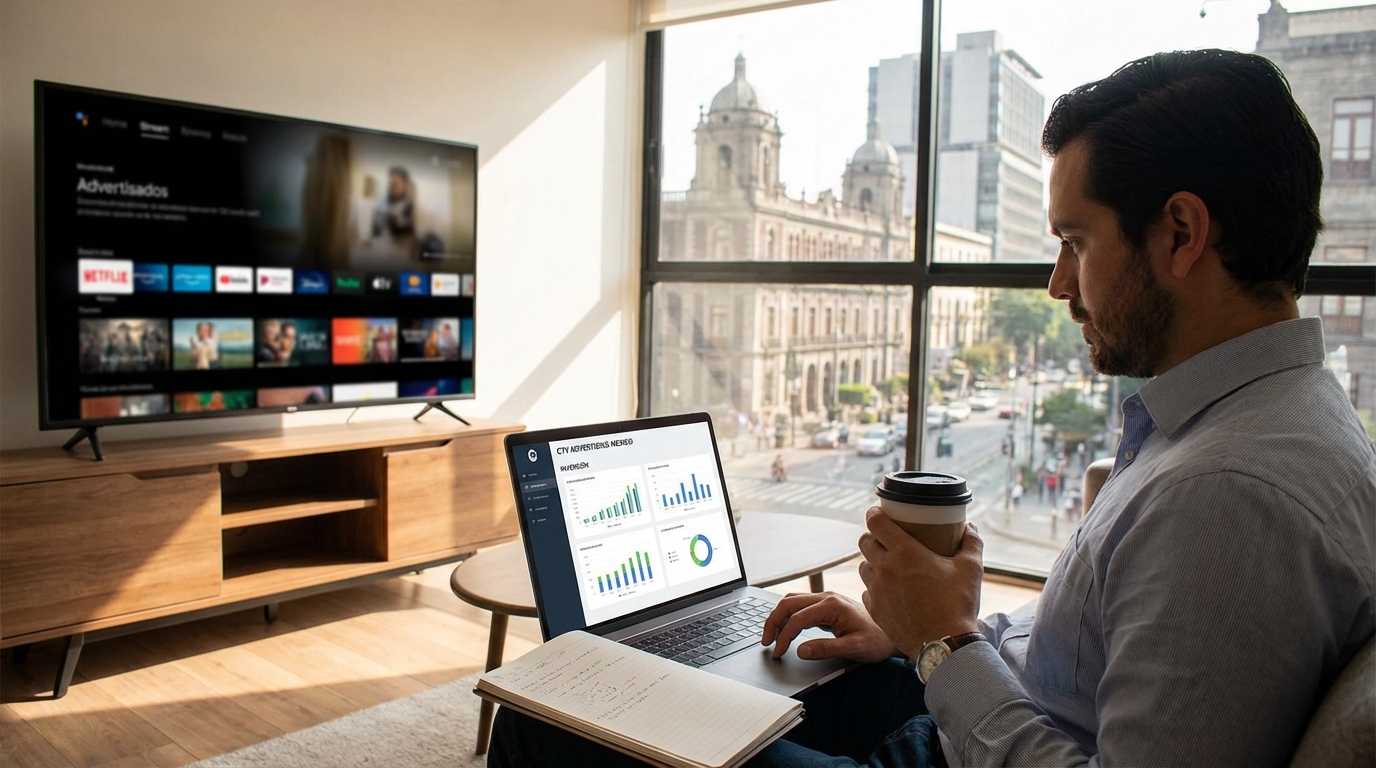
Imagine your brand appearing right before the final of a match or the most talked-about episode of a soap opera. Millions of people watching the screen, all at the same time, with your message in the spotlight. That is still the power of television in Mexico, even in the midst of the era of social media and short-form video.
Far from dying, television has transformed. Today, 65% of Mexican internet users watch connected TV, representing more than 51 million people according to Comscore data. And brands know it: advertising investment in the country reached US$7.722 billion in 2024, a 4% increase over the previous year, according to the 2025 Total Media Value Study. If your company isn't yet taking advantage of TV—whether traditional or connected—there is a real opportunity on the table.
Is it still worth advertising on television in Mexico?
For many companies, the question is the same: "Isn't it better to invest everything in digital?" The answer, in Mexico, is almost always "it depends... but TV still carries a lot of weight." The country maintains a very high level of access to television sets and consumption of television content, something reflected in compilations such as Statista's dossier on the television industry in Mexico, which shows that TV continues to be a key mass medium for reaching the population.
The great advantage of television over other media is its ability to generate rapid impact and build brand equity. A good spot on a high-rated program can make your business known in weeks, not months. Furthermore, TV is increasingly integrating well with digital campaigns: the consumer sees your ad in their living room and then searches for your brand on their phone, compares, reads reviews, and ends up buying. That is why the question is no longer "TV or digital," but how to combine both to get the most out of them.
Types of television for advertising: broadcast, pay, and connected
Deciding to advertise on "television" is no longer just one thing. You have broadcast TV, pay TV (cable/satellite), and connected TV or CTV. Each has different logic, costs, and uses, and it is worth understanding them so you don't waste your budget.
Broadcast TV (traditional national and local channels) offers massive reach and works very well for brand awareness campaigns, national launches, or general consumer products. Pay TV, on the other hand, operates in a market with high concentration and a strong presence of operators offering triple-play packages, as explained by the research published in Comunicación y Sociedad on economic concentration in pay television. This implies fewer key players, but also interesting segmentation options by channel type (news, sports, children's, lifestyle, etc.), which is useful for very specific niches.
How to define your strategy before buying TV space
Before asking "how much does a spot cost?", it is better to pause and focus on strategy. The first step is to clarify the objective: do you want people to know you, remember your brand, download an app, visit your store, or try a new product? The objective defines the type of program where it makes sense to appear, the frequency of the spots, the creativity of the ad, and even whether it makes sense to go with broadcast, pay, or connected TV.
The second step is to take a magnifying glass to who you are talking to. Advertising a fast-food restaurant aimed at young people is not the same as advertising a credit firm for SMEs or a home goods brand. Think about age, socioeconomic level, lifestyle, and, above all, what they watch on TV. Series, news, reality shows, sports, or children's content? The clearer you are on this, the better you can negotiate your ad spend and avoid paying for slots your ideal customer doesn't even watch.
Finally, nail down your budget and the role of TV within your media mix. It is very common to use television to make a "splash" in terms of reach and rely on social media, search engines, and online video to deepen the message, generate interaction, and measure more precisely. TV puts you in front of many eyes; digital channels help those eyes click, write, ask, or buy.
Ad formats and creative that work
Today's television allows for much more than the classic spot during a commercial break. Between traditional formats and more flexible options, there is room to adapt to the size of your company and the stage you are in. The important thing is to understand what each format does and what you can expect from it, so you don't get frustrated with unrealistic results.

Traditional spots in commercial breaks
This is the format everyone has in mind: your ad appears within the commercial block of a specific program. It is ideal for building a brand, especially if you take care of three things: message clarity, repetition, and visual consistency. Your logo, colors, and key phrase must appear clearly and repeatedly. A common mistake for many companies is making ads that are too cluttered, full of text, phone numbers, addresses, and simultaneous promotions; the viewer cannot process that much. Less text, a stronger central idea, and a simple call to action work much better.
Mentions, sponsorships, and special formats
Live mentions by a program host, section sponsorships ("this segment is brought to you by..."), or product integrations within the content are sometimes more effective than a traditional spot. They help your brand associate with the credibility or charisma of the presenters, and they often feel more organic to the audience. These types of formats tend to be especially useful for businesses that rely on trust (financial services, health, education, professional services) or for products that are better explained with examples or short stories.
Spots designed for connected TV
Connected TV combines the best of the living room with digital logic: segmented ads, the ability to measure with more precision, and, in some cases, interactive messages. Since a large portion of internet users in Mexico already consume CTV, as shown by data from Comscore on connected television in the country, it is worth adapting your creative for this environment. Shorter messages that hook in the first few seconds, designed for large screens but using digital language, usually perform better. It is also advisable to design pieces that work for both streaming platform campaigns and online video, maximizing the use of your production.
How to buy television advertising in Mexico
When it comes time to buy, there are three typical paths: negotiate directly with television networks, work with a media agency , or purchase inventory on CTV and streaming platforms. Negotiating directly gives you proximity and sometimes better terms if your investment is significant, but it also requires experience to understand rates, bonuses, ratings, and deliverables. An agency, on the other hand, helps you plan, negotiate, and optimize based on data, which is especially useful if you are just entering television and don't want to learn the hard way.
It is important to understand that television networks and platforms are also competing to prove that their ads work. A case in point is Televisa, which was named "Advertiser of the Month" in June 2023 after achieving a notable increase in its ad awareness index, according to YouGov BrandIndex. This shows how the industry measures itself and showcases results, and it gives you a hint of what you can ask for: reach, frequency, audience affinity, cost per rating point, and, in the case of CTV, data on completion rates and audience behavior.
Metrics and how to know if your ad is working
Investing in television without measuring is like opening your wallet and hoping for the best. Although TV measurement is not as granular as digital, there are clear indicators you can track. In the short term, watch for spikes in website traffic, increased brand searches, social media messages, or visits to your points of sale that coincide with your airtime. You won't always see an explosive increase, but you will see patterns: more people saying "I saw you on TV," more quotes, and more spontaneous mentions.
At the brand level, you can rely on ad recall studies, associations with your key message, and the perception of your company compared to competitors. The Televisa case measured by YouGov BrandIndex illustrates exactly this: an increase in the recognition index following solid advertising activity. You don't need such sophisticated studies to get started; even simple surveys of current customers, comparing before and after your campaign, help you understand if TV is moving the needle on brand awareness and preference.
Final tips to get the most out of TV without wasting your budget
Commercial television in Mexico has proven to be a central instrument for influencing consumer demand and sustaining the industrial system, as analyzed in a study by the Revista Mexicana de Ciencias Políticas y Sociales. This means two things for your company: that TV has real power to move markets, but also that you are competing with many other messages at the same time. To avoid getting lost in the noise, focus your campaign on a simple idea, a clear benefit, and a visual execution that is consistent with everything you do in other media. Repeat it enough to be remembered, but without spending more than your business can handle.
Before signing any contract, ask for clarity in writing: which programs, which time slots, how many airings, what type of report you will receive, and what creative or production support is included. Think of TV as a giant amplifier; if the message is well-thought-out and your product delivers on its promises, the impact can be enormous. If the message is confusing or your offer isn't ready, TV will only make the problem more visible. With a good strategy, focused creativity, and basic but consistent measurement , advertising on television remains one of the best ways to grow a Mexican brand.
Convinced that television can catapult your brand but worried about costs and complications? Masha is the solution you've been looking for. With our platform, you can launch your streaming TV campaign with an investment starting at $2,000 MXN and no long-term contracts. Sign up in less than 5 minutes, choose your streaming platforms, segment your audience, and monitor your results in real time. Don't let big budgets intimidate you; with Masha, TV advertising is accessible for your business, allowing you to pay from just $0.01 per view. Ready to launch your first TV campaign? Join the television advertising revolution and get your brand seen by everyone.