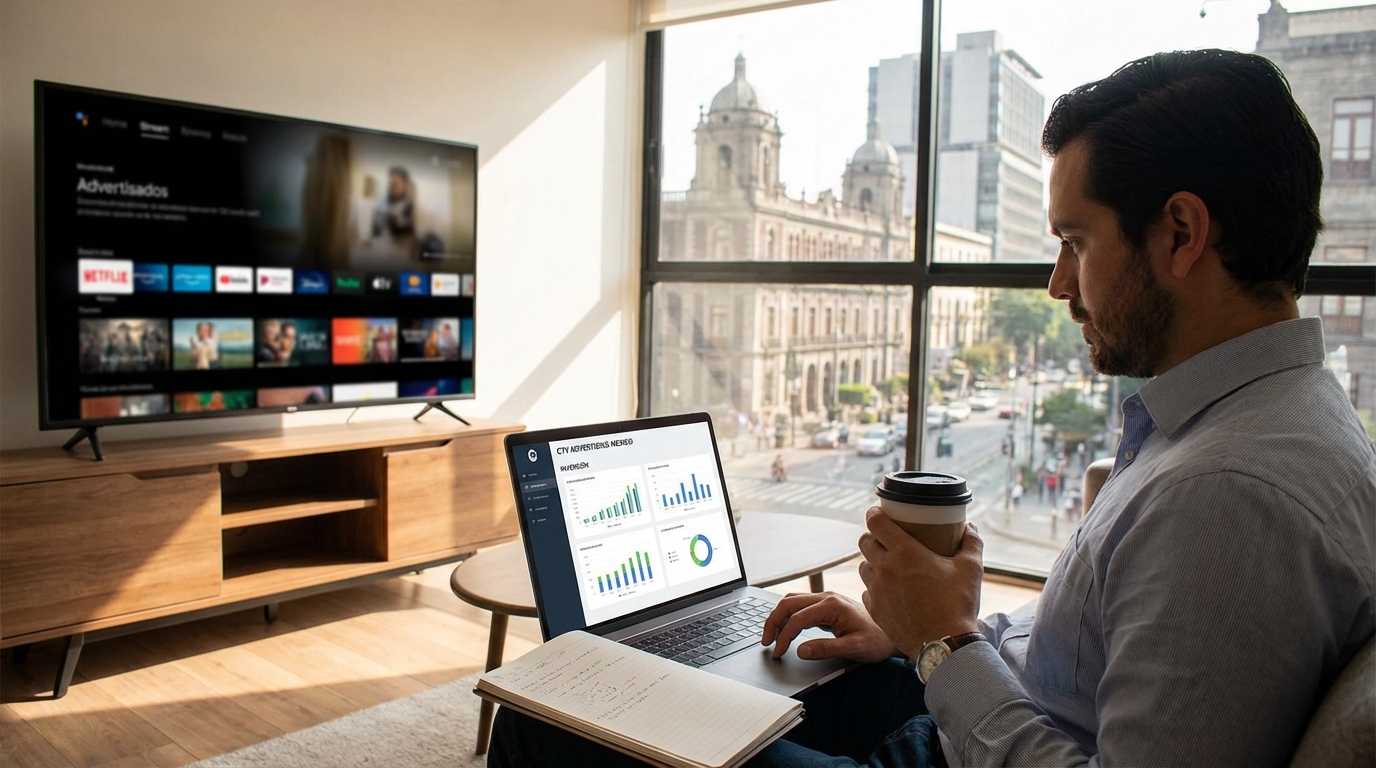
Advertising on traditional television was always the exclusive territory of big brands with million-dollar budgets. That reality changed radically with streaming. Today, any digital agency or medium-sized business can place ads on the same platforms where millions of Mexicans watch their favorite series. The data is conclusive: in 2024, 95% of Spanish-speaking internet users accessed internet TV content. This means your audience has already migrated, and your advertising strategy needs to follow them.
Learning how to advertise on streaming TV does not require a media team or endless negotiations with television networks. Self-service platforms have democratized access, allowing campaigns to be launched in a matter of days, not weeks. If you work at a mid-sized digital agency or manage marketing for multiple clients, this knowledge positions you as a strategic partner who masters the channels where consumer attention actually resides.
What follows is a practical guide to executing your first connected TV advertisingcampaign, from understanding the ecosystem to measuring results and optimizing your investment.
Fundamentals of Streaming TV and OTT Advertising
The term OTT stands for Over-the-Top, which describes any content transmitted directly to the viewer via the internet, bypassing traditional cable or broadcast infrastructure. Platforms like Netflix, Prime Video, Pluto TV, and Roku fall into this category. Advertising in this ecosystem works completely differently than buying a spot on broadcast television.
Advertising investment in streaming and CTV in Latin America is growing at a rate of 25% annually, with projections to reach 10 billion dollars by 2026, according to Grupo Galana. This growth reflects where smart advertising money is moving.
Key differences between traditional TV and Streaming
Traditional television operates on a mass-buying model. You pay for a specific time slot hoping your target audience is watching. There is no guarantee of who will see your ad, only estimates based on historical ratings. Contracts are usually long and investment minimums are prohibitive for mid-sized companies.
Streaming flips this logic. Instead of buying a time slot, you buy access to specific audiences. If you sell products for young parents in Guadalajara, your ad appears exclusively to that profile, regardless of whether they are watching content at 3 p.m. or 11 p.m. Granular targeting eliminates wasted impressions.
Advantages of advertising on Over-the-Top platforms
The metric that most impresses those migrating from traditional digital advertising is the video completion rate. CTV ads reach completion rates of 98%, far above any video format on social media or display. The reason is simple: viewers cannot skip the ad and are in a state of full attention, relaxing in their living room, not mindlessly scrolling on their phones.
Another critical advantage is measurement. Unlike traditional TV, where you rely on Nielsen panels, streaming provides precise data on how many people watched your ad in its entirety, on what device, and at what time. This information allows for real-time campaign optimization.
Audience Definition and Advanced Targeting
Targeting is where streaming demonstrates its superiority over traditional media. You aren't shooting in the dark hoping to connect with someone relevant. You are building audiences with surgical precision based on real behavioral data.
Using demographic and behavioral data
Streaming platforms collect detailed information about their users: age, gender, household composition, stated interests, and, most importantly, consumption behavior. If someone watches cooking documentaries, crime series, and sports content, that profile says a lot about their interests and potential as a consumer.
You can build audiences by combining multiple criteria. For example: women aged 25 to 45, in cities with more than 500,000 inhabitants, who consume lifestyle and wellness content. This level of specificity was unthinkable in traditional television and expensive even in conventional programmatic digital.
Device and geolocation targeting
Geolocation in CTV allows for hyper-local campaigns. A restaurant chain can advertise exclusively to people within a 10-kilometer radius of its locations. A real estate developer can target specific neighborhoods where their ideal buyer lives.
Device targeting also matters. You can choose to appear only on Smart TVs for a more premium format, or include mobile devices and tablets for greater reach. Each device has distinct characteristics regarding attention and consumption context.
Top Platforms for Advertising in Mexico
The streaming ecosystem in Mexico includes various business models, each with unique characteristics for advertisers.
Options in SVOD, AVOD, and FAST services
SVOD services are subscription platforms like Netflix and Disney+. Historically, they did not have advertising, but that has changed. 40% of active Netflix accounts used the ad-supported plan in the third quarter of 2025, a significant jump from 26% at the end of 2024. This opens up premium inventory on previously inaccessible platforms.
AVOD services have been ad-supported from the start. Pluto TV is the clearest example in Mexico: free content funded by ads. FAST channels operate similarly, offering free linear programming with traditional commercial breaks but in a streaming format.
Regarding costs, Prime Video CPMs hover around $40, similar to Netflix but lower than Disney+. However, self-service platforms like Masha allow access to inventory on Pluto TV, Roku, and other options at much more accessible prices, with clear CPMs and no hidden fees.
Step-by-Step Guide to Creating Your First Campaign
Running a CTV campaign for the first time can seem intimidating, but the process is more straightforward than you might think if you use the right tools.
Inventory selection and programmatic buying
The first step is to define where you want to appear. You can choose specific platforms or let the system optimize by distributing your budget where it gets the best results. Programmatic buying automates this process: you set your audience and budget criteria, and the system bids in real-time for impressions that meet your parameters.
Self-service platforms simplify this dramatically. With Masha, for example, you can select your inventory, define targeting, and launch in fewer than 10 clicks. You don't need to negotiate with sales reps or sign multi-month contracts. The process that traditionally took weeks is reduced to days.
Define your initial budget conservatively. Start with amounts that allow you to learn without risking too much. Many platforms allow you to start from 2,000 Mexican pesos, removing the barrier to entry that historically kept SMBs out of television.
Technical and creative ad specifications
Standard formats for CTV are 15 or 30-second videos. The minimum recommended resolution is 1080p, although 4K is becoming standard on premium platforms. The most widely accepted file format is MP4 with H.264 codec.
Creative content should work without relying on audio. Many viewers watch content with the volume low or in noisy environments. Include on-screen text that reinforces your main message. The first 3 seconds are critical for grabbing attention, so avoid long logos or slow intros.
If you don't have video production capabilities, some platforms offer creation tools using generative artificial intelligence. Masha includes this functionality, allowing you to create video and audio ads directly on the platform without needing to hire external production.
Measuring Success and Optimizing Results
Launching a campaign is just the beginning. The real advantage of CTV over traditional media lies in the ability to measure and optimize continuously.
Essential metrics: VTR, reach, and frequency
VTR, or Video Through Rate, measures what percentage of viewers watched your ad to completion. In CTV, this metric is usually above 95%, but variations can indicate problems with your creative or targeting. If your VTR drops significantly, check if your ad maintains interest throughout its entire duration.
Reach indicates how many unique people saw your ad. Frequency measures how many times, on average, each person saw it. A typical balance aims for a frequency between 3 and 7 exposures per user during a campaign. Less than 3 may be insufficient to generate recall; more than 7 can cause fatigue and waste budget.
Self-service platforms display these metrics in real time. You can view your campaign's performance while it runs and make adjustments without waiting for weekly or monthly reports.
Attribution and return on investment in digital advertising
Measuring ROI in CTV requires correctly setting up your attribution. Options include:
- Exposure-based attribution: measures conversions from users who saw your ad, even if they didn't click
- Site visit attribution: connects web visits with previous ad exposures
- Incrementality: compares the behavior of exposed versus non-exposed groups
For businesses with a physical presence, some platforms allow you to measure store visits after ad exposure. For e-commerce, integration with conversion pixels directly connects sales to specific campaigns.
The cost per view on accessible platforms can be as low as 0.01 Mexican pesos, allowing you to experiment with different creatives and segments without committing entire budgets. This flexibility is invaluable for agencies managing multiple clients with diverse needs.
Your next step in streaming advertising
Advertising on connected TV is no longer exclusive to large corporations. Barriers to entry have fallen, tools have been simplified, and the audience is already there, consuming hours of streaming content every week. For digital agencies, mastering this channel means offering your clients access to a high-impact medium that was previously out of reach.
The time to experiment is now, while costs remain accessible and competition for inventory has not saturated the market. If you are looking for a practical way to get started, Masha allows you to launch campaigns on premium platforms starting at 2,000 pesos, with no contracts or minimum investments, featuring real-time metrics and prices starting at 0.01 pesos per view.