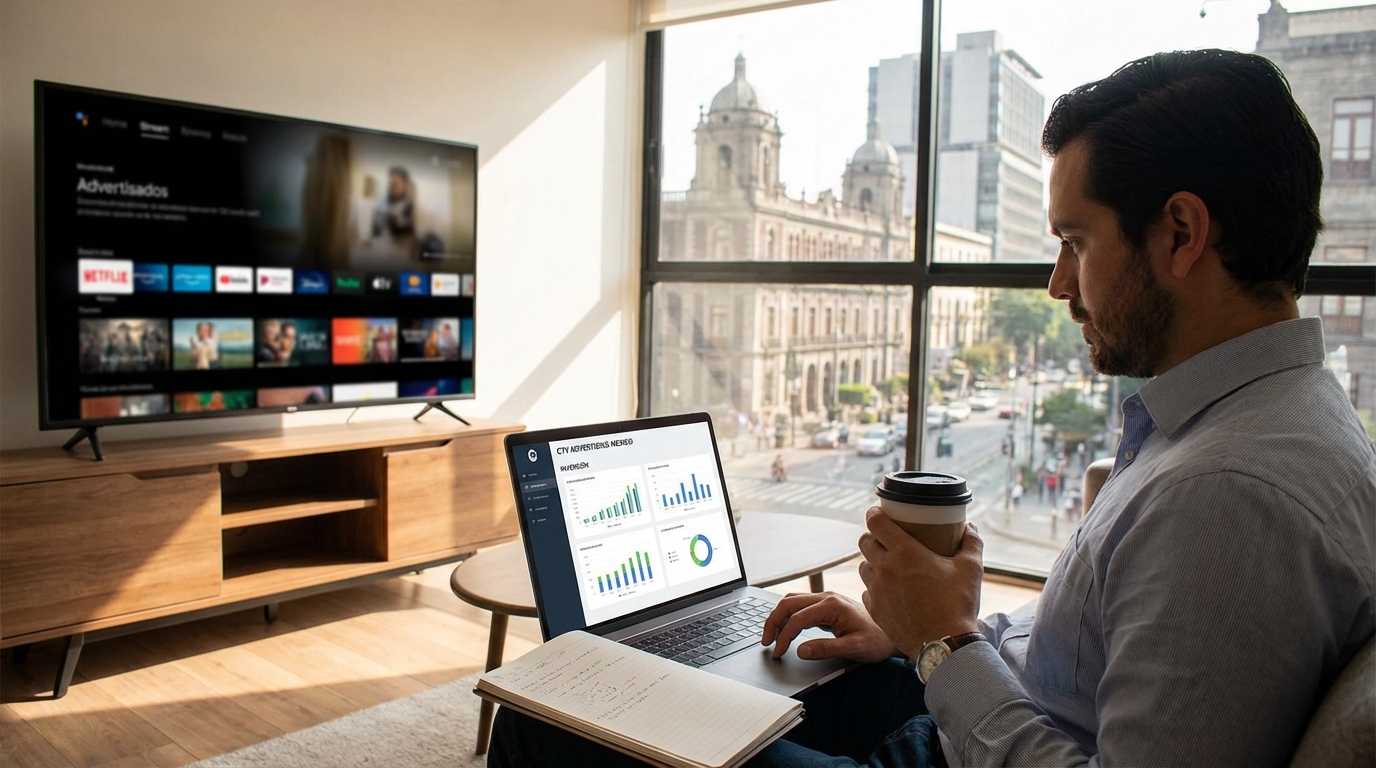
When you hear "TV advertising," you probably think of million-dollar budgets, giant agencies, and contracts that tie your business down for months. That’s the image we’ve been sold for decades. But here is the truth that few people tell you: advertising on TV no longer requires emptying your company’s bank accounts or signing eternal commitments. The question many business owners ask themselves is straightforward: my budget is small, can I advertise on TV with Masha and the Bear? The short answer is yes. The long answer involves understanding how the current connected TV ecosystem works, what options you have available, and how to get the most out of every dollar invested. Masha and the Bear has become one of the most-watched children's shows in Mexico, and that represents a golden opportunity for brands that want to reach families with young children. The interesting thing is that streaming platforms have democratized access to these advertising spaces. You no longer need to negotiate with TV network executives or meet absurd minimum investment requirements. With tools like Masha, you can launch campaigns starting at $0.01 per view, with no contracts and real-time metrics that allow you to adjust on the fly.
The impact of Masha and the Bear on the Mexican children's audience
Masha and the Bear is not just another cartoon show. It is a phenomenon that has captured the attention of millions of Mexican families since it first hit screens. The Russian series has achieved something few children's shows manage: engaging both children and parents. The episodes are short, fun, and have that touch of humor that adults can enjoy while watching with their kids.
The show is broadcast on multiple streaming platforms available in Mexico, including services like Pluto TV and other connected TV apps. This means the audience is fragmented across different channels, but it also means there are multiple entry points for advertisers. A small business can choose exactly where it wants to appear, rather than paying for generic spots that don't guarantee reaching their target audience.
The viewership numbers are impressive. Masha and the Bear consistently appears among the most-watched content in children's streaming categories. This is no coincidence: the content is universal, does not rely on specific cultural references, and episodes can be watched in any order without losing the narrative thread.
Why Masha is a magnet for brands
Brands that sell products for children or families find this show to be an ideal vehicle. The viewing context is perfect: families gathered together, captured attention, and a positive environment associated with entertainment. When your ad appears during or around this content, you inherit some of that good vibe.
The products that work best include children's food, toys, children's clothing, educational services, and household products. But don't limit yourself to the obvious. Family restaurants, entertainment services, educational apps, and even life insurance have found receptive audiences in this space. The key is for your message to resonate with the viewer: parents who make purchasing decisions while their children enjoy the content.
The cost per effective impact is considerably lower than in traditional television. While a prime-time spot on broadcast TV can cost you tens of thousands of pesos for a few seconds, connected TV allows you to start with budgets that fit into the wallet of any SME.
Demographics and viewer behavior
The profile of the Masha and the Bear viewer in Mexico is quite specific. We are talking primarily about families with children between 2 and 8 years old, although the range can extend further. Parents are usually between 25 and 45 years old, with average incomes that allow them to access streaming services and connected devices like smart TVs, Roku, or similar devices.
Viewing behavior is also predictable. Audience peaks occur on weekend mornings, afternoons after school, and during holidays. These patterns allow you to plan your campaigns to maximize impact without wasting budget on low-viewership time slots.
A key insight: families who stream content tend to be more receptive to advertising than those who watch traditional television. Why? Because they are accustomed to a model where ads are part of the trade-off for free or low-cost content. There isn't the same level of rejection generated by the ad bombardment of broadcast TV.
Strategies for TV advertising on a limited budget
Having a small budget doesn't mean settling for mediocre results. It means being smarter with every dollar. The right strategy can make a modest investment generate results comparable to much more expensive campaigns. The secret is precision: reaching exactly who you want, when you want, and where you want.
Connected TV offers advantages that traditional television never had. You can segment by geographic location, interests, and viewing habits. This eliminates the waste that characterizes traditional mass media, where you pay to reach millions but are only interested in thousands.
Buying spots in off-peak hours
Prime time isn't the only time that works. In fact, for many businesses, off-peak hours offer a better cost-benefit ratio. Weekday mornings, late nights, and certain afternoon blocks have significantly lower rates but still reach a relevant audience.
Think about who watches content during those times. Early mornings can capture parents putting on cartoons while they make breakfast. Afternoons reach families after school. Each time slot has its own audience, and if that audience matches your ideal customer, "non-prime" time becomes your best ally.
The key is to test different combinations. Platforms like Masha allow you to experiment with small budgets, see what works, and then scale what delivers results. You don't need to commit your entire budget to a single bet.
Leveraging regional and local signals
If your business operates in a specific city or region, it makes no sense to pay for national reach. Geographic segmentation is one of the most powerful tools for limited budgets. You can direct your ads exclusively to specific states, cities, or even metropolitan areas.
A restaurant in Guadalajara doesn't need its ad to reach Cancun. A children's clothing store in Monterrey can concentrate its entire budget on the metropolitan area where it operates. This precision dramatically reduces costs while maintaining effectiveness.
Local signals also tend to have less advertising competition. While big national brands fight for the most coveted spots, local businesses can find opportunities in less saturated markets.
Accessible ad formats beyond the traditional spot
The 30-second commercial isn't your only option. In fact, for small budgets, other formats can offer better performance. Creativity in the format can compensate for budgetary limitations and generate a memorable impact without requiring expensive productions.
Brand mentions and product placement
Brand mentions during programming represent an interesting alternative. Instead of interrupting the content, your brand is integrated more organically. This can work particularly well in streaming programming where viewers are more attentive to the content.
Product placement, while more complex to negotiate, offers exposure that doesn't feel like traditional advertising. Viewers tend to better remember brands they see integrated naturally into the content they consume. For businesses with physical products, this can be a path worth exploring.
The advantage of these formats is that they usually require less production. You don't need to create a full commercial with actors, locations, and post-production. The content already exists; your brand simply associates itself with it.
Lower thirds and broadcast sponsorships
Lower thirds are those information bars that appear at the bottom or top of the screen during programming. They are less intrusive than traditional commercials but keep your brand visible for extended periods. The cost per second of exposure is usually lower than that of a traditional spot.
Sponsorships of specific segments also offer a good cost-benefit ratio. Instead of sponsoring an entire program, you can associate your brand with specific moments: the intro, commercial breaks, or the closing credits. This gives you presence without the financial commitment of a full sponsorship.
These formats work especially well for long-term brand building. Don't expect immediate sales, but rather gradual recognition that eventually translates into preference when the consumer needs what you offer.
Optimizing creative production for a low budget
A commercial doesn't need to look like a Hollywood production to work. In fact, some of the most effective ads are surprisingly simple. What matters is the message, clarity, and relevance to your audience. Elaborate production can even be counterproductive if it distracts from the core message.
Start with what you have. A modern smartphone records video in sufficient quality for connected TV. Natural lighting, when used well, can look professional. Audio is where you shouldn't skimp: a decent microphone makes more of a difference than an expensive camera.
The script is your most important tool and costs nothing but time and thought. Clearly define what you want the viewer to feel, know, and do after watching your ad. Keep the message simple: one main idea, one clear call to action. Ads that try to say too much end up saying nothing at all.
Consider formats that don't require actors. Simple animations, text over images, or product demonstrations filmed at your own business. These approaches dramatically reduce costs while being just as effective. Authenticity often beats polished production in terms of connecting with the audience.
Measuring return on investment in small campaigns
Every dollar counts when the budget is limited, so measuring results is not optional. The good news is that connected TV offers measurement capabilities that traditional TV never had. You can know exactly how many people saw your ad, for how long, and what actions they took afterward.
Define clear metrics before launching. Are you looking for website visits? Phone calls? Direct sales? Brand awareness? Each goal requires different metrics and different expectations for results. A branding ad is not measured the same way as a direct response ad.
Establish an attribution system. Use unique promo codes for your TV campaign, specific URLs, or dedicated phone numbers. This allows you to track exactly which results come from your TV investment versus other channels.
Audience monitoring tools
Streaming platforms provide dashboards with real-time metrics. You can see how many impressions your campaign has generated, the completion rate, unique reach, and average frequency. This data allows you to optimize on the fly instead of waiting weeks to know if it worked.
Complement platform metrics with your own tools. Google Analytics can show traffic spikes correlated with your broadcasts. Your point-of-sale system can reveal sales increases during campaign periods. Simple surveys for new customers can confirm where they heard about you.
Comparing periods is essential. Measure your key metrics before, during, and after the campaign. Look for significant changes that can be attributed to your TV advertising. Don't expect immediate miracles, but look for positive trends that justify continuing or scaling your investment.
Steps to start your first campaign with Masha
Launching your first connected TV campaign is simpler than you think. The entire process can be completed in less than an hour if you have your creative assets ready. Here is the step-by-step path to go from idea to broadcast.
First, define your goal with precision. Do you want people to visit your physical store? Download your app? Remember your brand for when they need your product? This goal will guide all subsequent decisions, from the creative message to audience targeting.
Second, prepare your creative assets. If you don't have a produced commercial, consider the low-cost options mentioned above. Ensure the video meets the platform's technical specifications: resolution, duration, and file format. Most platforms accept standard formats and offer clear guidelines.
Third, set up your account on the platform. Registering on Masha takes less than 5 minutes. You will need basic business information and a payment method. There are no contracts to sign or minimum investment requirements to meet.
Fourth, configure your campaign. Select your target audience by geographic location and interests. Define your daily or total budget. Choose the times and programming where you want to appear. With platforms like Masha, you can launch in 10 clicks without intermediaries or complications.
Fifth, monitor and adjust. Once your campaign is live, check the metrics regularly. If something isn't working, you have the flexibility to pause, modify, or redirect your budget toward what is actually generating results.
The barrier to entry for television advertising has fallen dramatically. It is no longer the exclusive territory of large corporations with million-dollar budgets. If your business has a relevant message for Mexican families, advertising space around content like Masha and the Bear is more accessible than ever.
To take the first step toward your connected TV campaign, Masha offers exactly what you need: a platform where you can launch ads from $0.01 per view, with no contracts or minimum investments, and live metrics to monitor your success in real time. Start here and discover how easy it is to bring your brand to the biggest screens in the Mexican home.